
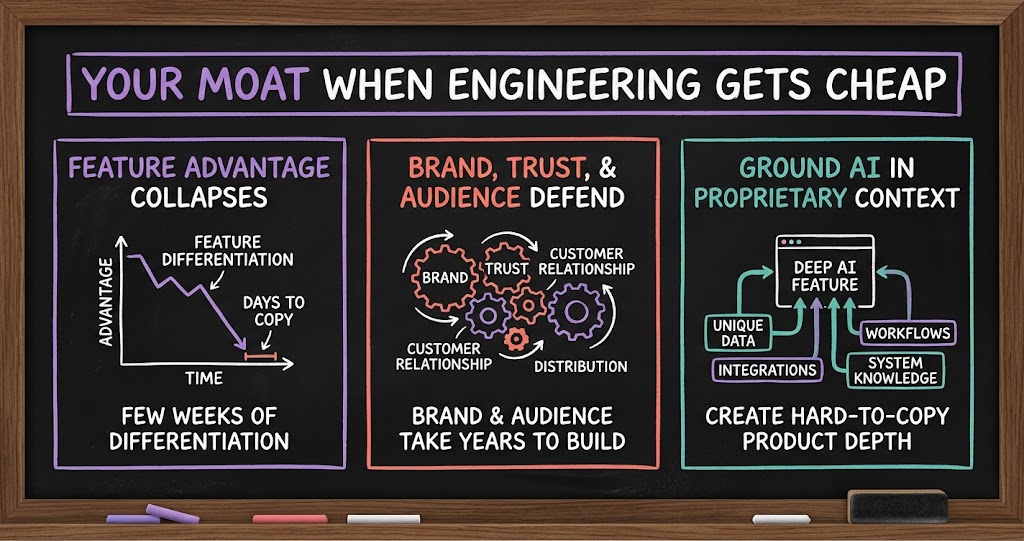
Your Moat When Engineering Gets Cheap
AI coding tools mean a competitor can copy your best feature in a week, and some customers now think they can build your product themselves. Here is what SaaS founders in our mastermind see as the new sources of defensibility.

For most of SaaS history, engineering was the barrier to entry. Building a real product took years, a team of expensive developers, and a lot of patience. If you got there first and built something good, the cost of catching up protected you. That protection is disappearing fast, and a recent SaaS CEO Mastermind session made the shift feel very concrete.
One founder described building a new in-app AI assistant that walks users step by step through doing whatever they asked about, like a guided wizard generated on the fly. The core of that functionality was built in two days. When another member said his team had shipped something similar, the first founder didn't hesitate to admit he'd seen it. The idea had been on his whiteboard for two months. He handed it to a new engineer, came back a couple of days later, and it was done.
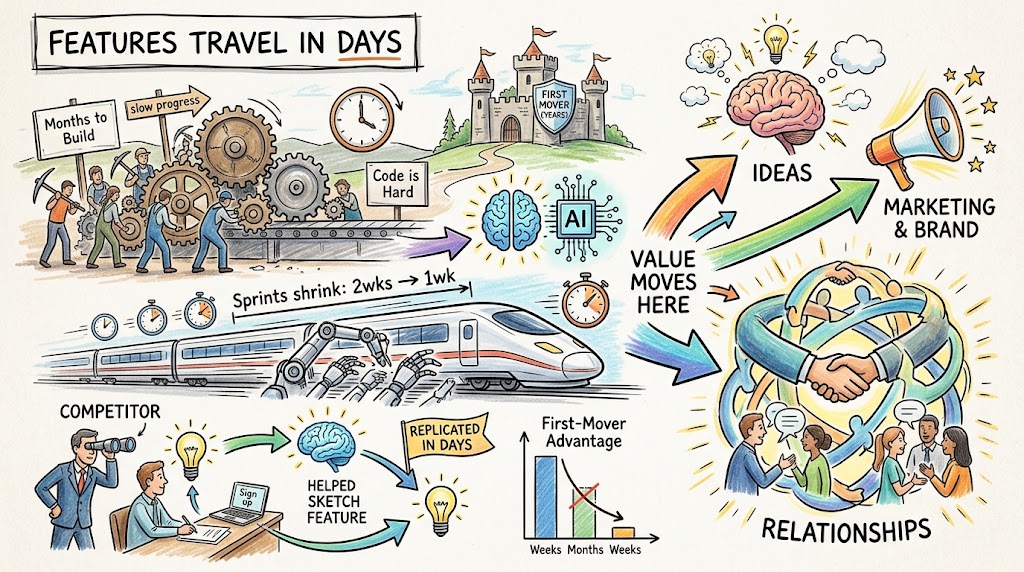
Features Now Travel in Days
His conclusion stuck with everyone on the call. As he put it, engineering is cheap now. The barrier to entry has moved to the ideas, the marketing, and the relationship with customers. We're so used to a world where coding was the hard part that it takes a while to absorb what that means.
Another founder shared the other side of the same experience. His team adopted AI coding early, saw their sprints shrink from two weeks to one, and loved the speed. Then they started noticing competitors shipping features that looked very similar to theirs. Any competitor can sign up for an account, see what you've built, and have a version working in their own product within a week.
- Speed of copying has collapsed. A feature that took months to build can be replicated in days.
- Your product is visible to everyone. Competitors can sign up, study your UX, and brief their AI tools.
- First-mover advantage is shorter. You may get weeks of differentiation instead of years.
- The same tools help you too. You can ship faster, but so can everyone else in your category.
Building still matters, but when features become cheap to copy, the value moves to things that are much harder to replicate.
A Radical Response: Open Source It
The founder frustrated by competitors copying his features made a bold move. His company became the only one in its category to open source its base model. His reasoning was simple. If competitors were going to end up with everything anyway, there was little point in pretending otherwise. So they released the whole thing.
He was honest that he isn't sure it was the right call and wishes they'd thought it through a little more. But it did give them a noticeable boost in visibility for a while, including in AI search results, because they became the only company in their space doing it. His team has also pulled back on AI-written code, and now uses AI mainly for integration work.
- Open sourcing can create attention. Being the only open option in a category is a clear point of difference.
- It can reset the competitive game. If everyone can have the base, you compete on what you build around it.
- It's hard to reverse. Think it through carefully before you give away the core.
- Integrations can be a better place to invest. Deep connections into customer systems are harder to copy than UI features.
This is an extreme response, and it won't fit most companies. But it's a useful thought experiment. If your core features were public tomorrow, what would still make customers choose you?
Customers Now Think They Can Build It Themselves
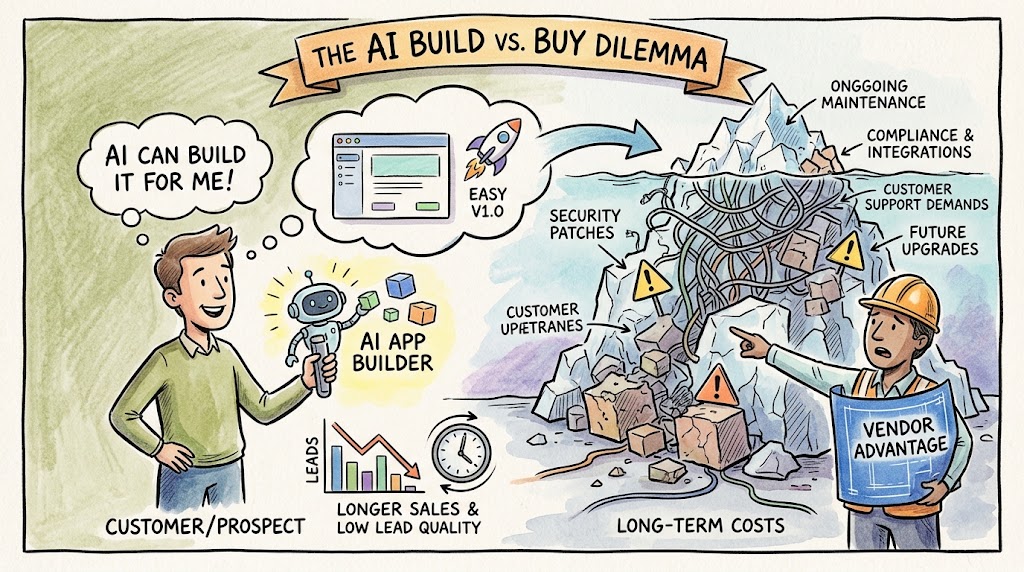
There's a second threat that's quieter but may matter more. Several members noted that lead quality has dropped, and part of the reason is that prospects now wonder whether they need to buy software at all. One founder said leads coming through organic search are more hesitant to spend, because they aren't sure whether they could just do the thing themselves with AI.
Another member said he doesn't believe vibe coders will build everything in a couple of years, but they're already distracting clients. Buyers are starting to think they can build whatever they need on their own. The founder who built the in-app assistant had the best response: they'd have to build it, maintain it, hire people to support it, and handle all the other problems that come with owning software. That's the real challenge, and it's where established vendors still have a big advantage.
- Prospects are asking "build or buy" more often. AI has made building feel easy, even when it isn't.
- Sales cycles get longer. Hesitant buyers need convincing that ownership is harder than it looks.
- Maintenance is your argument. Building version one is easy; supporting, securing, and upgrading it for years is the hard part.
Founders should expect this objection and be ready to answer it with specifics, like the ongoing cost of maintenance, security, compliance, integrations, and support.
Where Defensibility Lives Now
If code is no longer the moat, what is? The members on the call pointed to a few areas that AI can't easily replicate. The first is the relationship with your customers. Knowing their workflows, being trusted with their data, and having years of history with them are much harder to copy than a feature.
The second is distribution and marketing. The founder who called engineering cheap put ideas and marketing right next to customer relationships as the new barriers. A competitor can copy your feature in a week, but they can't copy your brand, your audience, or your position in the market in a week.
- Customer relationships. Deep trust, history, and understanding of workflows are hard to replicate.
- Distribution. An audience, a brand, and a go-to-market engine take years to build.
- Ideas and speed of iteration. The team that keeps generating the right ideas stays ahead even if each one gets copied.
- Proprietary context. Deep knowledge of your own systems, data, and customers makes your AI features smarter than a quick clone.
- Integrations and data access. Being embedded in customer systems, with secure and well-scoped access, creates real switching costs.
That fourth point connects to something the same founder said about AI coding. His team's real asset is a large repository of markdown documentation that explains their infrastructure, their history, and where they're going. That context is what lets AI do great work on their product, and a competitor copying features from the outside doesn't have it.
Turn AI Into Product Depth
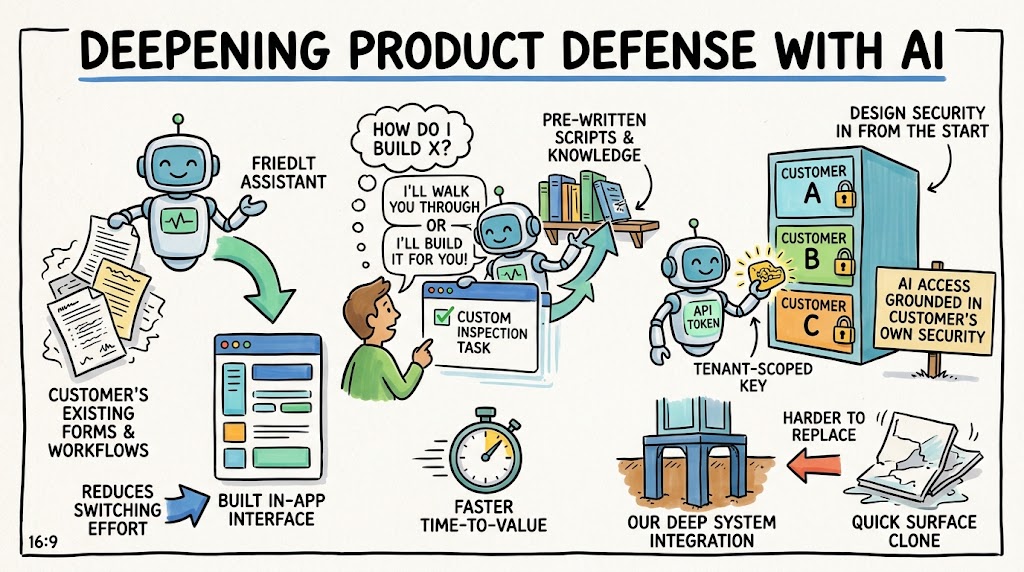
The founder who built the in-app assistant is also using AI to make his product harder to replace. His assistant can already take a PDF of a form a customer uses today and rebuild it inside the product by calling the same endpoints the regular interface uses. The new guided walkthrough goes a step further: a user asks how to build something, like a vehicle inspection task, and the assistant either builds it for them or walks them through each click. The assistant starts from pre-written scripts for common tasks and adapts them to the specific request.
He was careful about how he built it. His product is multi-tenant, so the AI only reaches customer data through each customer's own API token. It can't see anything that user isn't allowed to see, which means nobody can trick it into revealing another customer's information. That kind of careful design takes real knowledge of your own system, and it builds trust that a quick clone won't have.
- Use AI to reduce switching effort. Features that import a customer's existing forms and workflows make it easier to adopt your product and harder to leave.
- Guide users to value faster. An assistant that builds or walks users through setup shortens time to value.
- Design security in from the start. Tenant-scoped API access keeps AI features safe in a multi-tenant product.
- Build on your own context. Pre-written scripts and deep system knowledge make your AI features more useful than a surface copy.
The common thread is that AI features grounded in your own data, workflows, and security model are much harder to copy than a UI screen.
Invest Where Copying Is Hard
The practical takeaway for SaaS leaders is to rethink where you invest. Shipping features faster is necessary, but it won't protect you on its own. Spend more time on the things competitors can't clone in a week: understanding your customers deeply, building distribution, and creating integrations and data advantages that make your product harder to leave.
It also helps to change how you think about competitors copying you. The founder who built the AI assistant encouraged everyone on the call to steal his idea, because he thought it was really cool. That attitude reflects real confidence. What keeps his customers is his team's ability to keep coming up with the next idea and deliver it to people who already trust them, and a single copied feature doesn't change that.
In a world where anyone can build, the companies that win will be the ones that customers want to buy from. That means your brand, your relationships, and your speed of learning matter more than ever. If you're still counting on your codebase to protect you, now is a good time to take an honest look at what else you've built.