
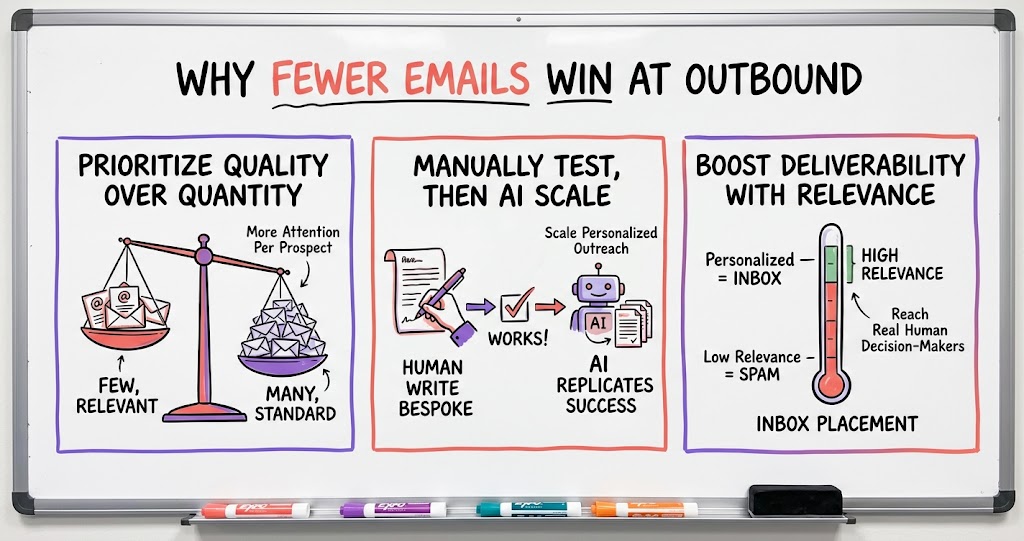
Why Fewer Emails Win at Outbound
After years of scaling cold email volume, we cut from around 200,000 messages a month to about 2,000 and started getting better results. Here is what changed in outbound, what is still working on LinkedIn, and how to rebuild your outbound engine for the AI era.

During a recent SaaS CEO Mastermind session, a member asked a simple question: is there anything new in outbound, and has anyone landed on something that works well right now? It's a question I hear constantly, because outbound has changed more in the last 18 months than in the five years before that. What worked beautifully in early 2025 is struggling today, and a lot of founders are still running the old playbook and wondering why their results keep sliding.
I shared what we've learned at SaaSRise, and several members added their own experience. The short version is that the teams getting results today are sending far fewer messages, putting much more thought into each one, and using AI to scale quality instead of volume.
A Quick History of Cold Outbound
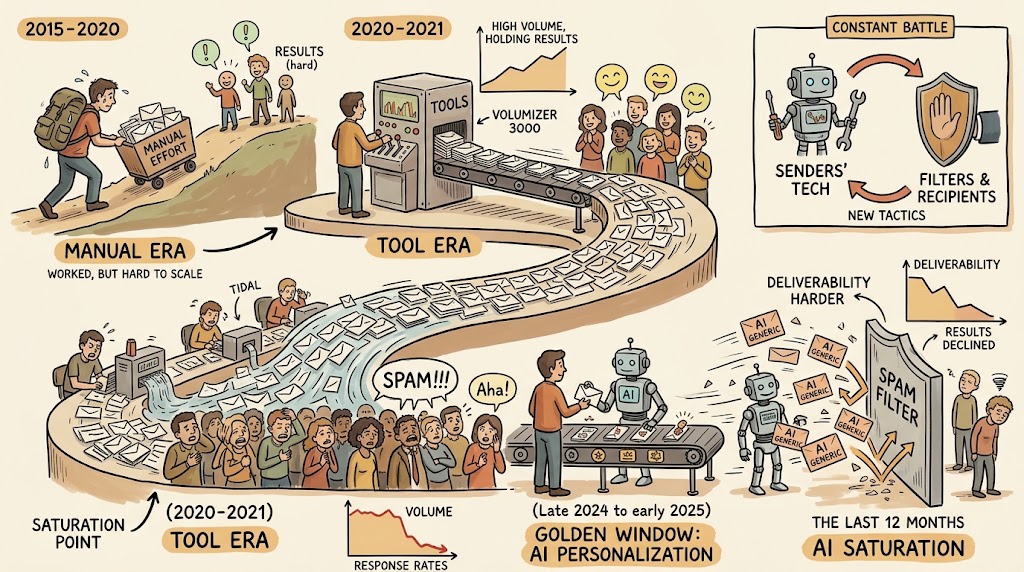
To understand why fewer messages work better, it helps to see how we got here. From about 2015 to 2020, outbound worked really well, but there weren't easy tools to scale it. Doing it well took a lot of manual effort. Around 2020 and 2021, tools like Instantly came out and made it much easier to send at high volume, and it kept working for a while.
Then it stopped working, because everyone started doing it. It came back in late 2024 and early 2025, when AI made it easy to write personalized messages before recipients had learned to recognize AI-written outreach. That was a golden window. We ramped up to around 200,000 messages a month at one point, and it worked great. Over the last 12 months, though, everyone started using AI, volumes grew, getting to the inbox got harder, and results dropped again.
- 2015 to 2020. Outbound worked, but it was manual and hard to scale.
- 2020 to 2021. New sending tools made volume easy, and results held up for a while.
- Saturation. Once everyone sent at scale, response rates fell.
- Late 2024 to early 2025. AI personalization opened a short golden window.
- The last 12 months. AI-written outreach became common, deliverability got harder, and results declined.
As I put it on the call, it's a constant battle between the technology senders use and the spam filters trying to stop them. Every time a new tactic works, it gets adopted widely, and then the filters and the recipients adapt.
What's Working Now: 2,000 Instead of 200,000
What we've seen working over the last three months is the opposite of the old volume game. We cut our volume dramatically, from around 200,000 personalized messages a month to something closer to 2,000. At the same time, we significantly increased the effort, thoughtfulness, and intentionality that goes into each message.
We actually went back to basics. Our salesperson started manually writing three or four bespoke messages a day to high-value prospects. Those messages got into the inbox and started getting replies. Once we had messages that were working, we took them as templates and asked Claude to copy what we'd just done and produce about 30 a day instead of four. That's working too. The key lesson for us was mindset. As I said on the call, you have to "get out of the mindset that more is better and into the mindset that fewer is better," and write messages that are highly relevant and well thought through for each person.
- Cut volume hard. Fewer messages means better deliverability and more attention on each prospect.
- Start manually. Have a real person write a handful of bespoke messages to high-value prospects.
- Find what works first. Only scale once you have messages that are landing and getting replies.
- Use AI to scale quality. Feed your best manual messages to Claude as examples and have it produce more in the same style.
- Focus on relevance. Every message should feel like it was written for that specific person.
Volume Can Still Work, If the Math Supports It
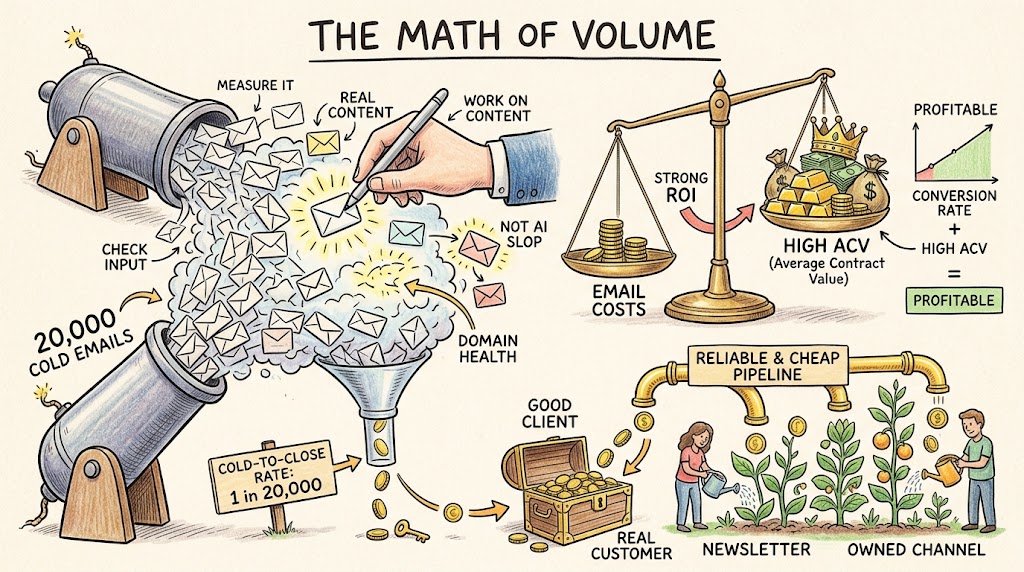
To be fair, not everyone on the call had given up on volume. One member who follows a similar playbook said his team still sends a lot of email and is making sales from it. They get roughly one good client for every 20,000 emails sent, and because his deal sizes are high enough, that still produces a strong ROI. He was careful to say that they put real work into making sure the content isn't AI slop.
That's a useful reminder that the right approach depends on your numbers. A one-in-20,000 cold-to-close rate only works if your average contract value is large enough to justify it, and if you can keep your sending domains healthy. He also said a newsletter he runs, combined with high-volume cold email, has been his most reliable and cheapest source of pipeline.
- Know your cold-to-close rate. Measure how many sends it takes to land a real customer.
- Check it against your ACV. High contract values can justify lower conversion rates.
- Protect quality even at volume. Content that reads like AI slop will hurt deliverability and your brand.
- Build owned channels. A newsletter gives you a warm audience that doesn't depend on cold deliverability.
LinkedIn: What's Dead and What Still Works
Several members said LinkedIn outreach had gone nearly dead for them. Connection requests and automated message sequences just weren't producing the way they used to. But a few approaches came up that are still working.
One member has someone on his team manually leave relevant comments on posts within his niche. That's brought a lot of visibility to his profile and a steady stream of interaction. Another founder is testing an AI agent that does something similar from his account. Instead of sending connection requests and pitches, it replies thoughtfully to posts from people in his ideal customer profile. Within two or three weeks, those people start sending him inbound connection requests.
On our side, what works best on LinkedIn is thought leader ads. You write organic posts and then boost them as sponsored content to a matched audience uploaded from your ABM list. The CPMs are around $30, compared with roughly $200 for standard display ads. For clients selling products at $50,000 or more per sale, we've also seen sponsored message ads do really well. And for connection requests and follow-up messages, we moved from HeyReach, which sends the same message to everyone, to a tool called Kakiyo, which writes a unique message for each person and then writes a new reply based on what they said. That creates a much more natural back-and-forth.
- Comment before you connect. Thoughtful replies on prospects' posts build familiarity and generate inbound interest.
- Use thought leader ads. Boost your organic posts to a matched ABM audience at a fraction of display ad costs.
- Try sponsored messages for high ACV. They've performed well for products priced at $50,000 or more.
- Personalize every connection message. Tools that write unique messages and respond naturally outperform identical sequences.
The Lead Quality Problem
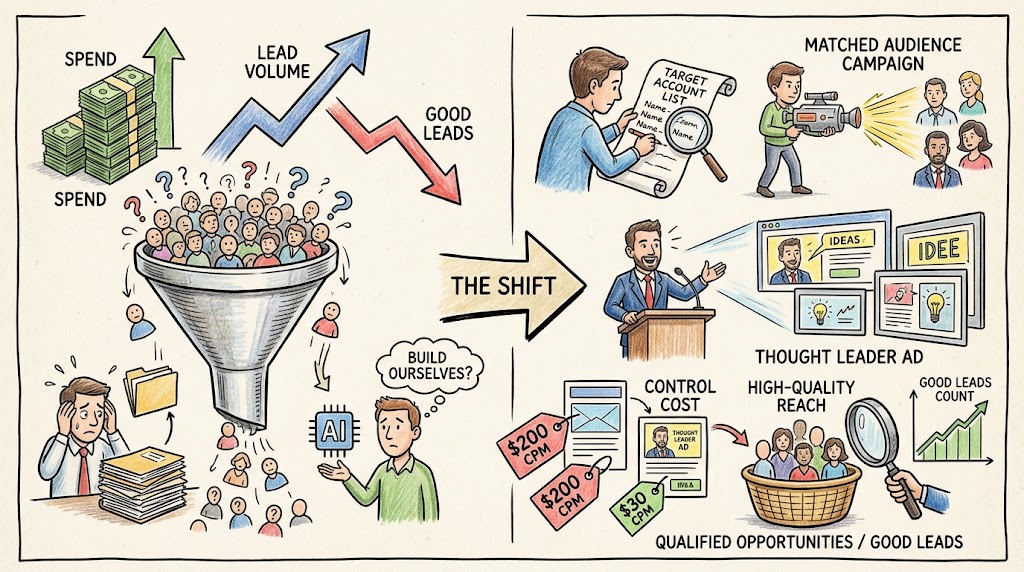
Toward the end of the session, one member raised a concern that ties all of this together. He's getting plenty of inbound leads from his omnichannel efforts, but the quality has dropped sharply over the last two years. Both the percentage and the absolute number of good leads have gone down, even as his spend has gone up.
That's what happens when you optimize for volume in a world where volume is cheap for everyone. My suggestions for him were the same principles behind the outbound shift: build a list of everyone in your target market, run matched audience ads to those specific people, and use thought leader ads to reach them at a reasonable cost. Targeting the right people precisely beats reaching more people loosely.
He pointed out that LinkedIn is expensive, and he's right if you're running standard display ads. That's exactly why thought leader ads matter. At around $30 CPM instead of $200, they make it affordable to put your thinking in front of every decision-maker on your target list over and over. Another member added that lower lead quality may also reflect something bigger: prospects increasingly wonder whether they can build what you sell themselves with AI, so they're more hesitant to buy.
- Build a full target account list. Know exactly who your ideal buyers are before you spend on reach.
- Run matched audience campaigns. Put your budget against the specific people on that list.
- Use thought leader ads to control cost. They deliver high-quality reach on LinkedIn at a fraction of display ad pricing.
- Measure good leads, not total leads. Track the absolute number of qualified opportunities, since total volume can hide a decline.
Rebuild Your Outbound Around Quality
If your outbound results have been sliding, try running the experiment we ran. Pause the high-volume sequences. Have one person write a few truly bespoke messages each day to your best-fit prospects. Watch what lands. Then use AI to replicate the messages that work at a modest scale, and keep a human reviewing the output.
The tools will keep changing, and so will the filters. What holds up over time is relevance: reaching the right people with messages that clearly show you understand their situation. When everyone else is sending more, sending fewer and better messages is one of the few ways left to stand out.