

Scaling Personal Relationships with Enterprise Clients Beyond the CEO
A founder closing six-figure deals learns that being the reason customers buy is a real advantage early on and an unscalable trap later. Here's how founders in our group are rationing their own time without losing the close-rate lift.

A founder in our mastermind sells into deals worth $75,000 to $100,000 a year, and he's hit a wall a lot of relationship-led sales leaders eventually hit. Closing one of these deals means becoming something close to a friend to the buying executive. Not doing the actual work himself, but being present enough, responsive enough, invested enough in the relationship that the person on the other side trusts him personally. It works. His close rate goes up noticeably whenever he's part of the conversation. The problem is that the relationship never gets handed down inside the customer's organization. Years into this pattern, he's the personal point of contact for dozens of executives, fielding calls from people he can barely place, and it's wearing him down. He even had a scare recently when a competitor nearly poached a long-tenured customer simply by out-investing him in face time while he wasn't paying close attention.
The Trap Hiding Inside the Advantage
At high price points, the buyer isn't only evaluating the software. They're evaluating the person behind it, whether they trust that person enough to bet real budget on the relationship. That's a genuine advantage in the early days of a company, when the founder's presence is part of what closes deals nobody else could close yet. The trap is that the exact same trust becomes a dependency that doesn't scale. Every new customer wants the same access, and there's only one of you.
The founder in the group isn't alone in this. Another founder in the same room described the identical problem: customers all want to call him directly, ask specific questions only he can answer, and there's no obvious lever to pull to change that. The advantage and the trap are the same mechanism, just viewed at different points in time.
- Founder presence closes deals early. When a company is small and unproven, the founder's personal credibility substitutes for the reputation a bigger company would otherwise provide.
- That same presence becomes a bottleneck later. As the customer count grows, the founder's calendar becomes the constraint on how many relationships the business can actually support.
- The fix isn't withdrawing, it's restructuring. The founders who solved this didn't stop showing up. They changed where in the process they show up.

Be the Closer, Not the Whole Stack
The clearest reframe that came out of the discussion: you don't have to exit the sales process to fix this, you just have to restructure where you sit in it. One founder described exactly this shift. He still comes in personally to close the biggest deals and still has a personal relationship with many of his customers, but he hired a strong salesperson to run discovery and demos, and a support engineer to handle onboarding. Between the two of them, deals now close that he was never part of at all, something he called a genuinely new experience after years of touching every single deal personally.
The model that emerged from the discussion: a salesperson runs the early stages, the founder appears specifically to close and attends the first implementation meeting or two, and then the team takes it from there. This preserves most of the close-rate lift that comes from founder involvement, at a fraction of the total time cost.
- Let a salesperson run discovery and demos. These are the highest-volume, most repeatable parts of the process, and they don't require the founder's personal credibility yet.
- Show up personally to close. This is where the trust premium actually matters, and it's a short, high-value moment rather than an ongoing relationship commitment.
- Attend the first implementation meeting, then step back. This reassures the customer during the highest-risk transition point without locking the founder into permanent involvement.
One founder summed up the goal well: you can still be there as a figurehead without being operationally involved in every account. That distinction, figurehead versus operator, is the whole difference between a sustainable version of this and the version that's draining people right now.
Hire Personality, Not Just Competence
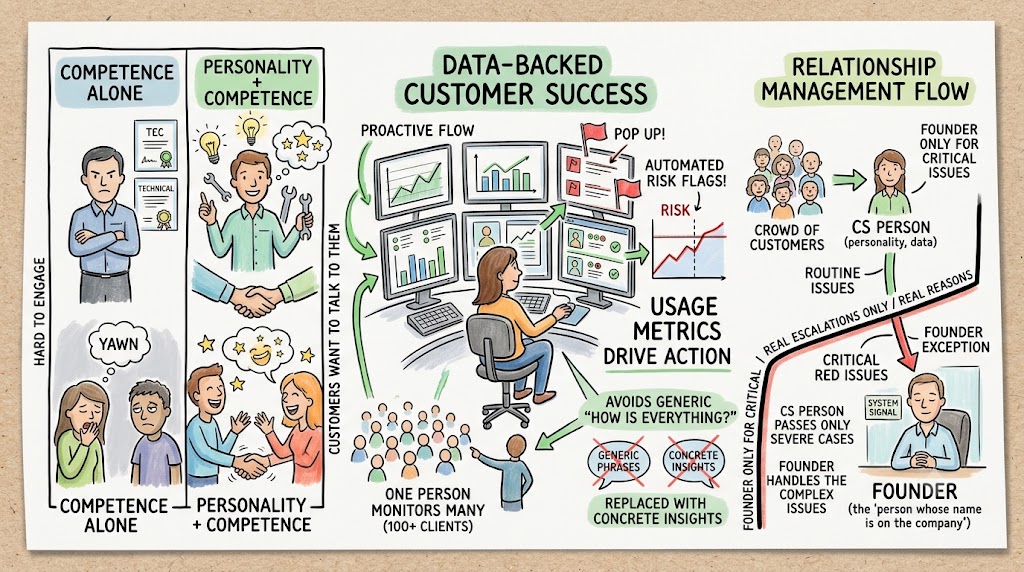
The person who eventually absorbs these relationships has to be someone customers actually want to talk to, not just someone technically capable of answering their questions. One founder described building toward a customer success hire whose entire job is proactive, scheduled check-ins, quarterly temperature checks backed by usage metrics that automatically flag accounts showing signs of risk. The founder only gets pulled back in when there's a real reason, not because a customer wants to make small talk with the person whose name is on the company.
This only works if the hire is genuinely likable and adds value beyond just being available. A customer success person who shows up only to ask how everything is going burns goodwill instead of building it. The bar has to be higher than that.
- Prioritize likability alongside competence. Customers need to want to engage with this person, not merely tolerate them as a substitute for the founder.
- Back the role with real usage data. Automated flags for accounts trending toward risk let one person effectively monitor far more relationships than manual check-ins alone would allow.
- Reserve founder involvement for real escalations. The team should only loop the founder in when there's an actual reason, not as a default courtesy.
With that structure in place, one founder now has over a hundred customers and doesn't personally check in with all of them every quarter. The system catches the signal, and he catches the exceptions.
An Assistant Who Can Write in Your Voice
For the smaller, more personal channels, one founder in the group found a simpler fix: he handed his inbox over to an executive assistant who now maintains ongoing customer touch points on his behalf, writing in his voice well enough that customers don't notice the difference. He also set explicit boundaries around the channels he still handles personally, replying to customers who have his direct number only on specific days of the week. Not a perfect system, by his own admission, but one that works more often than it doesn't.
- Delegate the inbox, not just the phone. An assistant who can write credibly in your voice absorbs a surprising amount of routine relationship maintenance.
- Set explicit response boundaries. Committing to specific days for direct, personal channels prevents an always-on expectation from forming in the first place.
- Accept an imperfect system over no system. These fixes don't eliminate the drain entirely, but they cut it down enough to be sustainable.
Audit What Actually Drains You, and What You'd Fight to Keep
Not every part of running founder-heavy relationships is equally draining, and the fix starts with figuring out which parts you'd actually keep if you could design the role from scratch. One founder framed it simply: step back and ask why you started the business and which parts of the work you genuinely love. For him, that's product, marketing, and customer strategy. Everything else, he hands off, even in areas where he believes he could personally do a better job than the person he's delegated to.
That last point is the one that trips founders up. Believing you could do something better than your team isn't a good enough reason to keep doing it yourself. The founder who stays in every function because nobody does it as well as he does becomes the bottleneck, and eventually starts resenting the very business he built.
- Identify the parts you'd keep by choice. These are usually the highest-value places for you personally to stay involved.
- Let go of the rest, even where you're better at it. Being the best at a task isn't the same as being the right person to keep doing it.
- Watch for resentment as a warning sign. If you're staying in a role out of obligation rather than enjoyment, that's usually the first sign you've become the constraint.
The High-Profit, Low-Maintenance Filter
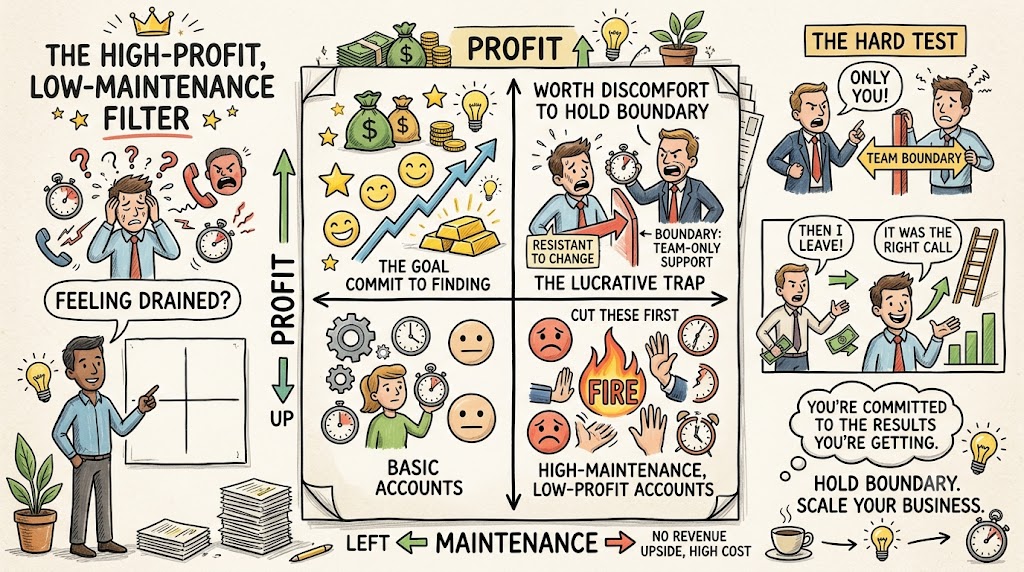
One of the most concrete frameworks to come out of the discussion belonged to a founder who went through coaching specifically to address this problem, since he described himself as a natural control freak reluctant to hand off anything important. His coach had him map every client onto a simple two-by-two: profit against maintenance. The instruction was blunt. Fire, or firmly restructure, the high-maintenance, low-profit accounts first, since they're taking up disproportionate time for the least return.
The hardest test of this framework was a lucrative client who refused to work with anyone on his team but him. He held the boundary anyway, and she left. It was still the right call, by his own account, because the alternative was staying trapped in an arrangement that couldn't scale no matter how much revenue it represented. His coach's framing stuck with him: you're committed to the results you're currently getting. If you actually want high-profit, low-maintenance clients, you have to commit to the process of finding them, not stay comfortable with the client roster you already have.
- Score every client on profit and maintenance. This turns a vague feeling of being drained into an actual, comparable metric across your whole book of business.
- Cut the high-maintenance, low-profit accounts first. These are the clearest candidates, since there's no revenue upside offsetting the time cost.
- Expect the hardest cases to be your most profitable ones. The accounts most resistant to change are often the ones generating the most revenue, which is exactly why they're worth the discomfort of holding a boundary.
Delegation Means Transferring the Thinking, Not Just the Task
The deepest insight from this conversation was also the most uncomfortable one. The client who refused to work with anyone but the founder wasn't actually attached to his execution. She wanted his strategic judgment, and he had never actually passed that judgment on to his team. He had delegated tasks, not thinking, and that gap was the real reason his team couldn't hold onto the relationship when it mattered.
Real delegation, as he described it, requires documented processes and a training sequence: do the work for someone, then watch them do it themselves, then watch them teach it to someone else. Skipping straight to handing over a checklist without that sequence means the team is executing your instructions without the judgment behind them, and customers can tell the difference immediately.
- Document the actual decision-making, not just the steps. A checklist tells someone what to do; it doesn't tell them how to think when the situation deviates from the checklist.
- Use a three-stage training sequence. Do it for them, watch them do it, then watch them teach it to someone else, before considering the skill transferred.
- Expect customer resistance to reveal the gap. When customers won't accept your team, it's often a sign the team genuinely isn't equipped with your judgment yet, and that's on you to fix, not on them to accept.
Founder-led relationships are rocket fuel with an expiration date. They get a company further, faster, than almost anything else in the early days. The way out isn't pulling back your presence entirely. It's rationing it deliberately: close and cameo instead of running the whole show, building people and systems your customers can trust in your place, and having the discipline to enforce a boundary even when a valuable account threatens to walk over it.