
What’s Actually Working in B2B SaaS Marketing in 2026
Every few years, B2B marketing supposedly “dies” and gets reborn under a new acronym. Outbound is dead. Cold email is dead. Paid ads are dead. Content is the only thing that works now—until next year, when it isn’t.

Meanwhile, the companies actually selling enterprise software with $25K–$250K+ ACVs are still building pipeline the same way they always have. Not by chasing one magic channel, but by layering channels, running real experiments, and touching buyers many times over a long period of time.
This post is a synthesis of what I’m seeing right now from founders and GTM leaders who are running real budgets, real SDR teams, and real enterprise sales cycles. This is not theory. It’s not “best practices.” It’s what works when you look at pipeline, not vibes.
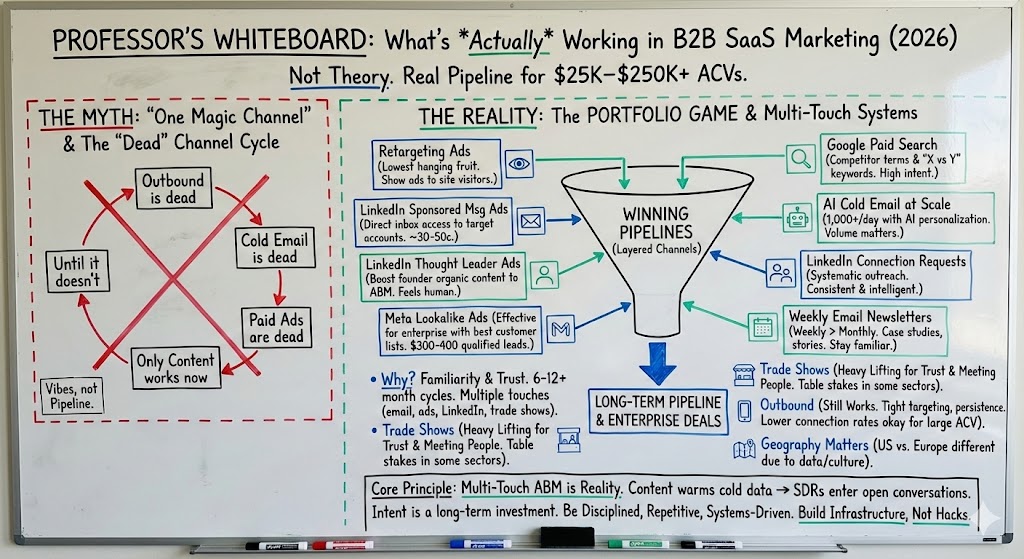
The Short Version: What’s Working Right Now
Before going deep, here’s the high-signal snapshot. If you’re selling enterprise B2B SaaS today, these are the eight customer acquisition levers that consistently show up in winning pipelines:
- Retargeting ads – The lowest hanging fruit. Show ads to people who have already visited your site.
- LinkedIn sponsored message ads – Direct inbox access to target accounts at roughly 30–50 cents per message.
- LinkedIn thought leader ads – Boost founder or exec organic content to ABM audiences instead of running polished corporate ads.
- Meta lookalike ads – Surprisingly effective for enterprise when built from your best customers, generating qualified leads at $300–400.
- Google paid search – Especially competitor brand terms and comparison keywords like “X vs Y” or “X alternative.”
- Cold email at scale – 1,000+ emails per day using AI (Claude) for personalization, not 100 handcrafted emails per week.
- LinkedIn connection requests – Systematic outreach using tools like Kakio, done consistently and intelligently.
- Weekly email newsletters – Weekly beats monthly. Include case studies, customer stories, and webinar recordings to stay familiar.
None of these work in isolation forever. But together, they form a strong foundation.
Now let’s unpack why.
The First Thing to Understand: B2B Marketing Is a Portfolio Game
Enterprise B2B SaaS marketing in 2026 is not about finding the channel.
It’s about building a portfolio of channels that reinforce each other.
Enterprise and mid-market buyers don’t convert because of one touch. They convert because they see you repeatedly—on LinkedIn, in their inbox, in retargeting ads, at trade shows, and eventually in a sales conversation. Different buyers respond to different stimuli. Some hate cold calls but read newsletters. Some ignore email but respond on LinkedIn. Some need to see your brand ten times before they’ll even take a meeting.
Once you accept that reality, a lot of the false debates about “what works” disappear.
.jpg)
Traditional Outbound Still Carries a Lot of Weight
Despite how unfashionable it is to say, traditional outbound is very much alive in enterprise SaaS—especially when the ACV is high and the product is complex.
Trade shows, in particular, continue to do a disproportionate amount of heavy lifting. One founder put it plainly:
“We heavily rely on trade shows, unfortunately, which is so expensive, but we do 14 trade shows a year. That’s the bulk of our leads.”
This comes up again and again. Enterprise buyers want to see the product. They want to meet the people behind it. They want reassurance before committing to six-figure contracts. For certain industries—security, logistics, healthcare, infrastructure—trade shows are not optional. They’re table stakes.
Outbound teams also continue to work, even though the numbers can look ugly at first glance.
“We have 14 ADRs making calls with less than a 2.5% connection rate.”
That’s not a failure. That’s enterprise math. When deal sizes are large, low connection rates can still produce excellent ROI—as long as targeting is tight and persistence is real.
Geography matters more than most people admit.
“We found that the successes were much higher in the US versus Europe… the data being the fuel.”
Cold calling still works in the US. In the UK and Europe, cultural resistance and GDPR-driven data quality issues make it far less effective. If you don’t adapt your channel mix by region, you’ll think outbound is broken when it’s really just misapplied.
The Digital Channels That Actually Convert in B2B SaaS
On the digital side, there’s plenty of noise and surprisingly little signal. After managing roughly $1M per month in enterprise B2B SaaS ad spend, a few truths consistently hold.
Retargeting is the most obvious and most underutilized channel. If someone has visited your site, they’re warm. Showing ads to those people isn’t clever marketing—it’s basic hygiene.
“Turn on retargeting—you can do that in 4 hours of work… you can show a thousand retargeting ads for $15.”
.jpg)
Retargeting doesn’t just convert on its own. It makes everything else work better by increasing familiarity and trust.
LinkedIn sponsored messages are effective not because they generate massive reply rates, but because they give you predictable reach into named accounts. At 30–50 cents per message, you can afford to test, refine, and stay visible without needing perfection.
LinkedIn thought leader ads are one of the more underrated tactics right now. Boosting founder or executive content to ABM lists consistently outperforms polished corporate creative. It feels human. It builds credibility. It doesn’t trigger the same resistance buyers have toward obvious vendor messaging.
.jpg)
Meta lookalike audiences still surprise people, but the data is hard to argue with. When built from high-quality customer lists—not generic leads—it’s common to see qualified enterprise leads in the $300–400 range. Meta isn’t the problem. Bad inputs are.
Google paid search remains valuable, especially for competitor and comparison terms. Buyers searching “X vs Y” are late in the decision process. These clicks are expensive, but they’re also among the highest-intent traffic you can buy.
Outreach Has to Scale (Or It Breaks)
One of the biggest shifts happening right now is the move away from artisanal outbound.
Sending 100 perfectly crafted emails per week is no longer enough. Inbox competition is too high. Attention is fragmented. Volume matters.
“At low volume, 2% reply rate is world class. But instead of doing 100 emails a week, if you can get a thousand emails a day and use AI to personalize it, it’ll start to work.”
AI has changed the equation. Tools like Claude now make it possible to personalize at scale well enough that copy quality is no longer the bottleneck. Infrastructure, deliverability, and list accuracy are.
.jpg)
The same logic applies to LinkedIn connection requests. Systematic outreach—done thoughtfully, with targeting and follow-up—still works. You don’t need to be clever. You need to be consistent.
Weekly newsletters fit into this same system. Monthly newsletters fade into irrelevance. Weekly communication keeps your brand familiar throughout a 6–12 month enterprise buying cycle. You’re not selling. You’re staying present.
Multi-Touch ABM Is the Reality (Not a Buzzword)
Enterprise deals don’t close because of one channel or one interaction. They close because systems work together.
One of the clearest lessons from the field is that cold data should almost never go straight to SDRs.
.jpg)
“The only thing we’ve found that works consistently is warming the cold data with content.”
Content-first warming—PDFs, webinars, case studies—creates context and intent before human outreach begins. SDRs then enter conversations that are already partially open.
Intent data works best when treated as a long-term investment, not a quick win.
“The strategy pays in like 6 months.”
Light, content-driven email campaigns run every couple of months, combined with aggressive retargeting of engagers, compound over time. It’s slow—but it’s real.
The Reality Check
Enterprise B2B SaaS marketing in 2026 is not clever. It’s not flashy. And it’s definitely not single-channel.
It’s disciplined. It’s repetitive. It’s systems-driven.
You win by showing up again and again across the channels your buyers already use. You win by building infrastructure, not hacks. You win by letting familiarity do most of the heavy lifting.
That’s what’s actually working right now.