

W2 vs. 1099 Contracts vs. Consultants: What's the Right Balance for a SaaS Firm
There's no universal ratio of employees to contractors that works for every SaaS company. Founders in our mastermind, running everything from four-person teams to companies with hundreds of staff, walked through the actual test they use to decide, and it has almost nothing to do with cost per hour.

A member running an enterprise SaaS company asked the group something that sounds simple and turns out not to be: does anyone set an actual target ratio between W2 employees and 1099 contractors?
- His current mix: about 98% W2. Labor costs at his company run almost entirely through full-time employees today.
- He's actively pushing the other direction. Encouraging his team to look at consultants and contractors more, given how many skilled people are open to project-based work.
- His question was a specific number. Whether other founders manage to a deliberate target, something like five or eight percent of payroll on 1099s or international contractors.
Nobody in the room had a fixed percentage. What came out instead was more useful than a number: three or four genuinely different models, each one shaped by the size and structure of the company running it, and a shared underlying question that mattered more than any ratio.
The Real Question Isn't Cost, It's Duration
One founder's answer cut straight past the ratio question. His company doesn't manage to a target split at all. The decision comes down to a single test: is there a full year's worth of work for this role or not? If yes, it's almost always cheaper to bring someone on as a W2 employee than to pay a consultant's markup for the same ongoing work over twelve months. If no, if the need is genuinely project-shaped with a defined end, that's when a consultant or contractor makes sense.
- The test is duration, not cost per hour. Is there a genuine year's worth of ongoing work for this role, or is it a defined project with an end date?
- Ongoing work usually favors W2. A consultant's markup on twelve straight months of work almost always costs more than a full-time comp package.
- It sidesteps the tax debate entirely. The test never has to touch classification or compliance questions, just whether the work itself is a role or a project.
That test scales down surprisingly well too. Even at a very small company, the same logic applies, you're just applying it to a smaller number of roles. The mistake to avoid is picking a structure because it's cheaper on paper this month and ignoring whether the underlying need is actually ongoing.

Why a Four-Person Company Can Run 100% on 1099
Another founder's situation looks nothing like a typical SaaS company because of size. All of their costs run through 1099 contractors, no exceptions. That works at a four- or five-person company in a way it genuinely would not work at thirty people. Part of it is structural: their executive assistant, for example, also supports other clients outside my business, and everyone on the team has the freedom to work when and where suits them.
- Size is the enabling factor. A four- or five-person team can run entirely on contractors in a way a thirty-person company genuinely cannot.
- Flexibility is part of the deal, not just a tax play. My EA supports other clients too, and everyone works when and where suits them, which is real value for the people doing the work.
- Favorable tax treatment, without a real cost penalty. I don't end up paying meaningfully more than a W2 structure once everything is accounted for.
- The one real downside: no ISOs. You can only grant non-qualified stock options to a 1099 contractor, which have less favorable tax treatment for the recipient.
For context on how differently this looks at scale: earlier in my career I ran a much larger, more conventional SaaS company with hundreds of employees, and there ninety-eight percent of the workforce was W2. Same founder, completely different structure, because the size and shape of the company changed what made sense.

Building a Global Team on Contract Terms
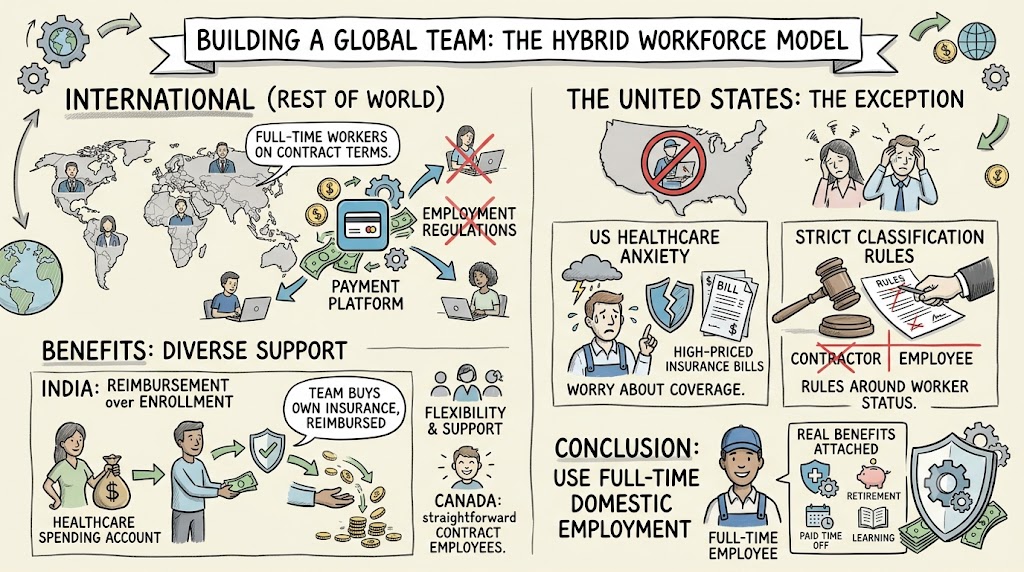
A different founder runs a team spread across several countries, with a large concentration of people in India. His structure is a hybrid worth understanding: people work full-time, effectively as employees in every practical sense, but they're paid as contractors, using a payment platform rather than running local payroll. The explicit goal is to avoid getting tangled in employment regulations in every jurisdiction where he has someone working.
- Benefits vary by country. The structure isn't one-size-fits-all; how people are supported depends on local norms and what's actually useful there.
- Reimbursement over enrollment. In India, the company funds a healthcare spending account rather than enrolling people in a fixed plan, so team members buy their own insurance and get reimbursed.
- Flexibility with real support. The goal is that it feels like a full benefits package even though the mechanism looks different from a traditional employer plan.
- The US is the exception. The same contractor-based approach that works well internationally ran into real friction domestically.
That last point is worth sitting with, because it's the piece that trips up founders who assume what works abroad will work at home. He tried extending the same contractor model to hires inside the United States and ran into real problems, largely tied to healthcare.
- US healthcare anxiety doesn't map onto contractor relationships. American workers carry a level of concern about coverage that a contractor arrangement doesn't address.
- US worker classification rules are considerably stricter. Compared to most of the countries where his team actually operates.
- His conclusion: go full-time domestically. In his own words, you basically have to use the full-time employment route with real benefits attached in the US.
- Canada was the exception to the exception. Contract employees there were straightforward, not the friction point the US turned out to be.
A Payroll Benchmark Worth Tracking
One more useful number came out of this conversation, and it's less about the W2-versus-1099 question directly and more about how much labor spend a healthy SaaS company can carry at all. One founder tracks a simple rule: keep total FTE payroll under total annual recurring revenue, with contractors filling in whatever's left after that.
- The ceiling: FTE payroll under total ARR. A simple rule that reframes the whole debate around a spending limit rather than a ratio.
- In practice, roughly 50% of revenue. Fairly consistent with what other B2B SaaS companies tend to run on full-time payroll.
- Above the line feels overextended. Payroll creeping meaningfully past that fifty percent mark starts to feel like too much fixed cost relative to revenue.
- Below the line means real room in the budget. Whether that room goes toward new hires, contractor spend, or just margin.
That benchmark is a useful sanity check even if you never adopt it as a hard rule. Instead of asking what percentage of your team should be contractors, ask what percentage of revenue your fixed payroll represents, and let the rest of your hiring decisions, W2 or contractor, flow from whatever room that leaves you.
There's No Universal Ratio, Just a Consistent Test
Put these four approaches side by side and the pattern isn't a target percentage at all. It's the same underlying question asked at different company sizes: is this role ongoing work that justifies bringing someone in-house, and if it's global, does the jurisdiction you're hiring in actually support a contractor relationship without creating legal risk.
- A four-person company can run entirely on contractors. Because the founder is trading a modest tax benefit for real flexibility at a scale where that trade-off holds up.
- A hundreds-strong team runs almost entirely W2. At that scale, ongoing roles are the overwhelming majority of what the company needs filled.
- A global contractor model works abroad and hits a wall in the US. The same legal structure simply doesn't travel evenly across every jurisdiction.
If you're wrestling with this the way that first founder was, the fastest way through it isn't picking a target percentage and working backward.
- Go role by role, not team-wide. Ask whether the work in front of you is a twelve-month need or a defined project with an end date.
- Check the ceiling separately. Compare your total fixed payroll against revenue to make sure the shape of your team matches the shape of your business.
It's also worth revisiting the question periodically rather than treating whatever structure you started with as permanent. The company running everything W2 today might reasonably shift some project-based work to contractors as it grows into more defined, time-bound initiatives. The founder running entirely on 1099s at four people will almost certainly need to rethink that as headcount climbs into the double digits, because the flexibility that makes sense for a handful of people who all know each other well starts to create real coordination costs once a team gets larger. None of these structures are permanent commitments. They're just the right answer for the size and shape of the business you're running today.