The SaaSpocalypse Is Over: Why Investors Came Back to 80% Gross Margins
In February 2026, the market decided enterprise software was finished. Over the following ten weeks, public software stocks lost roughly a third of their value, because investors believed AI agents would soon make software sold by the seat obsolete. Six months later, they are changing their minds. This report assembles the data behind the reversal: the recovery in public software prices and multiples since the April bottom, the gross margin reality inside AI-native companies, what private equity firms and acquirers are now saying and doing with their capital, and the evidence that incumbent software companies are the ones actually monetizing AI. All market data is current through July 31, 2026, and every figure is sourced.
This report is published by SaasRise, the #1 mastermind community for SaaS CEOs with $1M–$100M+ in ARR. Members have collectively raised $1B+ and have $3B+ in ARR.
The Margin Gap at the Center of the Repricing
What the Market Is Paying For Instead
A note on what this report does and does not argue. It does not argue that AI is unimportant, or that every software company is safe. It argues something narrower and more useful: that the market conflated AI as a product with AI as a capability, priced enterprise software as if the first would destroy the second, and is now correcting. The companies at risk are the ones with thin workflows and no data. The companies compounding are the ones putting AI inside an 80%-gross-margin product they already own.
How to read the numbers in this report
Most of the data below comes from investors, so it arrives in investor language. Here is the plain-English version of the six terms that do the most work in this report. If you already speak this fluently, skip ahead.
Gross margin. What is left from a dollar of revenue after you pay the direct cost of delivering the product — hosting, third-party model fees, support tied to delivery. Not profit. Traditional SaaS keeps 80 cents; the AI companies in this report keep closer to 50.
Multiple. What a buyer pays for your company expressed as a number of times your revenue. A company at “4x” and $10M of revenue is worth $40M. When people say the market “re-rated” or “repriced,” they mean this number moved — often without anything changing inside the business.
Rule of 40. Growth rate plus profit margin. Grow 25% at a 15% margin and you are at 40. It is the shorthand investors use to decide whether you are growing efficiently or just spending.
Gross and net revenue retention (GRR and NRR). Of the revenue you had a year ago, how much is still there? GRR counts only losses, so it can never exceed 100%. NRR also counts upgrades and expansion, so it can. NRR above 100% means your existing customers alone grow your revenue.
Inference cost. The compute you pay for every single time a customer uses an AI feature. This is the crux of the whole report: unlike normal software, where the second customer costs you almost nothing, AI usage costs you real money each time.
Take-private. A private equity firm buys a public company outright and de-lists it from the stock exchange. A wave of these is a strong signal that professional buyers think public prices are too cheap.
📋 Table of Contents
- The Trade That Broke Software — And the Trade That Is Unwinding
- Why Most AI Companies Have a Concrete Plant's Margins
- What Investors and Acquirers Are Actually Saying
- Discipline Gets Paid: The Return of Gross Margin and EBITDA
- AI as a Capability: R&D, Sales & Marketing, and Business Ops
- The New Revenue Lines: Agents, APIs, and MCPs
- The Honest Retention Picture
- The Three Moats: Data, Brand, and Distribution
- The Playbook for a $5M–$100M ARR SaaS CEO
- The Bear Case We Take Seriously
- Sources
Key Findings
Software stocks bottomed on April 10, 2026 and have rallied sharply since, though they have not recovered the full year. The best companies re-rated first: the top-decile software multiple is now 25% above its pre-ZIRP median while the overall median sits 56% below. AI-native gross margins are improving quickly but remain roughly 25 points below software margins, and the largest AI companies are still losing money at scale. Meanwhile public SaaS profitability is at a record: median EBITDA margin is expected to reach 23.3% in 2026, and the market is paying nearly three times the revenue multiple for companies that clear the Rule of 40. Private equity is acting on this — Thoma Bravo, Francisco Partners, Hg and Vista have all publicly repositioned toward high-margin software with embedded AI, and Vista has published portfolio data showing R&D down 12.1% and sales & marketing down 15.8% as a share of revenue over two years. The AI revenue growing fastest right now is not sitting in startups; it is sitting inside Salesforce, ServiceNow, Microsoft, and mid-market platforms like Nexthink.
1. The Trade That Broke Software — And the Trade That Is Unwinding
The sell-off had a specific trigger. In February 2026, Anthropic unveiled advanced agentic tooling for its Claude co-working agent, and the market drew a straight line from “agents can do knowledge work” to “nobody will pay per seat again.” One product launch reportedly wiped out more than $285 billion of software market capitalization in a single day. By April, the iShares Expanded Tech-Software ETF (IGV) had fallen to $73.93, roughly 37% below its September 2025 high of $117.99. Software traded at a discount to the S&P 500 for only the second time since the 2008 financial crisis, after nearly two decades of commanding a premium.
Then it turned. IGV closed July 31, 2026 at $94.58 — up 27.9% from the April 10 low. The broader S&P Software & Services Select Industry Index ($SISS) is up 35.2% from the same low and is now down just 2.4% year to date. IGV rallied 21% in May alone, its strongest month since October 2001.
We are deliberately showing both numbers. A recovery narrative built only on the move off the bottom would be dishonest: IGV was still down 10.5% year to date and 19.8% below its 52-week high at the end of July. The accurate statement is simpler: the panic stopped, and the market started sorting winners from losers instead of selling everything at once.

The recovery is real and incomplete — which is exactly what a repricing looks like.
The best companies recovered first — and by a lot
Share prices tell you how the group did. Multiples — what buyers will pay per dollar of revenue — tell you which companies they actually want. Meritech tracks this across public software companies. In April, the typical company was valued at about 3.2 times its recurring revenue; by July 17 that had recovered to 3.8 times. But the top ten companies went from 11.7 times to 20.8 times over the same weeks.
To see why that is remarkable, compare it to 2019 — the last normal year before interest rates went to zero and inflated everything. Back then the top software companies traded at 16.6 times revenue. Today's top ten are 25% above that. The typical software company, meanwhile, is still 56% below its 2019 level of 8.7 times.
That gap is this entire report in two numbers. Investors did not decide software is fine. They decided good software is scarce and was on sale, and everything else still has to prove itself. Jamin Ball's July 31 data shows the same split: the typical company at 3.8 times forward revenue, the top five at 29.6 times.
Why this matters to you as an operator: being an average software company is now worth roughly a quarter of what being a top-decile one is worth. In 2021, a rising tide lifted everyone. It does not anymore.
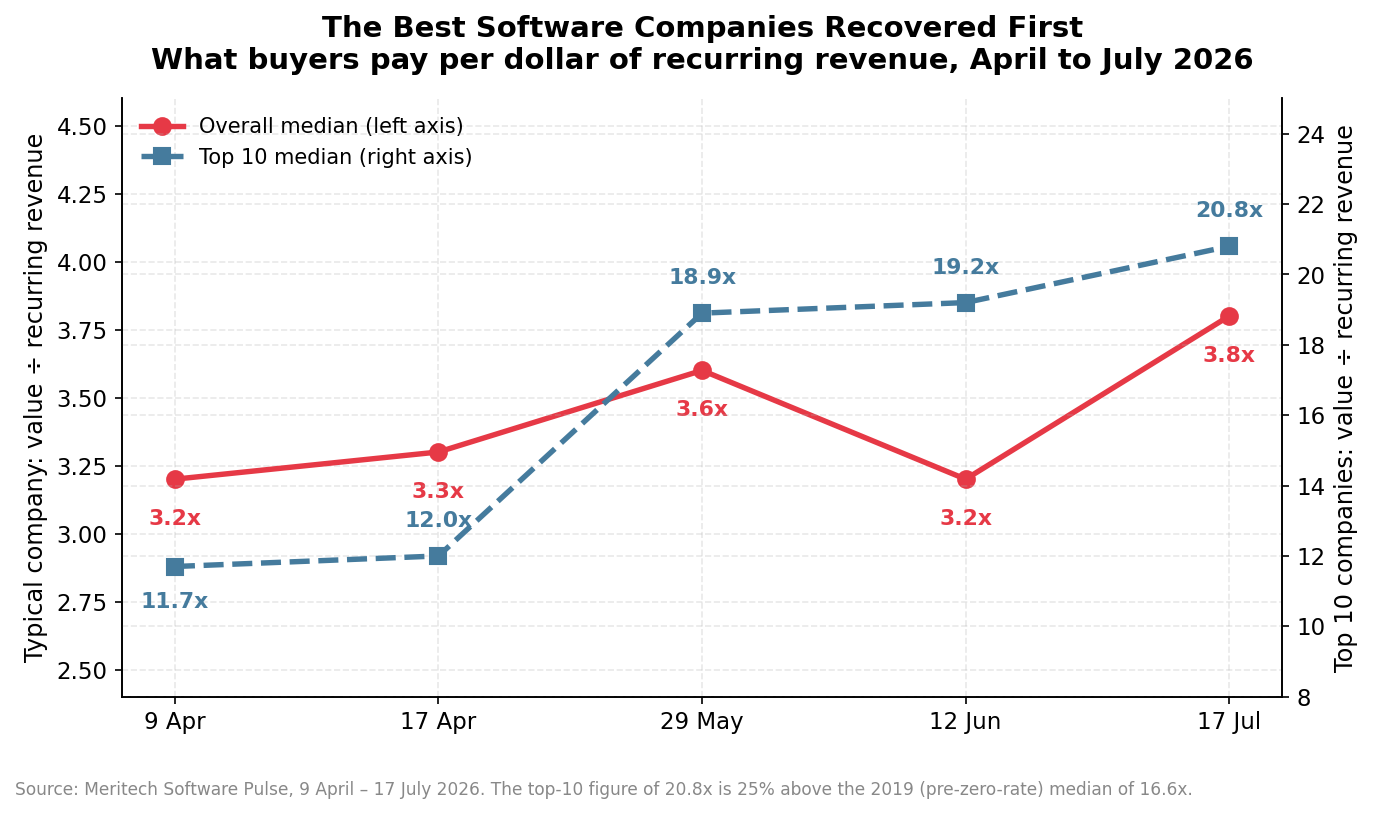
The gap between the top and the middle is the signal — money is going back into the best companies first.
First Analysis, tracking its own SaaS universe, reported the same inflection with an explanation attached: the average enterprise value multiple on 2026 estimated revenue rose to 4.7x at the end of the June quarter from 3.9x the quarter before, and its SaaS stocks gained 18.9% on average versus 14.9% for the S&P 500. Their summary of what changed: “The market seemed to realize that many (if not most) software companies will not be replaced by AI.”
The one-sentence version. From February to April, investors were trading on a fear about the future. From April to July, they started trading on what actually showed up in the numbers. This report is about what showed up.
2. Why Most AI Companies Have a Concrete Plant's Margins
A SaasRise member spent about a year in conversation with a well-known private equity group. Earlier this year that firm told him they had experienced a wake-up call on the AI businesses they had funded. The cost of goods sold, they said, “looks nothing like software, and everything like a traditional, capital-intensive business.”
Their own comparison was the memorable part. The same firm owns concrete plants in Asia that run at roughly a 35% markup. Classic SaaS runs at 85–95% gross margin. Many of their AI investments, they concluded, were landing much closer to the concrete plant than to the software company. The cost drivers they named were AI talent that never gets cheaper, electricity, buying GPUs, and the spare capacity you have to keep on hand so heavy AI workloads do not fall over. In other words: real costs that grow as you sell more.
The public data supports the anecdote almost exactly.
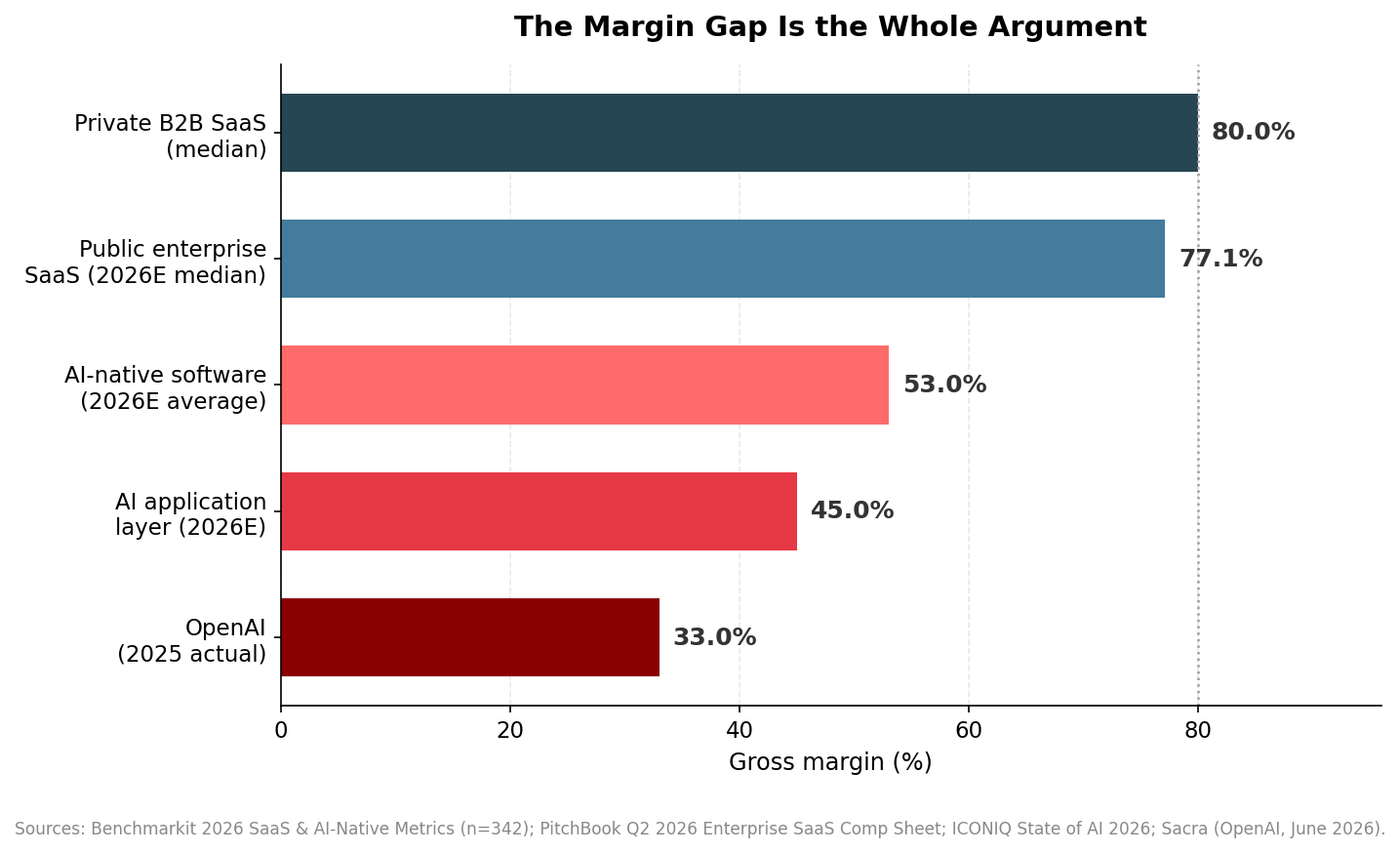
OpenAI's 33% gross margin sits within two points of that private equity firm's concrete plants.
Benchmarkit's 2026 benchmarks, drawn from 342 B2B SaaS and AI-native software companies, put median software gross margin at 80% — stable across four years of the survey. PitchBook's Q2 2026 comp sheet expects the public enterprise SaaS median to rise to 77.1% this year. ICONIQ's survey of roughly 300 software executives building AI products puts the average AI product gross margin at 53% in 2026, and at 45% for the application layer specifically. Sacra's analysis of OpenAI's 2025 financials puts its gross margin at 33%, with the cost of running its models — $8.4 billion in 2025 — projected to reach $14.1 billion in 2026 as usage grows.
The direction of travel matters, and it cuts both ways
Here is the part most bearish takes on AI margins get wrong. AI gross margins are not static — they are improving fast. ICONIQ's series runs 41% in 2024, 45% in 2025, 53% projected for 2026, and 59% projected for 2027, and the improvement is real: models keep getting cheaper to run, companies are learning to send easy requests to cheap models and only hard ones to expensive models, and scale helps. Note what is not driving it — nobody is raising prices. Model costs have fallen by more than two orders of magnitude in two years.
Two honest conclusions follow. First, the “AI companies can never have software margins” argument is too strong; the gap is closing. Second, on the AI industry's own projections, the gap is still 21 points in 2027 — and that is against a software median that has held at 80% for four years while absorbing its own AI costs.

The convergence is real. The convergence is also not finished, and it is not close.
The wrapper problem, stated precisely
“Wrapper” gets thrown around as an insult, so let us define it in business terms rather than technical ones. A wrapper is a company with two problems: your gross margin is set by your supplier's price list, and your main advantage can be wiped out by that same supplier's next product release. You are renting both your economics and your differentiation. Insight Partners put it plainly: “Many AI startups today rely on generic LLMs layered onto workflows, which unlocks value but is easy to replicate.”
Cursor is the instructive case, precisely because it is one of the winners. Anysphere scaled from $100 million ARR in January 2025 to roughly $2 billion by February 2026 and about $4 billion by June 2026 — and it did that while running negative gross margins until its own Composer model flipped enterprise margins positive. Individual developer plans, reportedly around 40% of revenue, are still understood to be gross-margin negative. Read that again: one of the fastest-growing software companies in history spent its early years losing money on every unit sold, and only fixed part of it by building its own model. That is the cost structure at the very top of this category. Below the top, it is worse.
AI as a cost center vs. AI as a capability
AI as a cost center: AI is the product. Every unit of usage consumes inference you pay for. Your gross margin is a function of your model vendor's pricing, your COGS scale with success, and your differentiation is a prompt layer away from being commoditized.
AI as a capability: AI is a feature inside a product that already earns 80% gross margins on proprietary data and an owned workflow. Inference is a line item measured in points of margin, not the entire cost structure — and it is offset by the R&D, support, and go-to-market leverage AI creates internally.
This is the distinction investors spent the first half of 2026 learning to make, and it is the single most useful lens in this report.
Benchmark Your Margins Against Real SaaS Companies
SaasRise members share actual gross margin, retention, and AI cost data across 300+ SaaS companies from $1M to $100M+ ARR — so you know where you truly stand before an investor tells you.
3. What Investors and Acquirers Are Actually Saying
The most useful evidence that the AI-kills-software trade is unwinding is not commentary. It is where the largest software buyers in the world are putting capital, and what they are willing to say publicly while doing it.
“The SaaSpocalypse is over. It's finished, no more. People were assuming that software companies just do one thing and they stay still. But software companies continue to evolve with infrastructure. Around 50% of our new revenue is AI revenue, agentic revenue. AI is an enormous tailwind for software companies.”
Orlando Bravo, Founder & Managing Partner, Thoma Bravo — the world's largest software-focused investment firm, managing almost $200 billion. Speaking to CNBC at SuperReturn International in Berlin, June 9, 2026. Thoma Bravo's portfolio companies generate roughly $35 billion in combined revenue.
Bravo is worth quoting at length because he is not a cheerleader. In March 2026 he said some of the AI-driven hits to software valuations were “very warranted.” He has also publicly refused the fantasy that AI collapses software cost structures: “We would love to take that 15% of R&D spend and bring it to 2%, but we're not seeing that, because there's a lot more that goes into delivering these solutions for enterprises.” In February, with the sector at its most hated, his read was: “There's some jewels in the public markets right now that are worth so much, that have 30 years of domain expertise built into their product. And those companies are really, really cheap right now.”
At a Miami meeting with the investors who fund its own funds, Managing Partner Holden Spaht presented the fundamental case in three numbers: public SaaS companies grew revenue roughly 17% last year against 6% for the rest of the S&P 500; software gross margins run around 74% versus 43% for non-tech S&P 500 companies; and 80–95% of a typical software business's next-year revenue is already under contract. His explanation for why software growth slowed from 2022 to 2025: interest rates rose and the COVID-era overbuying worked its way out of the system. Not AI. Then investors blamed AI anyway — before AI damage had actually shown up in any company's results.
Spaht also drew the distinction that matters more than any index-level call:
| Category | Characteristics | Examples of the workflow |
|---|---|---|
| Vulnerable | Generalist knowledge domains, simplified workflows, light regulatory oversight, limited switching costs | A point solution automating one task a human used to do — if AI does that task equally well, the product disappears |
| Protected | Deep domain expertise, zero-tolerance-for-error workflows, heavy compliance requirements, embedded cross-system integration | Aircraft maintenance records, pharmaceutical manufacturing validation, hospital billing compliance |
They are backing it with money, not just talk
Francisco Partners closed the first large software-focused fundraise after the February sell-off, raising $21 billion against an $18 billion target. Co-founder Dipanjan “DJ” Deb's position, reported by the Financial Times in July, is that markets have underestimated AI's potential to boost software efficiency and growth — while separately warning that AI company valuations have inflated into something reminiscent of 2000. Sit with that combination for a second. The same firm is raising a record amount of money to buy cheap software companies while publicly calling AI valuations a bubble. That is this report's argument, expressed as $21 billion of someone else's capital.
The buyouts tell the same story. When private equity takes a public company private, it is making a concrete bet that the stock market has the price wrong. Thoma Bravo completed its $12.3 billion acquisition of Dayforce in February 2026. Hg agreed to acquire OneStream for $6.4 billion at a 31% premium in January. Blackstone and Vista closed the $8.4 billion Smartsheet take-private. Deal flow continued straight through the summer: Cinven agreed to acquire Salsify in July, and Hg agreed to sell Quantios to Vista at roughly a 30% uplift to book value — explicitly citing upfront investment in the company's AI product suite as the driver of buyer interest.
“Let's not get carried away, but incumbent SaaS businesses will capture some of this opportunity if they ‘re-found’ themselves as ‘AI first’ and quickly… This is where incumbents have a head start, and the key is to have already mobilised.”
Matthew Brockman, Managing Partner, Hg — on the “four Ds” that decide who wins: proprietary data, deep domain knowledge, distribution, and dominance. Hg's Head of Research David Toms adds the discipline: long-term value creation in software has come from earnings growth, not multiples.
On the public side, Wedbush's Dan Ives called the sell-off “the most disconnected call that I've ever seen,” arguing the market was “baking in a doomsday scenario for software companies… which we believe is extremely overblown, as many customers won't be willing to put their data at risk… until there is less risk with these migration projects,” and warning: “You cannot paint all of them with the same brush.” Morgan Stanley's software team told clients on July 21 that the market had become “too negative on the group,” naming eight Overweight-rated names positioned for the AI era.
And the SaasRise member's own banking relationships reported the tell that usually precedes a cycle turn: strategic acquirer offers up roughly 20% in a month, with financial buyers still lagging by a couple of quarters. Strategics move first because they can see their own AI attach rates. Sponsors move when the data shows up in diligence.
4. Discipline Gets Paid: The Return of Gross Margin and EBITDA
Underneath the price action, public SaaS fundamentals in 2026 are the strongest they have been in the post-ZIRP era. PitchBook's Q2 2026 comp sheet, published July 24, reports median estimated 2026 revenue growth of 13.2% (up from 12.2% a quarter earlier), a median estimated EBITDA margin rising to 23.3% from 20% in 2025, and median gross margin rising to 77.1%.
The consequence for what your company is worth is stark. Companies at or above the Rule of 40 are valued at a median of 6.6 times revenue. Companies below it get 2.3 times.
Made concrete: two companies with $20M of revenue, one clearing the Rule of 40 and one not, are worth roughly $132M and $46M. Same revenue. Nearly $90M of difference, decided by growth and profitability together.
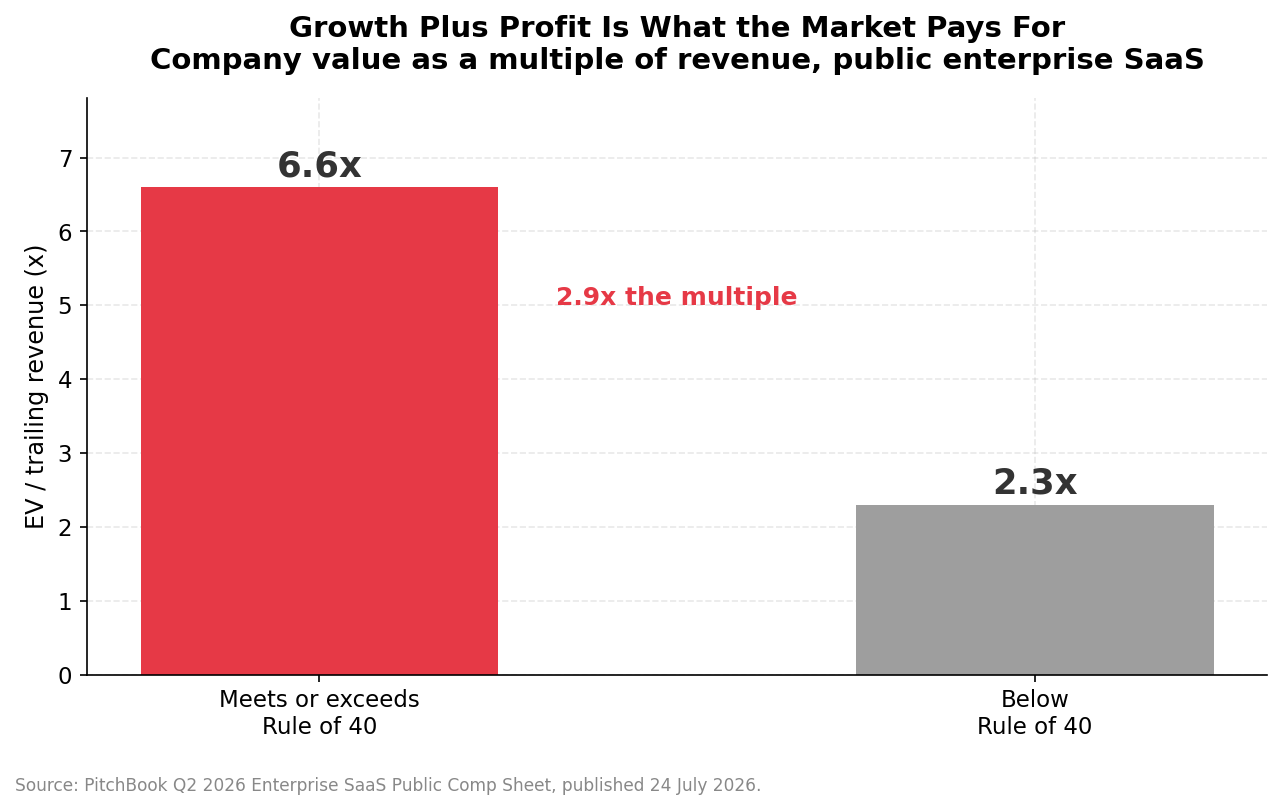
Nearly three times the value for the same revenue — which is the single largest opportunity most CEOs reading this have.
Benchmarkit's private-company data shows the same discipline arriving in the mid-market, and calls it the largest single-year improvement in five years of benchmarking: the median Rule of 40 score moved from 15 to 25, the time to earn back the cost of acquiring a customer fell from 18 months to 16, and revenue per employee rose 17% to a median of $175K. Growth is slower — the median fell from 26% to 20%, the fourth year in a row it has dropped — but companies are getting far more out of every dollar and every employee. That trade is one the market is currently rewarding.
What this means when you raise or sell. In 2021 the first slide was growth. In 2026 the first three questions are gross margin, net retention, and EBITDA — and the fourth is what your AI features cost you for every dollar of revenue they produce. Most companies cannot answer that, because the AI spend that serves customers sits in the same bill as the AI spend your engineers use to build faster. Split those two lines in your own reporting now. If you cannot, a buyer's diligence team will assume the worse of the two numbers.
5. AI as a Capability: R&D, Sales & Marketing, and Business Ops
The most rigorous public evidence that AI expands software margins rather than destroying them comes from Vista Equity Partners, which published measured portfolio data on July 20, 2026. Vista owns dozens of software companies and measured what AI actually did to them, looking at two things: did it grow revenue, and did it improve margins.
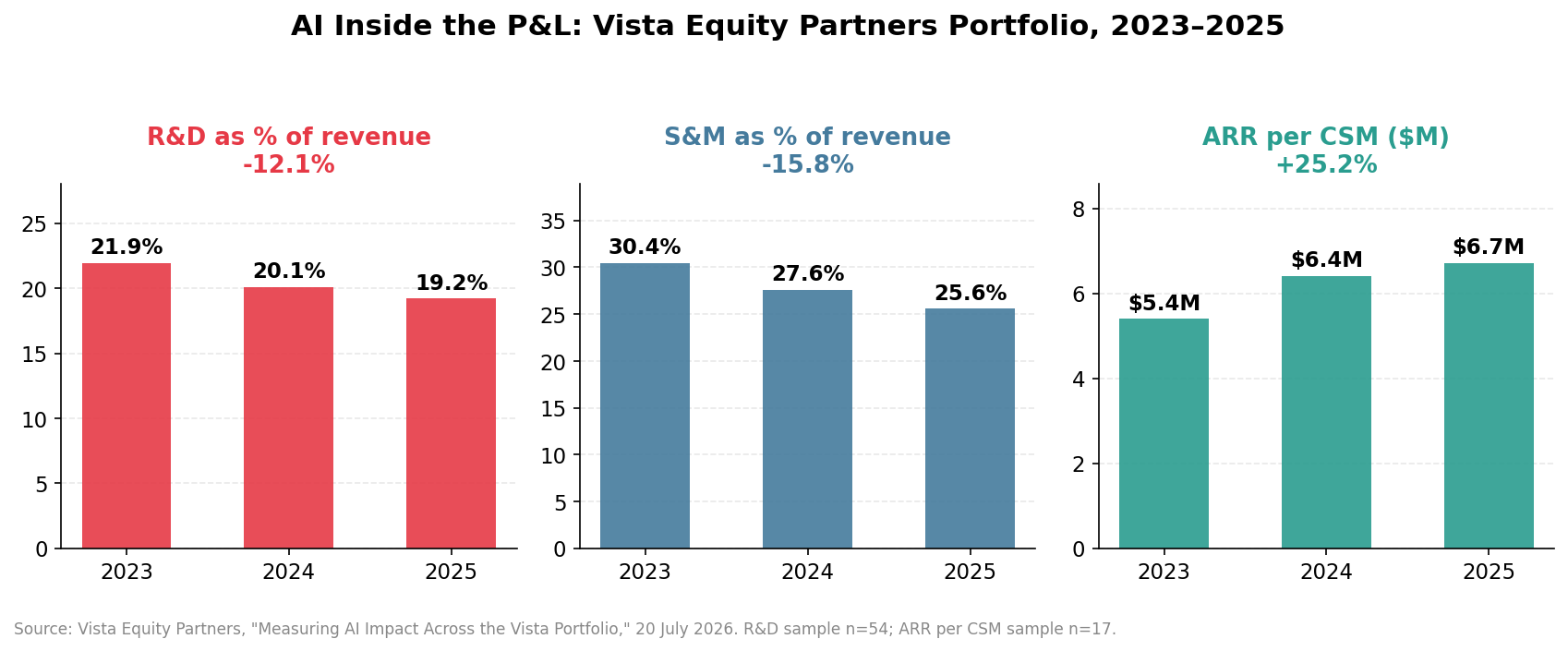
Three years, three P&L lines, one direction. Operating leverage is where AI is showing up first.
| Metric | 2023 | 2024 | 2025 | Change |
|---|---|---|---|---|
| R&D expense as % of revenue (54 portfolio companies) | 21.9% | 20.1% | 19.2% | −12.1% |
| Sales & marketing as % of revenue | 30.4% | 27.6% | 25.6% | −15.8% |
| ARR per customer success manager (17 portfolio companies) | $5.4M | $6.4M | $6.7M | +25.2% |
Benchmarkit's independent survey points the same way on R&D: R&D fell 8 points to 27% of revenue at the median, with the top quartile reaching 22% — a level its authors describe as achievable only through AI productivity. Salesforce shipped twice as many features in Q1 FY2027 as the year before, with its engineering headcount essentially flat at around 15,000 people.
The version of this claim that is not true
“AI lets us cut headcount” is a worse thesis than “AI lets the same team cover more.” Bravo's 15%-to-2% comment is the sharp end of it: enterprise software delivery is mostly not code generation. Look closely at what Vista actually measured: costs falling as a percentage of revenue while revenue grew, and each customer success manager covering more revenue. That is the same team handling more business — not a smaller team handling the same business. Operators who ran the layoff version of this play have been publicly walking it back, and CEOs pitching a margin story built purely on headcount reduction should expect a diligence team to test whether the work simply moved.
Your Peers Have Already Run This Experiment
Weekly SaasRise mastermind calls put you in the room with SaaS CEOs who have already deployed AI across R&D, support, and go-to-market — including the parts that did not work.
6. The New Revenue Lines: Agents, APIs, and MCPs
The seat-compression fear assumed AI would only subtract from software revenue. In practice, the fastest-growing AI revenue in enterprise software is being recognized by incumbents, on top of the seats they already sell.

None of these are startups. All of them sell AI into a customer base they already own.
- Salesforce: Agentforce ARR crossed $1 billion and reached $1.2 billion in Q1 FY2027, up 205% year over year. Combined AI and Data 360 ARR reached roughly $3.4 billion. The company processed 28.6 trillion tokens in the quarter, converted into 3.8 billion completed agentic work units, up 111% quarter over quarter, and closed a record 98 deals worth over $1 million in annual contract value.
- ServiceNow: AI crossed $1 billion in annual contract value in Q2 2026 — that is the yearly value of AI contracts signed — against a $1.5 billion target for the year. Subscription revenue grew 24.5%, non-GAAP operating margin was 29.5%, and customers running agentic AI in production grew ninefold in nine months. Management expects AI to be 30% of everything it sells by 2030.
- Microsoft: Microsoft 365 Copilot passed 30 million paid seats in the June quarter, up from more than 20 million in April, with net seat adds more than doubling sequentially. GitHub Copilot reached 50 million users. Note what this is: an AI product sold as an upsell on existing seats, driving ARPU growth.
- Mid-market platforms: Nexthink's AI-native ARR went from $20 million to $109 million in a year, with its autonomous IT-support agent resolving roughly 80% of tickets and 85% of customers using an AI product. LogicMonitor's Edwin AI went from $4.1 million to $15.7 million of realized ARR in five quarters, delivering roughly $2 million in average annual customer savings at about 6x ROI on selling price.
APIs and MCPs: getting paid when someone else's agent uses your system
Here is a point that gets lost in the fear. An AI agent cannot do anything useful on its own — it needs to read and write real data in real systems. Your system, if you own the record. The Model Context Protocol (MCP) is simply the standard way agents plug into software, and it went from an Anthropic proposal to the default in about 18 months: public MCP server repositories grew from roughly 2,000 at the start of 2025 to 12,000+ by Q1 2026, with production deployments growing over 400% year over year. By July 2026, an estimated 78% of enterprise AI teams had MCP-backed agents in production and 28% of the Fortune 500 were running MCP servers.
For you, that is a new thing to sell. Every one of those agents needs permissioned, metered, audited access to the system of record you already own — and access you can meter is a product you can charge for. The agent showing up in your customer's workflow is a new revenue line, not just a competitor.
The pricing lesson from Sonatype. Over twelve months, per-developer licenses fell 1% while scan volume rose 40% — the seat model had stopped capturing the value flowing through the platform. The company was charging by the developer while its customers' actual usage grew 40%. Switching to charging per scan is expected to add more than $10 million of new ARR, with migrated customers showing a 40% ARR increase and 80% longer contracts, with no change in renewal or win rates. Seat compression is a pricing problem before it is a demand problem.
7. The Honest Retention Picture
This is the section where the bears have real evidence, and a report that skipped it would not be worth reading.
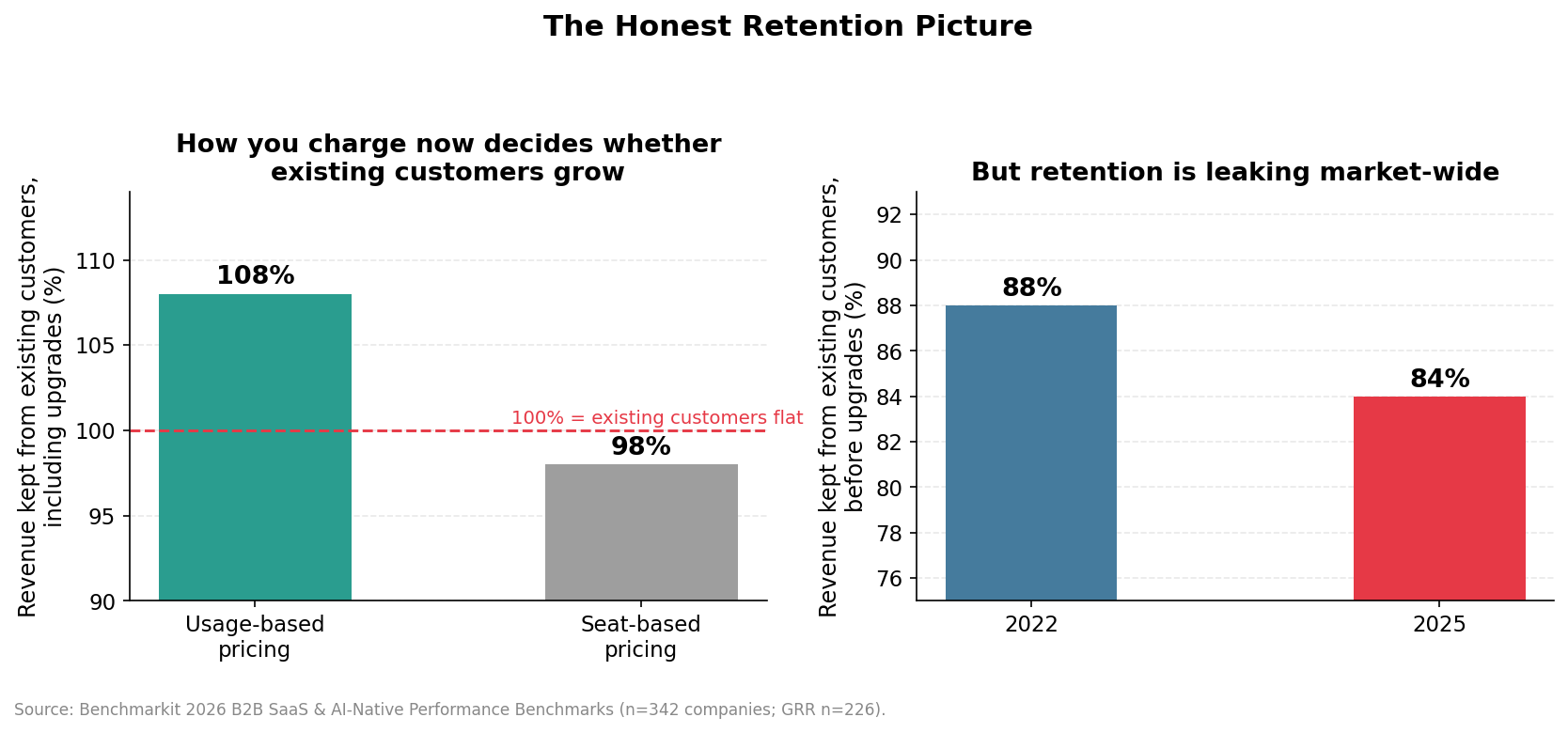
Retention is deteriorating market-wide — and pricing architecture now determines who feels it.
Benchmarkit's 2026 data shows median gross revenue retention — the share of last year's revenue you keep, before any upgrades — falling from 88% to 84%. Even the top quarter of companies slipped from 95% to 91%. At 84%, you start every year having to replace one dollar in six just to stand still. Its authors call this a market-level structural dynamic rather than a company-level execution failure — top performers were not immune.
The split underneath is where you can act. Companies that charge based on usage kept and grew 108% of their revenue. Companies that charge per seat came in at 98% — under the line, meaning their existing customers shrank slightly instead of growing. Upgrades and expansion now supply 40% of all new revenue at the median company. The logic is simple: if you charge per person and your customer's headcount stops growing, your revenue stops growing with it. Charge for the work your software does instead of for the people who log in to do it.
The counterexample worth internalizing is Figma: Q1 2026 revenue grew 46% year over year to $333.4 million, accelerating from 40% the prior quarter, and existing customers spending 139% of what they spent a year earlier — its best in over two years — with full-year guidance raised by $55 million. Design was supposed to be one of the categories AI would gut. Salesforce, meanwhile, has $33.6 billion of already-signed contracts not yet delivered, up 13%. Customers walking away from a doomed product do not sign longer contracts.