
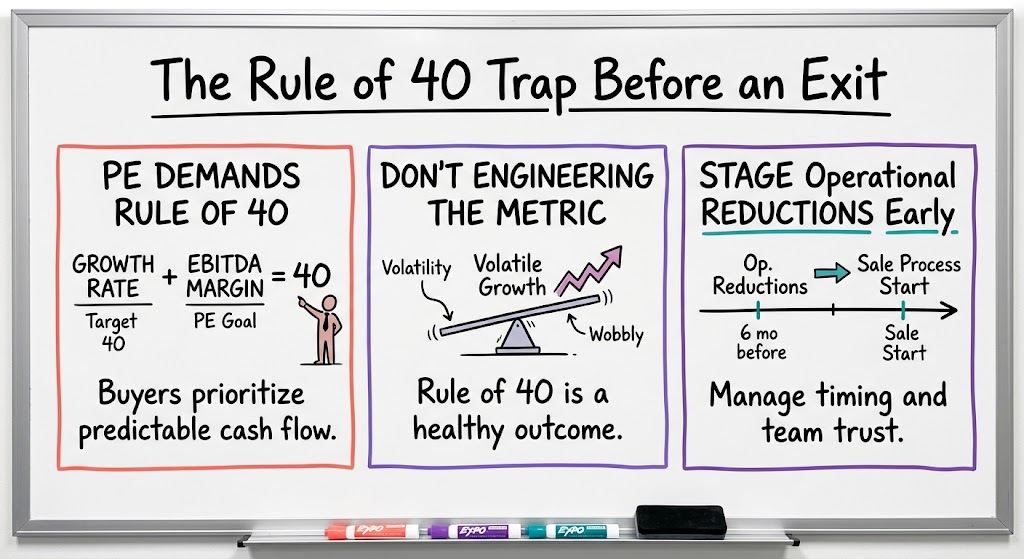
The Rule of 40 Trap Before an Exit
Buyers keep asking for Rule of 40 and 25% EBITDA, so founders preparing to sell are tempted to slash costs fast. Here is why forcing the number can backfire, and what our mastermind members recommend doing instead.

If you're preparing a SaaS company for an exit right now, you've probably heard some version of the same message from bankers, advisors, and potential buyers: get to the Rule of 40. Your growth rate plus your EBITDA margin should add up to at least 40. And if your growth has slowed, that means the margin has to carry most of the load.
That message puts a lot of founders in a painful spot. In a recent Enterprise Mastermind session, one CEO described it as being asked to cut off his nose, arms, and legs. He's working with a fractional CFO who came out of private equity, and that CFO is preparing the business for a financial buyer. His chairman, meanwhile, believes that at the company's size, the most likely buyer is a strategic, not a PE firm. So he's building next year's budget while trying to figure out how much to cut, knowing that deep cuts could hurt growth and shake his team's confidence in him.
Why Buyers Are So Focused on EBITDA
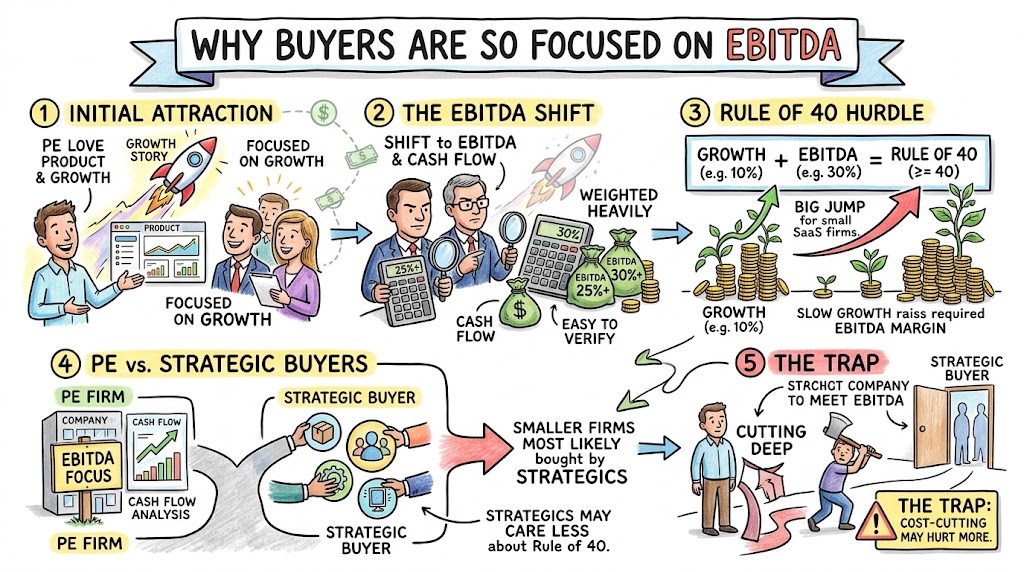
Several members confirmed the pattern. One founder who has been in conversations with PE firms for three or four years said they all love the product and the growth story at first. Then the conversation gets down to the nuts and bolts, and they want to see at least 25% EBITDA. He admitted he was surprised at how heavily EBITDA is weighted, especially in a year when growth has slowed a bit.
That shift makes sense given the market. When a business is trading on a multiple of EBITDA, the buyer is underwriting cash flow, and cash flow is easier to verify than a growth forecast. For a company growing 10%, getting to Rule of 40 means running a 30% EBITDA margin. For many smaller SaaS businesses, that's a big jump from where they are today.
- PE buyers are underwriting cash flow. In this climate, growth stories get discounted unless they come with strong margins.
- 25% EBITDA is a common ask. Members hearing from multiple PE firms reported that number consistently.
- Slower growth raises the margin bar. At 10% growth, you need 30% EBITDA to reach Rule of 40.
- Size matters. Smaller companies are more likely to be bought by strategics, who may care less about the Rule of 40.
That last point is where the trap starts. If your likely buyer doesn't care much about the metric, cutting deep to hit it may cost you more than it gains.
You Can't Force Your Way to the Rule of 40
The most useful pushback in the session came from a member who said the question itself rests on a bit of a false premise. As he put it, if anybody could simply force their way to Rule of 40, everyone would. Another founder added that Rule of 40 is something that happens to you after years of hard work, when the underlying business supports it. Trying to manufacture it in twelve months, without a clear plan, is really hard, if not impossible.
The CEO facing the decision had a specific problem that made it harder. For more than a decade, his growth rate has been unpredictable. It depends on macroeconomic swings, algorithm changes at the platforms that drive his distribution, supplier feeds, and pricing moves he doesn't control. When he plans for 15% growth, he sometimes does 25%. When he plans for 30%, he sometimes does 7%. With that kind of variance, he can't count on growth to cover part of the Rule of 40 equation, so every point has to come from cuts.
- Rule of 40 is an outcome. It reflects a healthy business over time, and trying to engineer it in a single year rarely works.
- Unpredictable growth makes it worse. If you can't forecast growth, you can't plan the margin you need to hit 40.
- Buyers will discount volatility anyway. Even a good growth year won't get full credit if the history is inconsistent.
Build Your Base Case First
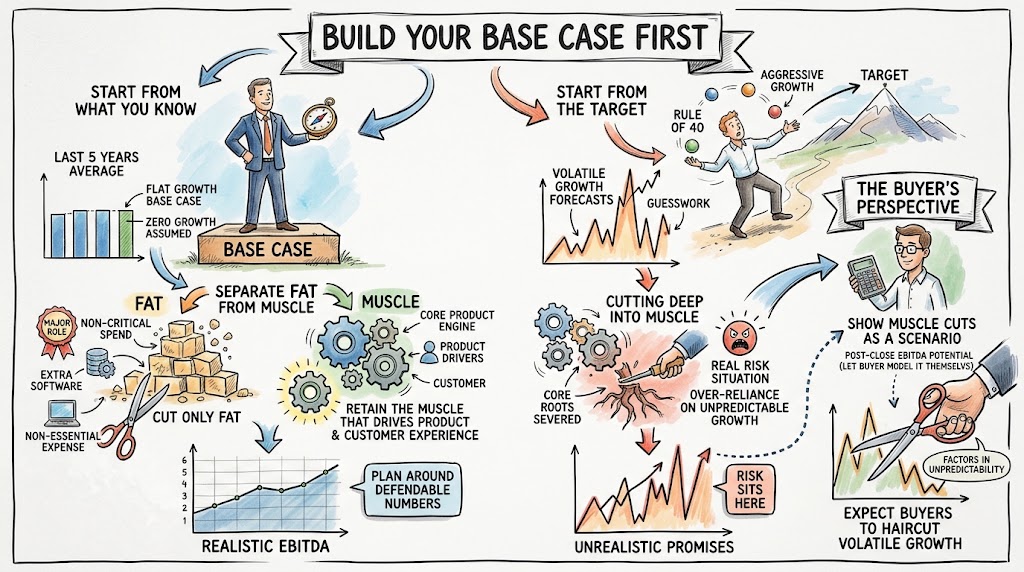
The practical advice that came out of this was to stop starting from the target and start from what you know. One member suggested modeling a base case where you assume zero growth, or an average of your last five years if that's more realistic. Then ask what EBITDA the business can reach by cutting only fat, without touching the muscle that drives the product and customer experience.
He shared something Ryan told him a couple of years ago, which reshaped how he runs his own company: you should either be putting away 10% or you should be growing. Come up with a framework for what the business can do with only the fat cut. If there's a bigger story to tell by cutting muscle, you can tell it to the buyer, but the buyer is going to model that themselves, and they'll also factor in how unpredictable your growth has been.
- Model a flat-growth base case. It removes the guesswork and shows what the business earns on its own.
- Separate fat from muscle. Fat is spend that doesn't affect product, customers, or growth. Muscle is everything that does.
- Show the muscle cuts as a scenario. Let the buyer see what EBITDA could look like post-close without actually making those cuts yet.
- Expect buyers to haircut volatile growth. Plan around the numbers you can defend, not the ones you hope for.
In the CEO's case, he had already been cutting fat all year and had eliminated three major roles. At a flat growth rate, his EBITDA would land in the single digits. Getting to Rule of 40 from there would mean cutting deep into the muscle, and that's where the real risk sits.
Timing: Cut Before the Process, or After Close?
Members disagreed on when cuts should happen, and the disagreement is instructive. One founder shared that at his first company, they did the whole exercise on paper. They modeled out the cost reductions, used that model to get a financial buyer interested, and then brought in a strategic buyer and used the financial buyer's interest to create urgency. They never made a single cut until the transaction was complete.
Another member in active talks with PE firms is taking a staged approach. His team built a detailed list of cuts that wouldn't hurt the muscle, and they're planning to reach 20% EBITDA next year and 25% the year after. Ryan offered a general rule of thumb on timing. As he explained it, you'd generally want to make operational expense reductions about six months before you start a sale process, so you have two quarters of financials to build a forecast from. If you're already in the middle of a process, you probably don't need to make those changes before close, as long as the buyer has confidence that they can be made afterward.
- Paper exercise first. Model the cuts and share them with buyers before you actually make them.
- Cut six months before a process. That gives you two clean quarters to show the new margin profile.
- Mid-process, let the buyer own it. If they believe the cuts are achievable, they can make them after close.
- Stage it if you're not selling soon. Hitting 20% one year and 25% the next is more believable than jumping overnight.
The Hidden Cost: Your Team
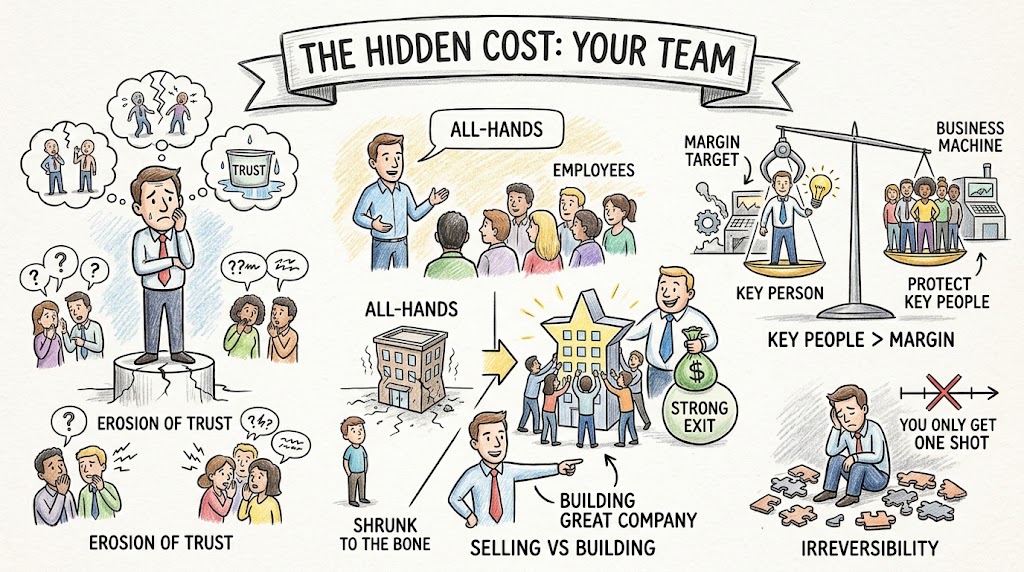
The cost of deep cuts isn't only financial. The CEO worried that while his leadership team would understand cuts made to prepare for a sale, the rest of the company would think he had lost his mind. He's known as a rational CEO, and he didn't want to erode the trust that comes with that.
Another founder confirmed that this fear is justified. His company had reduced its team significantly over the prior year or so, and employees were already saying that leadership was shrinking the company to sell it. He had to address it directly at an all-hands. His message was that you don't sell a company because you shrunk it to the bone, because nobody wants to buy that. You sell a company because it's a great company. His plan was to build a great company, and a sale would follow from that.
Ryan added the point that I think every founder should keep in mind before making big cuts. As he put it, "the challenge with cutting too much too soon is you can't do it twice. Once you lose key people, it's really hard to build it back."
- Employees will assume you're selling. Any workforce reduction invites that story, so be ready to address it.
- Say what you're building toward. Be clear that the goal is a great company, and that a strong company is what earns a strong exit.
- Protect key people. Losing the wrong person to hit a margin target can damage the business more than a lower EBITDA would.
- You only get one shot. Deep cuts can't easily be reversed if the deal doesn't happen.
How to Approach It
If you're facing this decision, start by being honest about who your likely buyer is. If it's a strategic, the Rule of 40 may matter far less than the fit between your product and theirs. If it's a financial buyer, build the flat-growth base case, separate fat from muscle, and present the deeper cuts as a scenario rather than a done deal. Make operational changes early enough to show two quarters of results, or let the buyer own them post-close.
The founders who get the best outcomes treat the Rule of 40 as one of several lenses a buyer will use, and they keep it in proportion. If you cut your way to a metric and lose the team and growth engine that made your company valuable, you may end up with a better margin and a worse exit.