
The New Way to Build a SaaS in 2026 With AI Coding Tools

There’s a new way to build SaaS products in 2026 that’s delivering 10x development speed, and I’d bet most SaaS R&D teams still aren’t using it.
I’ve been coaching experienced SaaS CEOs and founders for over a decade, and I’ve never seen a shift move this fast. A couple days ago, a founder in our community told me he vibe coded a full replacement of a 1 million line legacy SaaS product in four weeks—not a mockup, not a Figma file, but working software with production-ready security and scalability.
That’s not “a cool demo.” That’s a sign the bottleneck just moved.
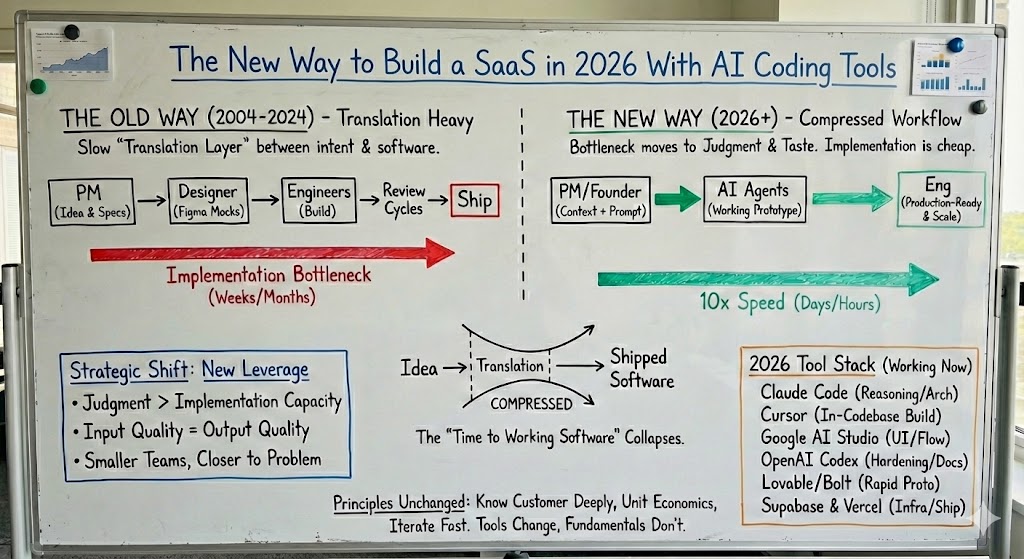
The old product workflow is getting compressed
For the last 20 years, most SaaS product development looked like this:
PM talks to customers → writes a spec → designer builds Figma mocks → review cycles → engineers build → more review cycles → ship.
And it worked. I used that process at iContact when we scaled to $50M ARR—because there wasn’t a real alternative. The bottleneck was implementation. Translating an idea into working software required a chain of specialists and a lot of waiting.
But in 2026, that bottleneck is disappearing.
I read a post from a PM at Google who nailed it: the time between “I know what we should build” and “here it is” has collapsed—but the work of deciding what to build didn’t get easier. It got more important.
That’s the shift: the “translation layer” between intent and working software is compressing. And if your team is still structured around the old translation-heavy workflow, you’re moving slower than you need to.
The new model: the people closest to the problem build the first pass
Here’s the workflow I’m seeing work across the SaaS companies I coach:
The PM (or founder) figures out what to build, builds the first version with AI agents, iterates quickly on real software, then hands it to engineers to make production-ready.
The key isn’t “AI writes code.” The key is that the first iteration happens immediately, without weeks of specs and mock reviews.
Instead of debating mocks, you’re reacting to a working interface. Instead of waiting for engineering just to see if your concept survives reality, you can test it in hours.
One founder in SaasRise told me they basically moved away from Figma. They kept a single UI/UX person who learned the AI tools deeply, and that one person 10x’d the speed of their design process. His words were: “I think this is what every team will look like in the very near future.”
Another member shared something I think a lot of founders will recognize: they built a purpose-designed UX team to rebuild their legacy platform, and product + UX kept deviating, arguing over screen layouts, and spending weeks perfecting Figma specs. So he set aside a weekend, grabbed pizza and Red Bull, and vibe coded a transaction screen in under an hour.
It wasn’t production-ready—but it solved the problem well enough that it forced a better question:
What if we train our people to get world-class at researching ICP pain points and turning those into world-class prompts?
Because the upside is huge: lower “translation payroll,” fewer wasted cycles, and shipping the features that matter faster than ever.
The tools that are actually working right now
Every few years, founders love to argue tools. But what I’m seeing is more consistent than you’d expect: the same names keep showing up across high-performing SaaS teams.
The stack I keep hearing includes Claude Code, Cursor, Google AI Studio, OpenAI Codex, Lovable, Bolt, plus Supabase and Vercel as the infrastructure layer that makes all of this shippable.
Here’s how these tools tend to slot into a modern workflow:
- Claude Code: reasoning + architecture. Great at turning messy context into clean structured code, especially backend logic and multi-step workflows.
- Cursor: building inside the real codebase. It’s the “AI pair programmer” that collapses the gap between idea and production code.
- Google AI Studio: UI and flow generation. Teams paste requirements and get UI layouts + component logic + front-end code, often replacing Figma for early iterations.
- OpenAI Codex: precision inside existing systems—production hardening, tests, edge cases, refactors, docs.
- Lovable: rapid UI prototyping you can click through—real components and flows, not just visuals.
- Bolt: idea → deployed app in a single session (internal tools, MVPs, dashboards, early features).
- Supabase: “default backend” for many AI-built products (auth, DB, row-level security, storage, realtime).
- Vercel: makes shipping feel instant—preview links for every change, rollbacks, fast iteration with real users.
The meta-point: you don’t need to pick a “forever stack” on day one. Many teams bounce between Claude Code, Cursor, AI Studio, Codex, and Bolt depending on the task—while Supabase and Vercel quietly power everything underneath.
But the tool matters less than the muscle.
The new leverage: context + taste beats “implementation capacity”
The workflow that works is simple, but it requires discipline:
Start with a clear problem statement (not a vague idea). Feed the agent real context—who the user is, what “good” looks like, what you’ve tried that failed, and what constraints actually matter. Let the agent build a first pass. Then react, guide, and iterate.
And here’s the part founders miss: output quality is proportional to input quality.
The PMs who are effective with these tools keep lightweight “context docs” they reuse across projects—user descriptions, customer-language problem statements, examples of good output, constraints that matter. When they do that, the output fits shockingly well.
In other words: we’re leaving the era where your competitive advantage is “we can implement faster.” Implementation is getting cheaper.
The scarce resource is becoming judgment—knowing what’s worth building, and having the taste and customer understanding to steer fast iterations toward something valuable.
What this means for team structure
This is where it gets strategic.
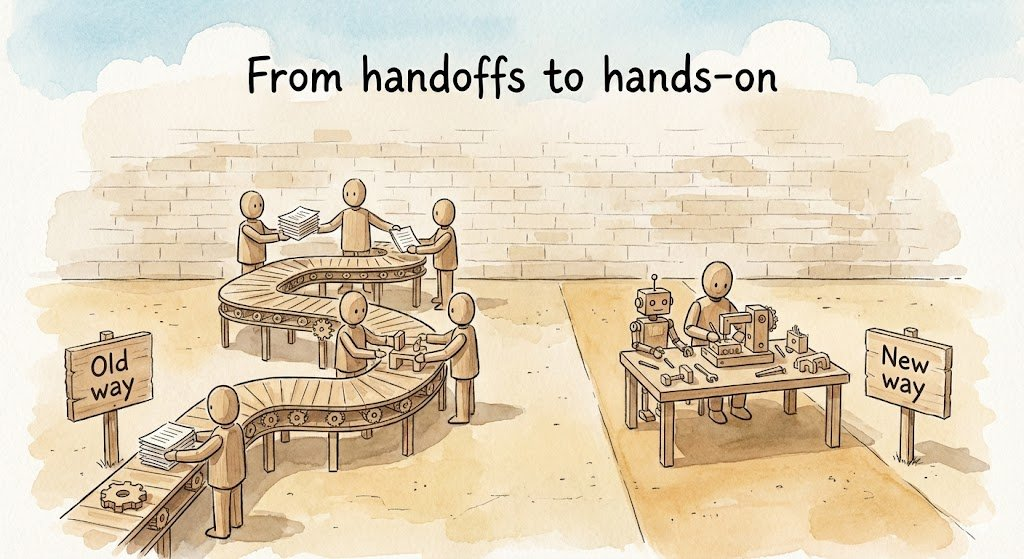
The old model required a lot of people in the translation layer: PMs who write specs, designers who turn specs into mockups, engineers who translate mocks into code, project managers who coordinate the whole thing.
The new model compresses that.
What I’m seeing work is smaller teams where the people closest to the customer problem can build the first iteration of the solution. Your best PMs become more valuable because they can go from insight to prototype in a day. Your engineers become more valuable because they’re focused on production readiness and scalability, not translating someone else’s intent.
And yes—some roles will get squeezed. If someone’s job is mostly translation (turning customer needs into documents for engineers), that’s increasingly a workflow, and workflows are getting automated.
But if someone’s job is deep problem understanding—user empathy, judgment, taste—that person becomes more valuable than ever. Because agents amplify that understanding into shipped product faster than any team ever could before.
How to start without blowing up your org
If you haven’t worked this way yet, don’t start by reorganizing your team. Start by building the muscle.
Pick a small problem you actually have right now—something annoying, tedious, or stuck in backlog. Then spend 30 minutes writing context:
Who is it for? What’s the problem in their words? What does “good” look like? What have you tried that didn’t work? What constraints matter?
Then point an agent at it. Don’t expect perfection. Expect a starting point. React, guide, iterate.
Do that ten times across different problems. You’ll develop intuition for what context matters, how to evaluate output, and where agents are strong vs. where humans need to take the wheel.
That intuition is the new skill.
Zooming out: the tools are changing, the principles aren’t
I’ve been building and coaching SaaS companies for a long time. I’ve seen major shifts—cloud computing, mobile software, subscription models. But this feels different because product cycle times are compressing toward something closer to continuous deployment of ideas.
When the implementation barrier drops this fast, the bottleneck moves upstream. The scarce resource isn’t engineering capacity anymore—it’s knowing what’s worth building.
Which is why the fundamentals still win:
- Understand your unit economics.
- Know your customer deeply.
- Build systems that let you learn fast and iterate.
The tools are changing. The principles aren’t. You still need to solve a real problem for a real market. You still need to acquire customers profitably. You still need a team that can execute.
[Insert Slide from Program Slides here: the “What You’ll Learn / The Five Key Metrics in SaaS” slide(s) — slide number needs confirmation.]
A practical note if you’re trying to implement this as a founder
If you’re a SaaS founder/CEO trying to operationalize this shift (not just “play with tools”), this is exactly the kind of change we talk about inside SaasRise—what’s working across real SaaS companies right now, how teams are restructuring, and how operators are applying these workflows in production.