
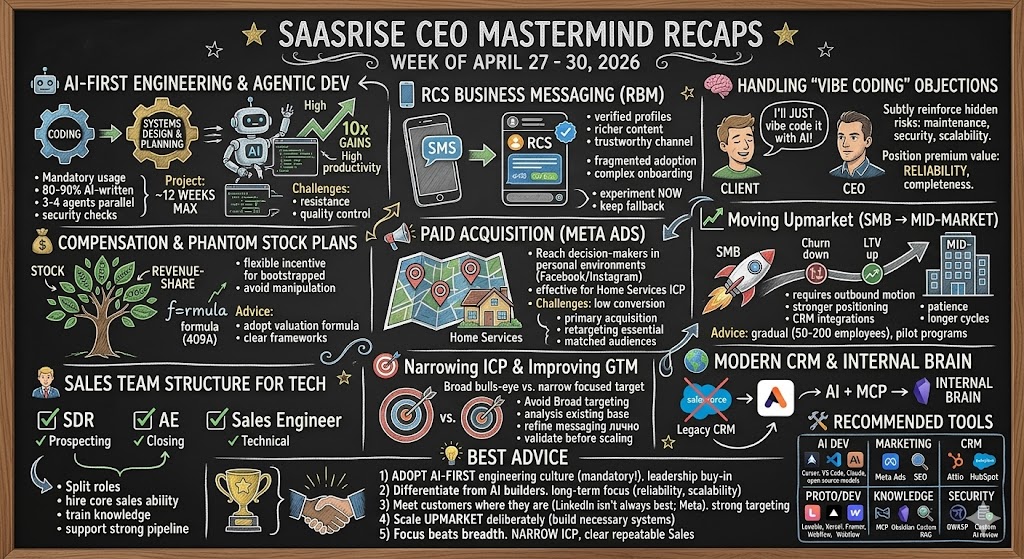
SaasRise CEO Mastermind Recaps for the Week of April 27 - 30, 2026
This week’s SaasRise masterminds covered the shift to AI-first engineering, evolving buyer behavior in the age of AI, and practical strategies for scaling SaaS companies—from improving paid acquisition with Meta ads to moving upmarket and refining ICP focus. The discussions focused on how founders can adapt their product, sales, and engineering strategies to stay competitive as AI reshapes both how software is built and how it is bought.

🤖 AI-First Engineering & Agentic Development
The conversation highlighted a fundamental shift in how engineering teams operate: developers are no longer primarily responsible for writing code, but for designing systems, planning execution, and orchestrating AI agents that generate the majority of the output. High-performing teams are already seeing 10x productivity gains, but only when leadership fully commits to this transition.
Challenges: Many teams are still operating with outdated development timelines (projects taking 6–12+ months), resistance from senior engineers who are slower to adopt AI workflows, and lack of structured processes for managing AI-generated code. There are also concerns around quality control, security vulnerabilities, and over-reliance on “one-shot” outputs that haven’t been properly reviewed.
Advice: AI adoption must be enforced top-down—this is not optional. Teams should make AI usage mandatory, track usage at the individual level, and incentivize top performers. Developers should run multiple agents in parallel (3–4 at a time), with 80–90% of code being AI-generated. The focus should shift heavily toward planning, with detailed instructions that AI executes against. Iteration is critical—code should go through multiple review cycles, including dedicated security checks. Companies should also invest heavily in tokens and build internal knowledge systems to improve context and output quality. Nothing should take more than ~12 weeks to build under this model.
📱 RCS Business Messaging (RBM)
RCS is emerging as the next evolution of business messaging, replacing traditional SMS/MMS with a richer, more branded experience that includes verified profiles, logos, and enhanced interactivity. This creates a more trustworthy and engaging channel for customer communication.
Challenges: Adoption is still fragmented across devices and carriers, making it unreliable as a standalone channel. The onboarding process is also non-trivial, requiring businesses to go through verification steps, complete detailed forms, and invest time and money before going live. Many companies are unsure whether the ROI justifies early adoption.
Advice: Companies should begin experimenting with RCS now to build familiarity and early advantage, but must maintain SMS/MMS fallback systems to ensure full coverage. The expectation is that adoption will increase significantly within the next year, so early movers will benefit from higher engagement rates and less competition in the channel.
🧠 Handling “Vibe Coding” Objections
A growing trend in sales conversations is prospects claiming they can simply “vibe code” a solution themselves using AI tools. This reflects a broader shift in buyer perception, where AI lowers the perceived barrier to building software.
Challenges: This objection can stall deals if handled poorly. Being defensive or dismissive can damage trust, while agreeing too much can undermine the value of the product. It also reflects a real risk: some prospects will attempt to build internally and only return later after failing.
Advice: The recommended approach is to lean into the objection without resistance. Acknowledge their ability to try, wish them success, and leave the door open for future engagement. At the same time, subtly reinforce the hidden complexity—ongoing maintenance, security risks, scalability challenges, and the time cost of building vs buying. For higher-end customers, positioning should shift toward premium value: reliability, completeness, and long-term support. The ultimate goal is to make the product so robust that building internally becomes impractical.
💰 Compensation & Phantom Stock Plans
Phantom stock is increasingly being used by bootstrapped companies as a flexible way to incentivize employees without issuing real equity. It allows team members to benefit from company growth without the legal and structural complexity of traditional stock options.
Challenges: Structuring phantom stock correctly requires careful consideration of valuation methods, payout triggers, and compliance requirements such as 409A valuations. Without clear frameworks, companies risk disputes or misaligned incentives. Profit-sharing models can also be manipulated through accounting decisions.
Advice: Companies should either adopt a consistent valuation formula or conduct regular 409A valuations to ensure fairness and transparency. Managed service providers can help handle administration and reduce complexity. In many cases, revenue-share models are preferred over profit-share to avoid manipulation and create clearer incentives. Phantom stock is particularly well-suited for bootstrapped companies, while venture-backed startups may still benefit more from traditional equity structures.
📣 Paid Acquisition with Meta Ads
For certain ICPs—especially in industries like home services—traditional B2B channels such as LinkedIn are underperforming. Instead, platforms like Facebook and Instagram are proving to be highly effective for reaching decision-makers in their personal environments.
Challenges: Companies struggle with low website traffic, ineffective cold outreach, and poor conversion rates. There is often a lack of understanding of how to properly structure campaigns, target the right audiences, and create messaging that resonates.
Advice: Meta ads should be used as a primary acquisition channel in these cases, starting with small budgets to test performance. Retargeting is essential to capture visitors who don’t convert on the first interaction. Building matched audiences (e.g., lists of business owners) improves targeting accuracy. Messaging should be highly specific to each niche (e.g., roofers, contractors), allowing the algorithm to optimize delivery. Over time, this creates a scalable and predictable lead generation engine.
📈 Moving Upmarket (SMB → Mid-Market)
Many SaaS companies experience strong early traction with SMBs but struggle with high churn and low lifetime value. Moving upmarket is a natural progression, but it introduces new complexities.
Challenges: Mid-market deals involve longer sales cycles, multiple stakeholders, and more rigorous evaluation processes. Companies often lack the outbound systems, positioning, and infrastructure required to compete at this level. There is also uncertainty around how to transition without disrupting existing growth.
Advice: The transition should be gradual, starting with companies in the 50–200 employee range. Outbound (email + LinkedIn) becomes essential for reaching these customers. Messaging must evolve to emphasize scalability, security, and integration capabilities. Integrations with established CRMs (Salesforce, HubSpot, etc.) act as credibility signals. Pilot programs can help generate case studies and testimonials, which are critical for closing larger deals. This approach reduces churn, increases LTV, and creates a more predictable revenue engine.
🌐 AI’s Impact on Buyer Behavior
AI is fundamentally changing how buyers evaluate software. With more tools available and more content being generated, the market is becoming increasingly noisy and harder to navigate.
Challenges: Buyers are overwhelmed with options and often believe they can build solutions themselves. Product relevance cycles are shortening, meaning companies must continuously adapt to stay competitive. Differentiation is becoming more difficult as features are easier to replicate.
Advice: Companies need to shift their messaging away from features and toward outcomes, expertise, and execution. The focus should be on what the customer achieves, not just what the product does. Positioning should also address why building internally is not the best option—highlighting speed, reliability, and long-term support as key differentiators.
🧑💼 Sales Team Structure for Technical Products
Selling technical products requires a different approach to team structure, as it is rare to find individuals who excel at both sales and deep technical understanding.
Challenges: Hiring “full-stack” salespeople often leads to poor performance, especially when the product requires detailed explanations or customization. Companies also struggle to balance inbound conversion with outbound prospecting.
Advice: The most effective approach is to split responsibilities into specialized roles—Account Executives (closing), SDRs (prospecting), and Sales Engineers (technical support). Hiring should prioritize core sales ability, with technical knowledge taught over time. Customer support teams can serve as a strong pipeline for future sales hires, as they already understand the product and customer needs.
🎯 Narrowing ICP & Improving GTM Focus
A common issue across early-stage companies is trying to serve too broad of a market, leading to inconsistent results and high churn.
Challenges: A wide ICP makes it difficult to craft clear messaging, target the right customers, and build a repeatable sales process. It often results in poor conversion rates and wasted resources on unqualified leads.
Advice: Companies should analyze their existing customer base to identify the most successful segments and double down on those. Founders should remain closely involved in sales to refine messaging and understand objections firsthand. Only once there is clear product-market fit within a defined niche should the company scale its sales team and marketing efforts.
🌍 Modern CRM & AI-Powered Internal Systems
There is a growing shift away from legacy CRMs like Salesforce toward more modern, flexible systems that integrate seamlessly with AI tools and workflows.
Challenges: Traditional CRMs are often seen as clunky, difficult to customize, and poorly integrated with other tools. Teams struggle to centralize knowledge and make data easily accessible across the organization.
Advice: Modern CRMs like Attio provide better integration with communication tools (email, meetings) and enable automated data capture (e.g., transcription, notes). When combined with AI tools (like Claude) and protocols like MCP, companies can build internal “brains” that connect CRM data with broader business knowledge. Syncing this data into tools like Obsidian creates a searchable, unified system that improves decision-making and operational efficiency.
💡 Best Advice
Adopt an AI-first culture at the leadership level. Without strong top-down enforcement, teams will default to old habits and miss out on massive productivity gains.
When prospects say they’ll build it themselves, don’t push back aggressively. Let them try, while clearly positioning your product as the more reliable and scalable long-term solution.
Focus your growth efforts on channels where your audience actually spends time. For some industries, Meta ads are significantly more effective than traditional B2B platforms.
Move upmarket in a controlled way, building the necessary systems, positioning, and proof points before attempting to close larger deals.
Narrow your ICP and refine your messaging before scaling. Focus and clarity are what turn early traction into a repeatable growth engine.
🛠️ Recommended Tools
AI Development & Coding
- Cursor
- VS Code
- Claude (Anthropic)
- Open source models (e.g., Kimi)
- Terminal-based AI agents
Marketing & Growth
- Meta Ads (Facebook/Instagram)
- SEO & backlink strategies
- Cold email + LinkedIn outbound
CRM & Sales
- Attio
- Salesforce
- HubSpot
- SugarCRM
- DecileHub
Prototyping & Development
- Lovable
- Vercel
- Framer
- Webflow
Knowledge & AI Infrastructure
- MCP (Model Context Protocol)
- Obsidian
- Custom RAG / vector databases
Security & Code Review
- OWASP agents
- Custom AI review agents
Other Tools
- Stripe
- Workable
- JIRA
- GitHub
- Dropbox