
Managing Price increases for Existing SaaS Customers
A vertical SaaS founder facing a seven-figure gap between two pricing paths walks through the break-even churn math, and what founders across a range of SaaS companies actually do to raise prices without losing customers.

One of the founders in our mastermind group runs a fast-growing SaaS product built for a notoriously high-churn category of small business customers. His team is about to ship its biggest product release yet, and he's using the moment to do something he hasn't done in a year and a half: raise prices. The last increase went out cleanly. No churn worth mentioning, and a meaningful bump in recurring revenue. This one is bigger, a 20 to 30 percent jump depending on the plan, and it's doing double duty. Beyond the extra revenue, he's using it to reposition the whole product further upmarket, targeting bigger companies than the ones who signed up a couple of years ago.
That's the kind of price change that forces a real decision, not a rubber-stamp one. He can move every existing customer straight to the new pricing, which adds the most revenue. Or he can grandfather his installed base into a discounted "loyalty" rate for a year or so while new customers pay full price from day one. The gap between those two paths is not small. Run the math across a customer base like his and you're looking at a difference of roughly two to three million dollars a year. That's a decision worth thirty minutes of real analysis instead of a gut call.
The Math That Should Decide This, Not Fear
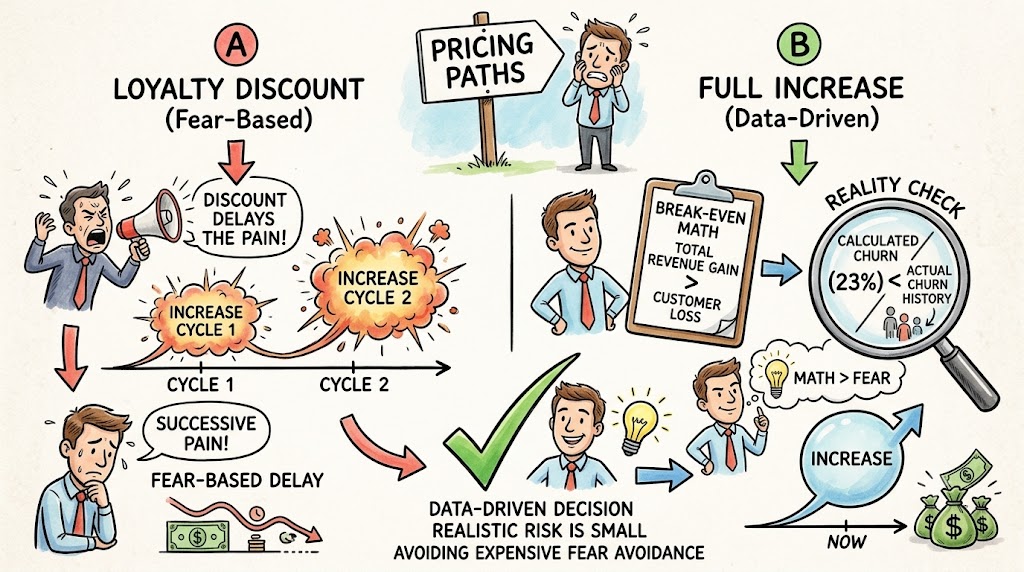
Here's the founder's own admission, and it's a useful one: the loyalty discount he was leaning toward wasn't really about protecting customers. It was about protecting himself from the discomfort of backlash. His marketing team pushed back hard, arguing that a temporary loyalty tier just delays the pain. Existing customers would absorb two price increases in quick succession, this one and then another when the loyalty window closes in a year, instead of one clean adjustment now.
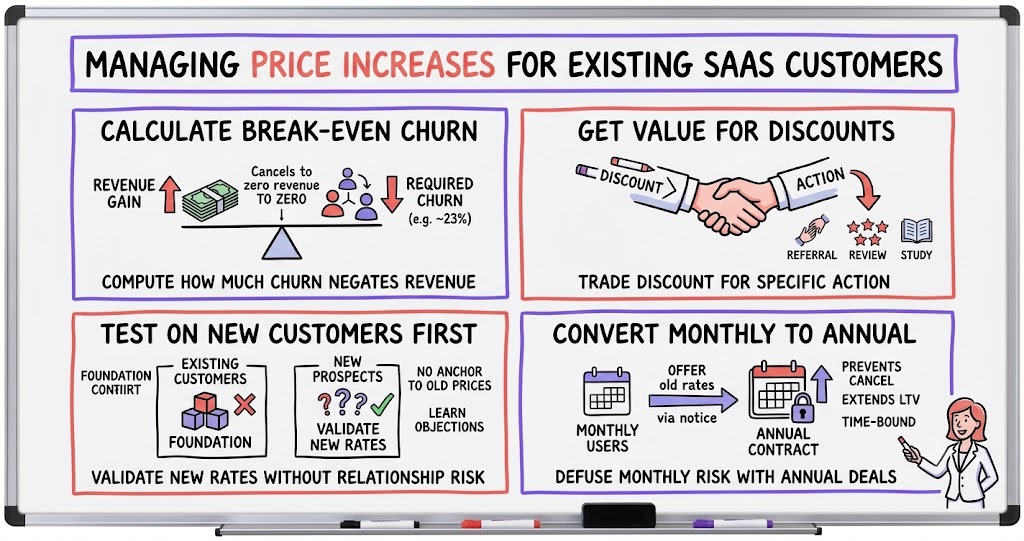
The way to settle an argument like this isn't to keep going back and forth on instinct. It's to run the number that actually tells you how much risk you're carrying: break-even churn. Take your full price increase, calculate how much of your existing base you'd have to lose for the additional revenue to net out to exactly zero, and compare that number to what churn realistically looks like in your business.
- Calculate your break-even churn rate. In this founder's case, the math showed he'd need to lose roughly 23 percent of his existing base for the full-price increase to wash out entirely.
- Compare it to your actual churn history. His monthly churn, even in a famously high-churn category, runs nowhere near that number. The realistic downside was a fraction of the break-even threshold.
- Notice when fear and math disagree. When the numbers say the risk is small and you're still hesitating, that hesitation is fear making the decision, not data.
That gap between what the math says and what your gut says is worth sitting with. It's the clearest signal you'll get that a "safe" choice is really just an expensive way to avoid an uncomfortable conversation.
If You Give a Loyalty Discount, Make Them Earn It
Say the math still points you toward some kind of grandfathering, maybe because your churn history is genuinely uncertain, or your customer base skews more price-sensitive than average. That's a legitimate call. But a loyalty discount handed out for free is just margin you're giving away. One member of the group who has run pricing changes before pushed on this exact point: if you're going to discount, get something in return.
Tie the discounted rate to an action that actually helps your funnel. Ask for a referral. Ask for a five-star review. Ask for a case study you can use in sales. The trade matters, because referrals convert better than almost any other channel most SaaS companies have.
- Trade the discount for a referral. A customer willing to introduce you to another prospect is worth more than the margin you're giving up, especially since referral close rates tend to run far above cold outreach.
- Trade it for a five-star review. Reviews and testimonials compound. One good one keeps working for you long after the loyalty window closes.
- Trade it for a case study. A documented customer story becomes a sales asset your whole team can use, not just a one-time favor to one account.
A discount you exchange for something is a growth lever. A discount you just hand out is a subsidy with no return.

The Size of the Jump Matters More Than the Jump Itself
The percentage matters as much as the fact that a price increase is happening at all. One member of the group who works closely with SaaS companies on retention put it well: an increase in the 20 to 30 percent range hits customers differently than one in the 10 to 15 percent range. It isn't a linear difference in how it feels. Below a certain threshold, most customers barely notice. Above it, especially for small business customers where every dollar is being watched, the increase pinches in a way that triggers real pushback.
That's why several founders in the group have moved away from big, infrequent price resets entirely. Instead, they bake a small increase, often in the 4 to 5 percent range, into every contract renewal. It's small enough that almost nobody complains, and it means they never again face the choice this founder is facing now: a single large jump that forces a binary decision about the entire installed base.
- A small jump barely registers. Increases under roughly 15 percent tend to move through a customer base with minimal friction.
- A large jump forces a decision. Once you cross into 20 to 30 percent territory, you're not adjusting price anymore, you're resetting the relationship, and customers respond accordingly.
- Annual increases prevent the reset. Baking in a modest yearly increase, even just 4 to 5 percent, means you never accumulate the pressure that leads to a single painful jump years later.
If you're planning your next pricing change and you have the choice, smaller and more frequent beats larger and rarer almost every time.
Test on New Customers, Not on Your Foundation
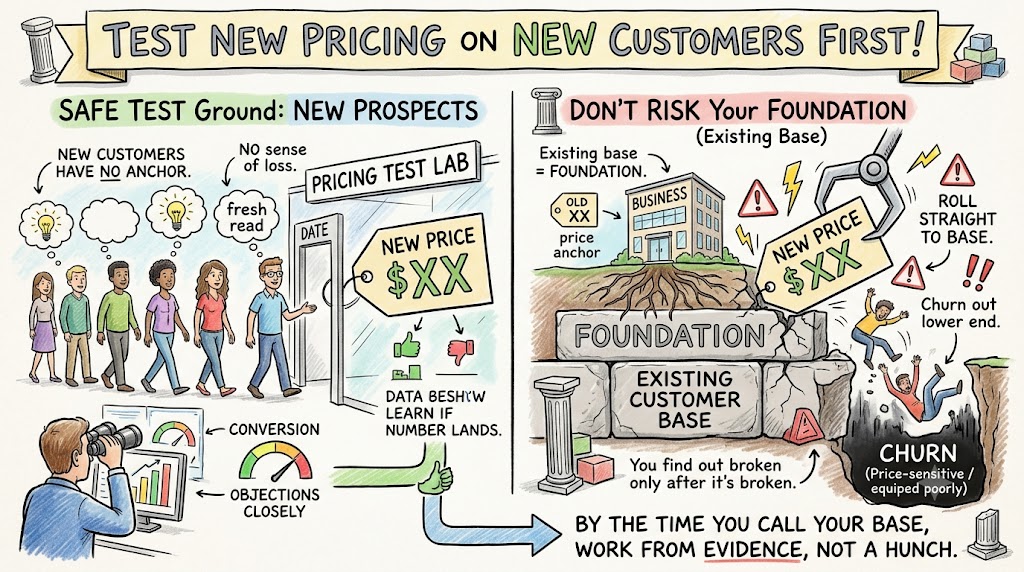
Before touching a single existing account, validate the new pricing with people who have nothing to lose by it, meaning brand new prospects. New customers have no anchor. They've never seen your old price, so there's no sense of loss to react to, only a fresh read on whether the new number feels fair for the value you're delivering.
One founder in the group shared a cautionary story from his own history: a pricing rollout that wasn't properly tested first ended up churning out the lower end of his customer portfolio, the accounts that were most price-sensitive and least equipped to absorb the change. That's the risk of skipping the test phase and rolling a new price straight into your existing base. You find out what breaks only after it's already broken.
- Launch new pricing with new customers first. You'll learn quickly whether the number lands, without risking a single existing relationship.
- Watch conversion and objections closely. If new prospects push back hard or convert at a noticeably lower rate, you have real data before you've touched your foundation.
- Only then decide how to handle existing accounts. By the time you're ready to make the call on your installed base, you're working from evidence instead of a hunch.
Your existing customer base is the foundation the whole business sits on. Test the risky part somewhere else first.
Turn the Price Change Into an Annual Conversion Event
Here's a move that came up repeatedly in the discussion, and it solves two problems at once. Give existing customers real notice, at least 30 days, and let them lock in their old rate, or something close to it, by switching from monthly to an annual plan. One founder who went through this exact transition a year earlier said this was the single thing that made his price increase land well: he used the notice period specifically to convert monthly customers to annual.
This matters because monthly customers are almost always your highest churn risk during any price change. They can leave with the least friction, so they're the ones most likely to bail rather than absorb an increase. Converting them to annual defuses that risk immediately and extends the customer's lifetime value in the same motion.
- Give at least 30 days' notice. Customers need real time to process the change, not a surprise on their next invoice.
- Let them lock in near-old pricing via annual. This gives monthly customers, your highest-risk segment, a clear reason to convert instead of cancel.
- Add a time-bound sweetener. One founder suggested throwing in bonus usage credits or add-ons, available only if the customer upgrades to annual within the notice window, to make the offer concrete instead of abstract.
A price increase framed as "here's how to lock in a better deal by going annual" reads completely differently to a customer than one framed as "your bill is going up." Same underlying event, very different customer experience.
Communication Is the Real Variable
Across the whole discussion, one thread kept surfacing: the founders who raised prices with almost no churn weren't the ones with the smallest increases. They were the ones who communicated well. Enough notice, clear framing of what the customer is actually getting for the new price, and a fallback discount held in reserve, not advertised up front, for the handful of customers who genuinely can't absorb the change.
That last piece matters more than it sounds like. The instinct is to lead with the discount, to soften the blow before anyone even complains. But the smarter sequencing is to let the retention conversation happen at the point where a customer actually tries to cancel, not in the original announcement. That way you're not discounting your entire base preemptively out of fear that some of them might leave.
- Lead with value, not apology. Frame the increase around what's new and improved, not as something to feel bad about.
- Hold your fallback offer in reserve. Save the discount conversation for customers who actually push back at the cancellation point, rather than offering it to everyone up front.
- Remember that high churn cuts both ways. In categories where customers routinely cycle between competitors anyway, anyone who leaves over price and eventually comes back will come back at your new pricing regardless.
The takeaway across all of this is pretty consistent. The instinct to protect existing customers with a loyalty discount usually isn't really about the customers. It's fear wearing a customer-love costume. Run the break-even churn math before you decide anything. Test the new price on people who have nothing to lose. Use the notice period to move monthly customers to annual. And if you do end up grandfathering anyone, make sure they're giving you something back for it.