

If I Started a SaaS in 2026, I’d Do This
If I were starting a SaaS company from scratch in 2026, I wouldn’t be chasing a quick $1M in ARR. I’d be building a system — one designed to scale predictably past $10M, then $50M, and eventually to a real exit outcome.

I’ve seen what happens when founders skip that step. I co-founded iContact, ran it as CEO for 10 years, scaled it to $50M in ARR, and ultimately sold it for $169M. Today, through SaasRise, I work with hundreds of SaaS CEOs between $1M and $100M in ARR, and the patterns are incredibly consistent.
Most SaaS companies don’t fail because the product is bad.
They stall because the growth engine was never built correctly in the first place.
The First Thing I’d Do: Get Obsessively Clear on Unit Economics
If I could only give one piece of advice to a founder starting today, it would be this:
Know your numbers cold before you try to scale.
Almost every SaaS company that gets stuck around $5M–$10M in ARR hits the same invisible wall. Churn creeps up. Growth slows. Marketing feels expensive. And leadership can’t confidently answer one simple question:
“How much can we afford to spend to acquire a customer?”
That’s a unit economics problem.
Before ads. Before outbound. Before hiring SDRs. I’d make sure I had absolute clarity on five core SaaS metrics:
- Customer Acquisition Cost (CAC)
- Average Revenue Per Account (ARPA)
- Monthly Account Churn
- Customer Lifespan
- Lifetime Value (LTV)
These aren’t abstract finance metrics. They’re the foundation of every smart growth decision you’ll ever make.
When you know these numbers, you stop guessing. You stop under-investing in growth. You stop killing channels that actually work just because they feel expensive.
.jpg)
Here’s how I think about it in practice.
If you know your ARPA and your churn, you can calculate your customer lifespan. Multiply ARPA by lifespan, and now you have LTV. From there, your target CAC becomes obvious.
For most healthy SaaS businesses, a 6–9 month CAC payback is a great target. That usually translates to spending about one-sixth of LTV to acquire a customer — sometimes more if you’re venture-backed and pushing growth, sometimes less if you’re optimizing for profitability.
Once you know that number, growth stops being scary. It becomes math.
With the Economics in Place, I’d Build the Growth System
After unit economics, everything else becomes execution.
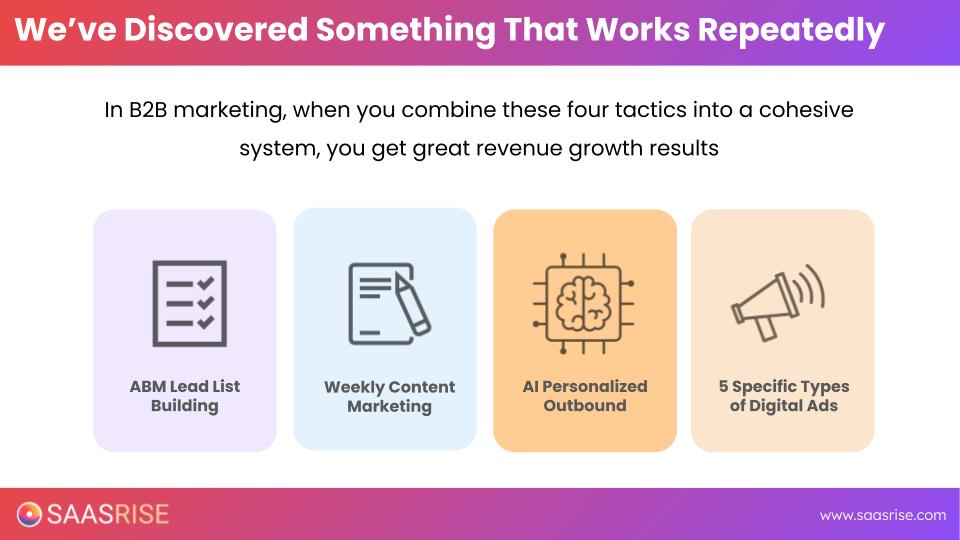
The SaaS growth engine I’d build has three core pillars. I’ve watched this exact system work repeatedly across dozens of B2B SaaS companies — including our own.
Pillar 1: Build a Complete ABM Lead List
The first pillar is audience ownership.
I wouldn’t rely on ad platforms to “figure out” my ICP. I’d define it myself and then build a comprehensive Account-Based Marketing (ABM) list of every company and buyer that fits.
That means:
- Job titles
- Company size
- Industry
- Geography
- Technology signals where relevant
This isn’t a list of a few hundred leads. This is a map of your entire market.
We use tools like Apollo, Instantly, ListKit, and LinkedIn Sales Navigator to do this, but the tools matter far less than the mindset. When you own the list, you control distribution. Everything else plugs into it.
Outbound. Ads. Content. Retargeting. All of it.
Pillar 2: Multi-Channel Outbound + Content Omnipresence
Once the ABM list exists, I’d focus on becoming unavoidable inside that market.
That starts with AI-personalized outbound email. Not spam. Not spray-and-pray. Real personalization that references the person, their role, and what they actually care about.
The goal of outbound isn’t to close deals in the inbox. It’s to identify who is paying attention.
Clicks matter. Engagement matters. Those signals fuel everything else.
From there, I’d layer in LinkedIn outreach to the most engaged prospects — the people who clicked or replied. LinkedIn builds familiarity fast, especially when the message comes from a founder or senior leader.
At the same time, I’d run a simple but consistent content machine.
One high-quality piece of content per week.
That’s it.
A blog post. A video. A webinar. A case study. Something genuinely useful.
That single piece then gets reused everywhere: outbound emails, warm newsletters, LinkedIn posts, retargeting ads, and sales follow-ups.
Over time, this creates something incredibly powerful: brand omnipresence.
Your ICP starts seeing you everywhere — not because you’re loud, but because you’re consistent.
.jpg)
Pillar 3: Paid Ads as the Accelerant
Ads are the nitrous oxide.
They don’t create the engine, but once the engine works, they turn linear growth into exponential growth.
The mistake most founders make is trying to use ads before they know their CAC or before they have demand signals.
I’d do the opposite.
With unit economics locked and outbound + content running, I’d scale paid acquisition scientifically.
There are five ad categories I’d focus on:
- Retargeting ads to site visitors and email clickers
- Matched audience ads using the ABM list
- Lookalike audiences based on customers and engaged leads
- Paid search (brand, competitor, and category terms)
- LinkedIn thought-leader ads promoting content
Some of these campaigns are demand generation. Some are demand capture. I’d track them separately and accept slightly higher CAC on demand gen, knowing it feeds the bottom of the funnel later.
Every week, I’d be looking at CPL, CPQL, and CAC — and only scaling what stays within target.
.jpg)
This Is a System, Not a Growth Hack
Here’s the part most founders don’t want to hear.
You can’t dabble in this.
This isn’t something you “try” for a month. It requires systems thinking, real execution, and a small but focused team.
You need people owning outbound. People owning content. People owning ads. And eventually, sales and customer success teams built to convert and retain the demand you’re creating.
But the payoff is massive.
When this system is working, growth stops feeling chaotic. You’re no longer relying on luck, referrals, or one channel behaving perfectly. You’re running a flywheel.
Your ABM list fuels outbound.
Outbound fuels content engagement.
Content fuels ads.
Ads fuel pipeline.
Pipeline fuels revenue.
Revenue funds more growth.
That’s how you break through the $5M–$10M plateau. That’s how you build a real SaaS company — one that scales predictably and is attractive to buyers.
Final Thought
If I were starting a SaaS in 2026, my goal wouldn’t be to find the next growth hack.
It would be to build a durable, data-driven growth engine — one that works even when I’m not personally pushing every deal across the finish line.
That’s how you go from founder-led hustle to a real asset.
And that’s how you build something worth exiting.
Now go build your system.