

How to Prevent Burn Out as a SaaS CEO
One of our members is having the best year of his company's life and still can't make himself want to walk into the office. Here's what came out of the group when we talked through what actually works to prevent burnout, from delegation to cold plunges to a long vacation.

A member of our enterprise mastermind opened up about something a lot of founders feel but rarely say out loud in a room full of peers. His company is having its best year in five years. Revenue is up twenty-five percent year over year, EBITDA is healthy, he's ready to make strategic hires and place real bets on growth. By every external measure, things are going well. And for the last three months, he's dreaded coming into the office most mornings. Once he's in and talking to a customer or working through a real problem, he loves it, the job, the product, the team. Getting there is the hard part.
That gap between loving the work once you're in it and dreading the walk to your desk is one of the clearest signs of burnout there is, and it's sneaky precisely because it doesn't show up in the numbers. The business can be thriving, the pipeline growing, and the team performing well above plan, while the person running all of it is quietly running on empty underneath the good results. What followed in the group was a genuinely useful back-and-forth about what actually helps, not platitudes about work-life balance, but specific things people have tried that made a measurable difference.
- Good numbers can mask a tired founder. Growth, margin, and team performance don't tell you anything about the person's actual energy level.
- The dread shows up at the threshold, not in the work. Plenty of burned-out founders still love the actual job once they're in a meeting; it's the getting there that's broken.
- The fixes below are specific, not generic. Not "find balance," but concrete things real founders in the group have actually tried and measured results from.
Benefits of an EA and Delegation
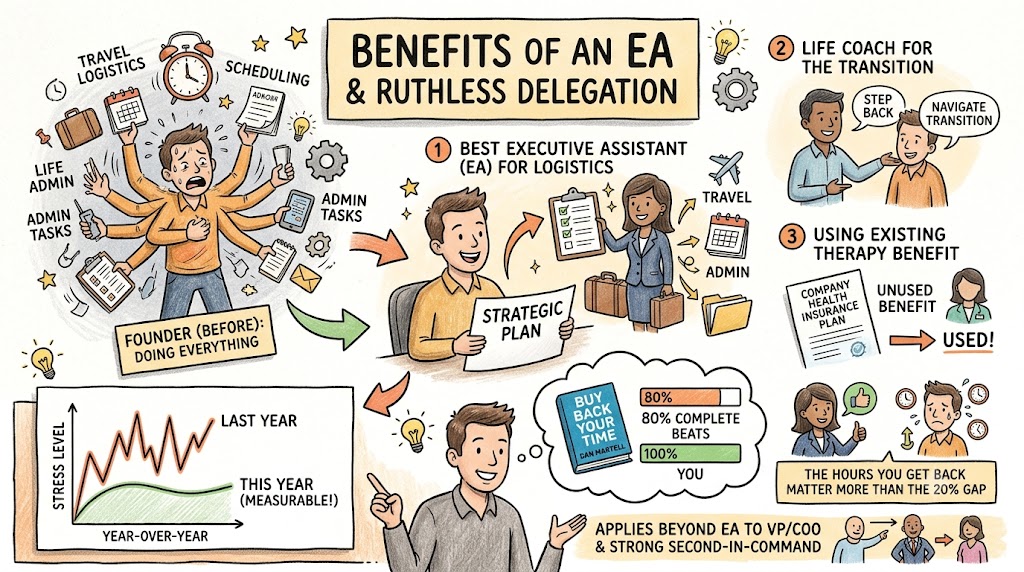
One member raised this exact question with the group about a year earlier, and the changes he made since then have visibly paid off. He hired the best executive assistant he could find and, in his own words, started ruthlessly dumping things on her, travel logistics, life administration, the dozens of small tasks that eat a founder's attention without ever showing up on a strategic plan. On top of that, he brought in a life coach specifically to help him navigate the transition out of doing everything himself, and started using the therapy benefit already sitting inside his own company's health insurance plan, something he half-joked about triple-dipping on. A year later, he reported feeling genuinely less stressed than he was at this same point the previous year.
- An executive assistant for logistics. Travel, scheduling, and life administration handed off entirely, not just delegated in theory.
- A life coach for the transition itself. Someone whose whole job is helping him navigate stepping back from doing everything himself.
- An existing benefit he wasn't using. Therapy coverage that was already sitting inside his own company's health plan, unused until he decided to use it.
- A year-over-year comparison, not just a vibe. He could point to feeling measurably less stressed at the same point this year versus last.
There's a useful mental model behind this that another member brought up, from Dan Martell's book Buy Back Your Time: if you can get someone else to do a task at eighty percent of your own quality bar, that's a full one hundred percent win for you, because the twenty percent gap almost never matters as much as the hours you get back.
- 80% from someone else beats 100% from you. The quality gap rarely matters as much as the hours you get back by not doing it yourself.
- It applies beyond an EA. A strong second-in-command, a COO or executive VP, lets you step back from what's wearing you down without losing control of the company.
Benefits of Cold Plunging and Working Out
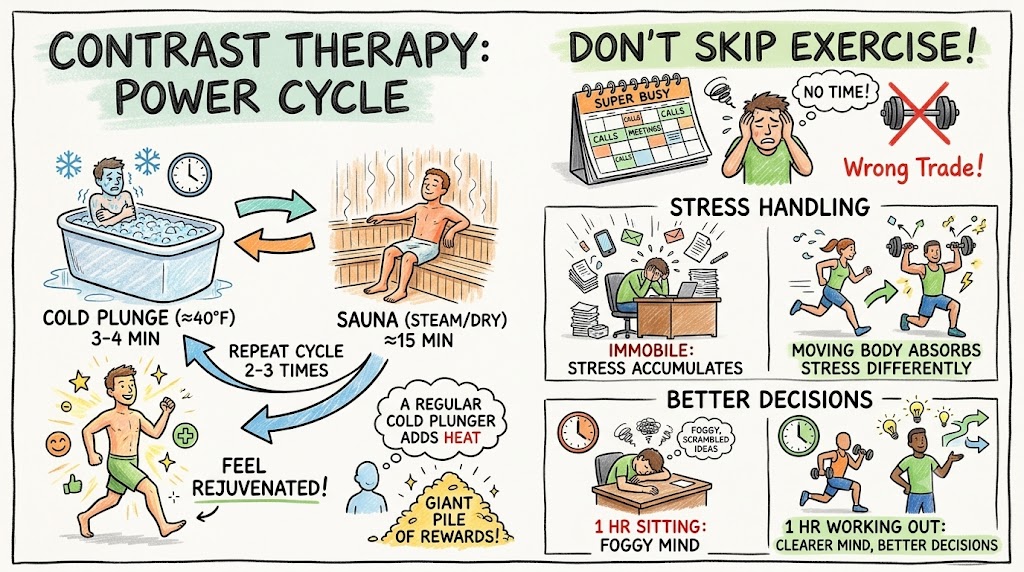
My own routine centers on contrast therapy, and it's simple enough that anyone can start this week. Three to four minutes in a cold plunge around forty degrees, followed by roughly fifteen minutes in a steam or dry sauna, cycling back and forth two or three times. It sounds almost too simple to matter, but the physiological effect of that repeated contrast between cold and heat is real, and you come out the other side feeling noticeably better than when you went in. One member who already does cold plunges regularly, especially given how much sport he plays, hadn't paired it with heat yet, and picking that up is a small change with an outsized return.
- The routine itself. Three to four minutes around forty degrees in the cold plunge, then about fifteen minutes in a steam or dry sauna.
- Repeat the cycle. Go back and forth between cold and heat two or three times in a single session.
- Pair what you're already doing. A member already doing cold plunges regularly hadn't added the heat side yet, a small addition with an outsized payoff.
Working out matters here for reasons beyond the physical. Founders who are burning out tend to cut exercise first, exactly when they need it most, because it feels like the easiest thing to sacrifice when the calendar gets tight. It's almost always the wrong trade.
- Exercise is usually the first thing cut, and shouldn't be. It feels like the easiest sacrifice when the calendar tightens, which is exactly backwards.
- A moving body handles stress differently. Regular exercise changes how you absorb three straight months of back-to-back calls.
- An hour of effort buys a better afternoon. The return on decision-making quality usually beats the hour spent sitting at a desk instead.
Benefits of a Weekly Massage to Stress Reduction
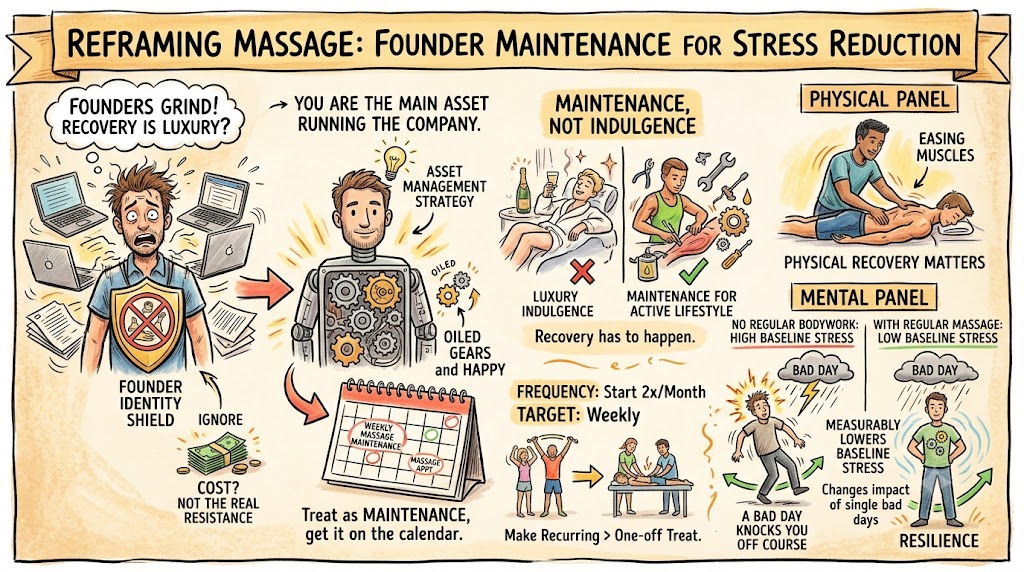
When one member heard a suggestion about getting a ninety-minute massage every week, his first reaction was that it sounded like a luxury he wasn't sure he could associate himself with. That reaction is common and worth pushing back on directly. Another founder in the group, who plays a lot of sports himself, was clear that this isn't indulgence, it's maintenance, and recommended it at a minimum of twice a month if weekly feels like too much of a stretch at first. The physical recovery matters if you're active at all, but the effect on your mental state is just as real. Regular bodywork measurably lowers the baseline stress you're walking around with, which changes how much any single bad day actually knocks you off course.
- Start at twice a month if weekly feels like too much. The frequency matters less than making it recurring rather than a one-off treat.
- It's maintenance, not indulgence. Especially relevant if you're physically active at all; the recovery work has to happen somewhere.
- The mental effect is separate from the physical one. Lowering your baseline stress level changes how much any single bad day can knock you off course.
The resistance founders feel to this kind of recurring self-care usually isn't about the money. Most of the people in this room could easily afford a weekly massage without noticing the expense.
- The real resistance is identity, not cost. A nagging sense that founders are supposed to be the ones grinding, not booking recovery time like a real appointment.
- Reframing fixes the identity problem. Treating it as maintenance for the asset that runs the entire company, you, tends to be what actually gets it onto the calendar and keeps it there.
Benefits of a Long Vacation
A real vacation matters here too, but it comes with an honest caveat worth naming. One member described taking a short weekend away with his spouse and feeling good for about two days before the old exhaustion crept back in. A short trip resets you briefly. It doesn't fix a burnout pattern that's been building for months, because you come back to the exact same inbox and the exact same pace waiting for you. A different member is planning a longer trip in January specifically because he doesn't expect this intense stretch to ease up before the end of the year, and he's treating the trip as a deliberate, planned recovery period rather than something squeezed in between two intense sprints.
- Length matters more than people assume. A weekend resets you for a couple of days. A real break, a week or more, gives your nervous system time to actually downshift instead of staying braced for the next fire.
- Plan it in advance, not reactively. Waiting until you're already depleted to book time off means you're recovering from a hole instead of preventing one.
- Bring the people who matter, not just your laptop. One founder mentioned trying to travel with family to make work trips double as connection time, a workaround worth borrowing even on a business trip.
- A long vacation only works if delegation already exists. None of this holds up if there's no one covering for you while you're gone, which is why the EA and second-in-command conversation comes first.
There's also a deeper question sitting underneath all of this that's worth asking honestly rather than papering over with a better recovery routine. One member is genuinely considering hiring a CEO to run day-to-day operations and shifting himself into a chief strategy role, something closer to three or four working days a week instead of the grind he's been running. He's been married thirty years, and by his own admission his wife has waited patiently through a long stretch of that marriage while the business came first. That's not a decision any recovery routine solves. Cold plunges and massages help you survive the current season. They don't answer whether the season itself needs to change shape.
- Recovery routines treat the symptom. Cold plunges, massage, and vacations make the current season survivable, but they don't touch the underlying structure.
- The real question is often structural. Whether the role itself, founder and operator combined, still fits at this stage of the company and this stage of life.
- The people around you are paying a cost too. A spouse or family absorbing years of the business coming first is part of the real calculus, not a side note to it.
I wrote a whole chapter on burnout in the book that just came out this week, largely because I burned myself out badly after my first company and again after the one I started right after it. It took me roughly a decade of real trial and error to figure out how to build a life that actually felt good instead of one that just looked successful from the outside. The honest answer is that there's no single fix, it's a combination of things working together.
- Delegation that actually frees up real hours. An EA, a coach, a strong second-in-command, whatever gets genuine tasks off your plate rather than just off your to-do list.
- Physical practices that change your baseline day to day. Cold plunging, sauna, and regular exercise, done consistently rather than as an occasional reward.
- Recovery habits that lower the stress you carry at all times. Weekly or biweekly massage, or whatever equivalent keeps your baseline tension from compounding.
- Long breaks planned far enough in advance. Real time away, scheduled before you're depleted, so you're preventing burnout instead of just patching it.
Put those four things together and you have something close to a real system, not just good intentions that fall apart the first busy quarter. Delegation without recovery habits just frees up hours you'll fill with more work, and recovery habits without delegation are a bandage on a schedule that's still too full. The founders who felt genuinely better a year later stacked more than one of these at once, not just a single fix carrying the whole load.