
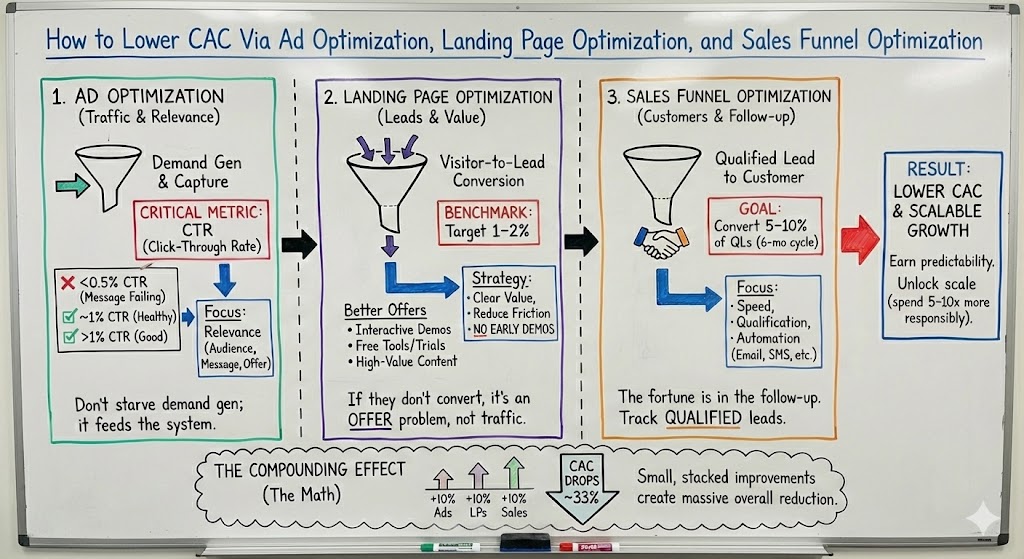
How to Lower CAC Via Ad Optimization, Landing Page Optimization, and Sales Funnel Optimization
A step-by-step breakdown of how to systematically lower customer acquisition cost by optimizing ads, landing pages, and sales follow-up together—so growth becomes predictable instead of painful.

If there’s one metric that quietly determines whether your SaaS company can scale—or stays stuck—it’s customer acquisition cost.
High CAC doesn’t usually come from one catastrophic mistake. It comes from a series of small inefficiencies stacked on top of each other: slightly weak ads, slightly confusing landing pages, slightly slow follow-up, slightly leaky sales handoffs.
The good news is that CAC works the same way in reverse.
As I told the group in our CRO session, “Conversion rate optimization is the practice of optimizing each step of the funnel just a little bit each month in order to achieve a big overall reduction in CAC.” That’s not theory. That’s math.
Let’s walk through how to do that across three areas that matter most: ads, landing pages, and the sales funnel itself.
Why CAC Is a System Problem (Not a Channel Problem)
When founders complain about CAC, they usually point at the channel.
“LinkedIn is too expensive.”
“Google search doesn’t work for us.”
“Meta leads are low quality.”
In almost every case, the channel isn’t the root cause. The funnel is.
.jpg)
I said this early in the webinar because it reframes everything: “If your cost per lead is too high right now, that’s okay—because what we’re going to show you is how to get that down by about seventy-five percent by optimizing every step of the funnel.”
Lowering CAC isn’t about finding a magic ad or a secret platform. It’s about tightening the system end to end.
Part 1: Lowering CAC Through Ad Optimization
Ad optimization starts before you ever look at CPL.
The first metric I care about is click-through rate. CTR is the tax you pay to enter the funnel. If it’s low, everything downstream gets more expensive.
As a rule of thumb:
- Below 0.5% CTR → your message isn’t landing
- Around 1% → you’re in a healthy range
- Above 1% → you’re doing something right
Ad optimization is primarily about relevance. Audience, message, and offer have to line up.
One thing I emphasize repeatedly is separating demand generation from demand capture. Retargeting and search will always look cheaper. Matched audiences and display usually won’t—but they’re feeding the system.
As I explained, “If you turn off demand gen because the CPL looks higher, you eventually starve demand capture downstream.” That mistake alone inflates CAC over time.
The goal with ads isn’t just cheap clicks. It’s qualified, scalable attention that feeds the rest of the funnel.
Part 2: Lowering CAC Through Landing Page Optimization
.jpg)
Landing pages are where CAC is either rescued or destroyed.
If your ads are working but leads aren’t coming in, the math is simple: traffic is arriving, but value isn’t clear enough to earn the next step.
The benchmark I use across B2B SaaS is straightforward: 1–2% visitor-to-lead conversion. Below that, you’re leaking money.
And when it’s really broken, it’s obvious. I said this very directly in the session: “If two hundred people in your market land on your page and not a single one wants what you’re offering, you don’t have a traffic problem—you have an offer problem.”
.jpg)
Early-funnel traffic should not be pushed into demos. That alone drives CAC through the roof.
Instead, high-performing funnels offer:
- Recorded demos
- Interactive demos
- Free tools or audits
- High-value reports or guides
- Free trials or limited accounts
As I told the group, “For marketing traffic, free trials, interactive demos, and high-value content convert far better than booking a sales call. People don’t book demos until they’re about ninety percent ready to buy.”
Remove navigation. Reduce friction. Make the value unmistakable above the fold. Landing page optimization is often the fastest way to cut CPL in half—without spending another dollar on ads.
Part 3: Lowering CAC Through Sales Funnel Optimization
This is the part most marketing teams don’t own—but it has massive CAC impact.
You can generate great leads and still have terrible CAC if:
- Follow-up is slow
- Sales doesn’t qualify consistently
- Leads fall into a black hole after the form fill
CAC is ultimately spend divided by customers—not leads.
That’s why I strongly encourage teams to track qualified leads, not just raw leads. Sales acceptance matters.
As I shared on the call, “If you can’t convert at least five to ten percent of your qualified leads into customers over a six-month sales cycle, something is broken in your follow-up or sales system.”
.jpg)
This is where automation, SDR discipline, and indoctrination sequences matter. Email alone isn’t enough. SMS, voicemail, WhatsApp, and retargeting all play a role.
And it bears repeating: “The fortune is in the follow-up.”
When follow-up improves, CAC drops—even if your CPL stays the same.
The Compounding Effect That Changes Everything
Here’s where this gets powerful.
Most founders try to fix CAC by attacking one piece of the funnel. That rarely works. The real leverage comes from compounding improvements.
We walked through the math live, and it always surprises people. “If you improve each step of the funnel by just ten percent, your CAC drops by about thirty-three percent.” Push each lever by twenty-five percent, and CAC falls by more than sixty percent.
None of those improvements sound dramatic on their own:
- Slightly better ads
- Slightly clearer landing page
- Slightly faster follow-up
- Slightly better sales qualification
But together, they change the entire growth equation.
Why Lower CAC Unlocks Scale (Not Just Efficiency)
Lower CAC isn’t the end goal. It’s the permission slip.
When your funnel is optimized, you’re no longer asking, “Should we spend more?” You’re asking, “How fast can we responsibly scale?”
That’s why I emphasize this point so often: “An optimized funnel doesn’t just spend two times more—it can spend five to ten times more within the same target CAC.”
This is how companies move from dabbling in ads to confidently deploying $50k, $100k, or $200k per month. Not by gambling—but by earning predictability.
The Real Playbook for Lowering CAC
Lowering CAC is not about hacks. It’s about ownership.
Own your ads by improving relevance.
Own your landing pages by earning the click.
Own your sales funnel by tightening follow-up and qualification.
When all three improve together, CAC drops naturally—and growth becomes something you can actually plan around.
That’s the difference between hoping ads work and building a system that scales.