
How to Implement EOS in SaaS: How SaaS Founders Actually Make the Entrepreneurial Operating System Work (and Where It Breaks)
EOS has quietly become one of the most widely adopted operating systems for growing companies. If you’re running a SaaS company with anywhere from 10 to a couple hundred employees, there’s a good chance someone on your leadership team has already handed you Traction and said, “We should do this.” And in many cases, they’re probably right.

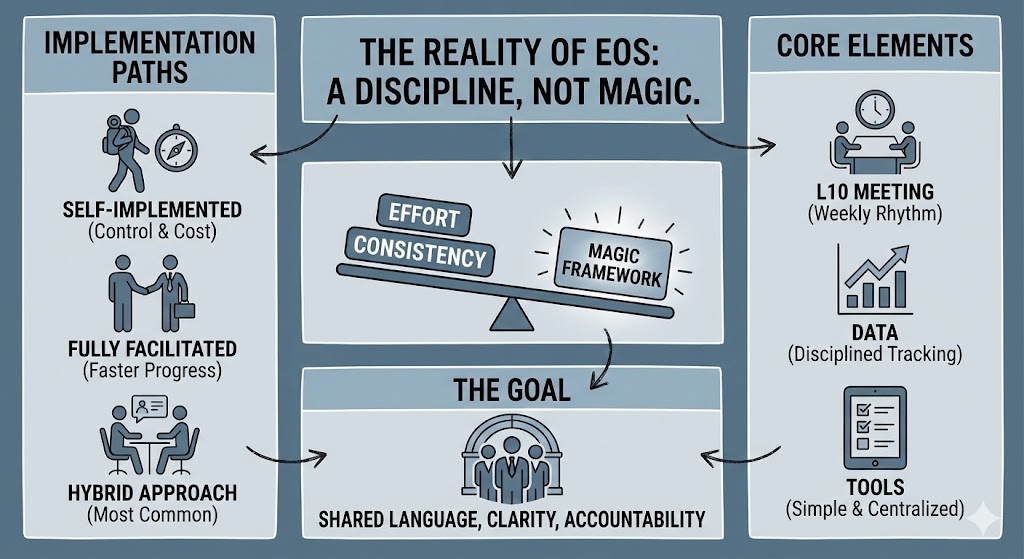
What tends to get lost, though, is that EOS isn’t some magic framework that fixes broken companies. It’s a discipline. And like most disciplines, the results depend far more on how you practice it than on the system itself.
I recently spent time with a group of founders and operators who have been running EOS anywhere from one year to eight years. Some implemented it entirely on their own. Some hired facilitators for years. Others landed somewhere in between. What came out of that conversation was a much more honest picture of EOS than you usually hear from books or consultants.
This post is about that reality — how EOS actually gets used, what works, where it helps, and where it can quietly wear you down if you’re not thoughtful about how you run it.
What EOS Really Is (and What It Isn’t)
At its core, EOS — the Entrepreneurial Operating System — is a business management framework. It gives leadership teams a shared language and a set of rhythms for running the company with more clarity and accountability.
EOS focuses on things like where you’re going, who owns what, how you measure progress, how issues get surfaced, and how decisions actually get made. It doesn’t try to tell you what your strategy should be or what product you should build. Instead, it creates a structure that forces you to confront reality on a regular basis.
That distinction matters. EOS won’t fix a bad strategy or make hard leadership conversations disappear. What it will do is make it much harder to ignore problems once the system is running consistently.
The Three Ways EOS Shows Up in the Wild
In theory, EOS looks clean and prescriptive. In practice, founders adapt it to their personalities, teams, and tolerance for operational overhead. Most companies I see fall into one of three implementation patterns.
Self-Implementing EOS: Control Comes With a Cost
Some founders choose to run EOS entirely on their own. No facilitator, no external pressure, just internal discipline. This can work surprisingly well, especially if the leadership team is already aligned and comfortable with accountability.
One SaasRise member shared their experience after years of doing it this way:
“We've been using EOS for about 8 years, something I self-implemented. Starting to get a little fatigued running the L10 meetings, looking to bring in some outside help.”
That sense of fatigue is common. When you self-implement EOS, the founder or operator often becomes the person who runs the meetings, enforces the rules, tracks accountability, and pushes the team when things slip. Over time, that can feel less like leadership and more like refereeing.
Self-implementation saves money and gives you control, but it does require real stamina.
Fully Facilitated EOS: Faster Progress, External Accountability
At the other end of the spectrum is working with a professional EOS implementer. This is the version where someone external helps install the system, runs key meetings, and holds the leadership team accountable to the process.
For teams newer to EOS, this can dramatically accelerate adoption. One founder described it this way:
“We're only one year into EOS. We did use a facilitator who met with me and my COO. For us, it's been helpful. I feel like we wouldn't have gotten this far with EOS this fast if we didn't have someone cracking the whip and coaching us.”
Another added context on cost and value:
“We pay them $7,000 day rate, so once a quarter we pay him $7,000. All throughout the quarter, he's there for emails back and forth and phone calls. I think of it as coaching for my COO.”
That framing is important. For many companies, the value of a facilitator isn’t really about EOS mechanics. It’s about having an experienced operator who pushes the leadership team to stick with the discipline when it gets uncomfortable or inconvenient.
The Hybrid Approach: Where Most Teams Land
The most common pattern I see, and the one that often works best, is a hybrid approach. Teams bring in a facilitator for six months to a year to get the system installed properly, then transition to running EOS internally once the rhythms are established.
As one founder put it:
“About 2 years. We don't follow it exactly how the book says you're supposed to do it. The most important thing is the weekly L10 meeting and the quarterly rocks. That's where we get the most value from.”
That’s a useful reminder that EOS doesn’t need to be followed perfectly to be effective. What matters most is consistency around the core practices, especially the weekly meeting cadence and quarterly priorities.
The L10 Meeting Is Where EOS Lives
If you strip EOS down to its essentials, everything really revolves around the weekly Level 10 meeting. This is where accountability shows up, issues get surfaced, and decisions actually happen.
Most teams eventually converge on a similar setup. Meetings tend to work best with five to eight people and a hard 90-minute time box. One operator described their current rhythm like this:
“We have about 8 people in the meeting. We got it down to about 90 minutes a week.”
The power of the L10 isn’t the agenda itself. It’s the predictability. When people know that metrics will be reviewed every week and issues won’t be brushed aside, behavior changes. Problems surface earlier, and conversations get more honest.
Data: The Quiet Backbone of EOS
One of the most underrated parts of EOS is how it forces teams to engage with data in a disciplined way. Not vanity metrics, but a small set of numbers that actually reflect how the business is performing.
One team shared a simple but effective approach:
“We have one person in our team responsible for all the data gathering. We hold them accountable for that number, but they're not responsible for inputting the data.”
That distinction matters. The person who owns a number needs to trust it and explain it, but they shouldn’t be stuck manually collecting data every week. When the data is reliable, meetings stop devolving into debates about accuracy and instead focus on what the numbers are telling you.
Some companies track a dozen metrics. Others track hundreds across departments. The exact count isn’t as important as having clear ownership and a shared understanding of what good looks like.
Tools Matter Less Than Discipline
EOS has its own official software, Ninety, and some teams use it happily. Many others don’t. In practice, I see a lot of EOS teams running their entire system on Google Docs, Google Sheets, or tools like ClickUp.
What they all have in common is simplicity. One centralized scorecard. Clear rocks. A place to track to-dos. The system works when leaders show up prepared and treat the meetings as non-negotiable.
No tool will save EOS if the leadership team stops taking it seriously.
Scaling EOS Beyond the Exec Team
EOS isn’t limited to small teams. One founder described running EOS in a roughly 95-person company, with 20 to 30 managers participating through layered L10 meetings. There’s typically one executive L10 and several departmental L10s, each kept intentionally small.
This layered approach allows EOS to scale without turning meetings into chaos. The key is keeping accountability clear and resisting the urge to overcomplicate the structure.
Where EOS Helps — and Where It Can Struggle
EOS tends to shine in organizations where accountability is fuzzy, priorities shift too often, or meetings feel unproductive. It gives teams a shared operating rhythm and makes it harder for important issues to fall through the cracks.
Where EOS struggles is in companies where leadership avoids conflict or treats the process as optional. If people aren’t willing to surface real issues or own their numbers, EOS won’t magically fix that. Instead, it tends to make the gaps more visible, which can be uncomfortable but ultimately useful.
The Founder’s Role Matters More Than You Think
One mistake I see often is founders delegating EOS entirely to their COO and mentally checking out. That almost never works long-term.
EOS works best when the founder is engaged, participates honestly, and is willing to be held accountable alongside everyone else. When the founder treats EOS as “the operations thing,” the system loses credibility fast.
EOS isn’t about control. It’s about shared discipline.
Is EOS Worth It?
For companies in the 10 to 250 employee range, EOS can be incredibly effective if you’re willing to commit to the rhythm. It doesn’t require perfection. It does require consistency.
You don’t need flawless scorecards or textbook meetings. You need weekly cadence, clear quarterly priorities, and real issue-solving.
If you’re willing to do that, EOS can quietly transform how your company runs over time.
The Bigger Takeaway
EOS isn’t exciting. It’s repetitive. It’s structured. And that’s exactly why it works.
In a world full of shiny new frameworks and management trends, EOS succeeds by doing something unglamorous: forcing leadership teams to show up every week and deal with reality.
For many founders, that discipline becomes a real competitive advantage.