
How to Actually Do SEO in 2026
A founder-focused playbook for modern SEO that goes beyond “rank on Google,” covering how to win in both traditional search and AI answer engines through on-site fundamentals, programmatic SEO, backlinks, reviews, and consistent execution over 6–12 months.

If you’ve been building SaaS for a while, you’ve probably lived some version of this cycle.
At some point you decide, “we should really invest in SEO.” You hire a consultant or agency, things kick off with optimism, and for a few months you check traffic more often than you should. Progress is slow, results feel abstract, and eventually patience runs out. SEO gets deprioritized in favor of paid and outbound, where results feel more immediate and controllable.
.jpg)
I hear this story constantly from founders, and I’ve lived versions of it myself.
One CEO in our mastermind summed it up more honestly than most people would in public. He said he’d been “allergic to SEO” his entire career—bringing in consultants, giving it a few months, losing patience, and shutting things down before anything had time to compound. What he was really asking wasn’t how to try SEO again, but how to build a system that could keep running even when it felt boring.
That framing matters, because the real challenge with SEO has never been knowing what to do. It’s sticking with it long enough for compounding to show up.
And in 2026, that challenge matters even more, because what we casually call “SEO” has expanded far beyond ranking blog posts in Google.
The 2026 Mental Model: Discovery, Not Just Search
The biggest shift founders need to internalize is that we’re no longer optimizing for search engines alone. We’re optimizing for discovery across multiple surfaces that influence how buyers research and make decisions.
Today, that includes:
- Traditional search engines like Google and Bing
- AI answer engines like ChatGPT, Perplexity, and Gemini
- Community platforms where real discussions happen
- High-authority third-party sites buyers already trust
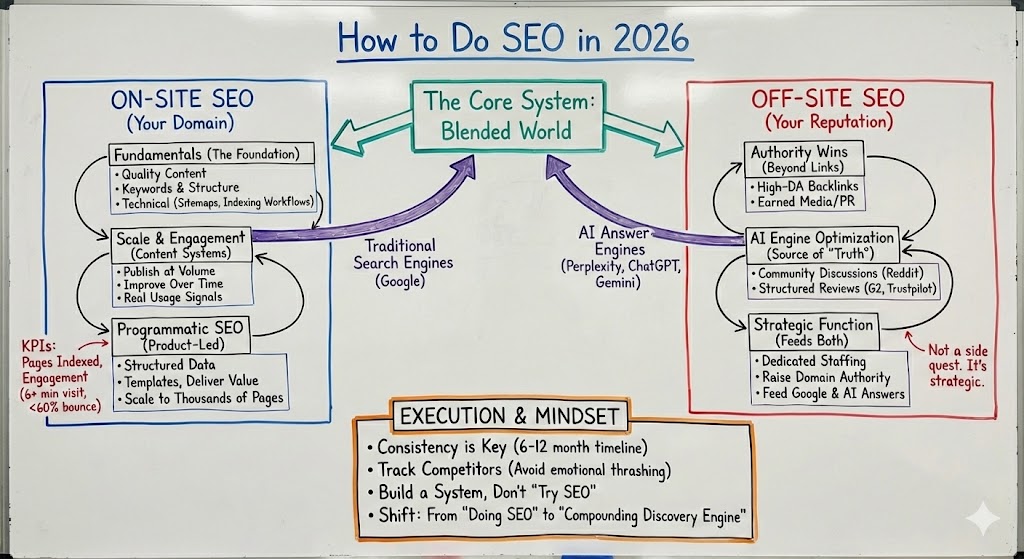
The way I’ve found it most useful to think about this is along two axes:
- Search engines vs. answer engines
- On-site vs. off-site
On-site is everything you control on your own domain. Off-site is everything that builds authority, reputation, and visibility elsewhere.
You can lean into one quadrant first, but you can’t ignore the others indefinitely. Teams that only focus on on-site work tend to plateau. Teams that chase backlinks without fixing fundamentals leak value. Teams that ignore AI answer engines slowly disappear from how modern buyers research software.
The teams that win in 2026 understand that all four quadrants reinforce each other.
On-Site SEO in 2026: Fundamentals, Scale, and Engagement
On-site SEO still isn’t glamorous, and that hasn’t changed. The fundamentals remain the fundamentals:
- Content quality and intent alignment
- Keyword coverage and logical structure
- Titles, headers, and internal linking
- Clean site architecture, sitemaps, and indexing workflows
What has changed is the importance of scale and consistency. The companies seeing meaningful results aren’t publishing a handful of thoughtful posts and hoping Google rewards them. They’re building content systems that publish continuously, improve over time, and generate real usage data that search engines and answer engines can trust.
One mindset shift that’s been helpful for me is to stop optimizing for “pages published” and start optimizing for:
- Pages indexed
- Pages actually read
- Pages that satisfy user intent
When you treat engagement as a first-class metric, especially in programmatic SEO, the picture becomes much clearer. With a solid technical foundation, it’s reasonable to expect a meaningful percentage of pages to get indexed within weeks rather than months. Once traffic starts flowing, metrics like visit duration, pages per session, and bounce rate tell you whether the system is creating real value or just producing noise.
.jpg)
Programmatic SEO: Build It Like a Product, Not a Blog
Programmatic SEO still makes some founders uneasy because it used to be synonymous with thin, spammy pages. That reputation came from teams treating it like a shortcut instead of a product.
When it’s done well, modern programmatic SEO looks much closer to product-led publishing:
- You start with structured data
- You design templates that deliver real value
- You scale those templates across thousands of pages
- You continuously improve based on real usage signals
We shared Pulse as a concrete example in our mastermind, not because it’s something others should copy directly, but because it shows what’s possible now. Pulse was built over roughly six months using an AI-assisted workflow. We generated around 40,000 pages automatically and have seen roughly 12,800 indexed so far. Early engagement has been strong for a new programmatic site, with multi-minute visit durations, multiple pages per visit, and reasonable bounce rates.
The takeaway isn’t the specifics of Pulse. It’s that in 2026, you can build a compounding discovery asset far faster than you could a few years ago, but only if you design it as a system instead of a one-off content sprint.
Studying other large programmatic plays reinforces this. Sites like Ainvest fundamentally change how you think about opportunity size once you see how hungry AI engines are for structured, authoritative, indexable content.
Off-Site SEO in 2026: Authority Is the Real Moat
If on-site SEO is your engine, off-site SEO is your reputation. That reputation determines whether you can rank in competitive spaces and whether AI models will cite you as a source.
Off-site SEO is broader than backlinks alone, but backlinks still matter a great deal. In the mastermind, one company shared how explicit they were about this internally. They hired a full-time person whose only responsibility was acquiring backlinks from high-authority sites. It wasn’t treated as a side project or something squeezed in between other responsibilities.
That’s ultimately a founder decision. You’re deciding that authority isn’t optional and that it’s worth staffing deliberately.
Their approach also included tactics that make some people uncomfortable but are rational if the economics work, such as paying to be ranked in category listicles. Those sites monetize rankings, and those rankings are exactly what both Google and AI engines tend to pick up.
You don’t have to take that exact approach, but the principle matters: your off-site footprint feeds both traditional rankings and AI answers, and it compounds across PR, list sites, community discussions, and reviews.
AI Engine Optimization: Control the Sources Models Trust
This is where many SaaS teams are still behind. AI assistants rely heavily on sources that are easy to summarize and perceived as trustworthy, which often means community discussions and structured review platforms.
In practice, that means treating platforms like these as distribution channels:
- Reddit and niche community forums
- Review platforms like G2, TrustRadius, and Capterra
- High-authority comparison and list sites
One of the most mature SEO teams in our mastermind treats reviews like a growth engine rather than a vanity metric. They rotate focus across platforms, incentivize customer success teams to request reviews after positive interactions, and offer customer credits in the right moments. The goal isn’t appearances—it’s influencing what AI engines reference and improving conversion once traffic lands.
Competitive Tracking: Making SEO Measurable Enough to Stick With
SEO feels frustrating when the feedback loop is long and vague. The way to fix that is measurement.
One team shared that they track 10–12 competitors monthly in SEMrush, focusing on relative growth and keyword movement rather than absolute numbers. That creates leading indicators and makes progress visible before revenue catches up.
The cadence that actually works looks something like this:
- Commit to a 6–12 month timeline
- Track core metrics weekly
- Revisit strategy quarterly, not emotionally
That structure prevents the constant resets that kill compounding before it has a chance to work.
What I’d Do If I Were Starting SEO From Scratch in 2026
If I were starting from zero today, I’d keep it simple and systematic.
I’d make sure the on-site fundamentals are solid, then pick a single scalable content motion and run it consistently. At the same time, I’d treat off-site authority as a real function, investing deliberately in backlinks, reviews, and visibility in the places AI engines pull from.
That’s the real shift in 2026. You’re not “doing SEO.” You’re building a compounding discovery engine that feeds both traditional search and AI answers, and you’re committing to it long enough for the math to actually work.