
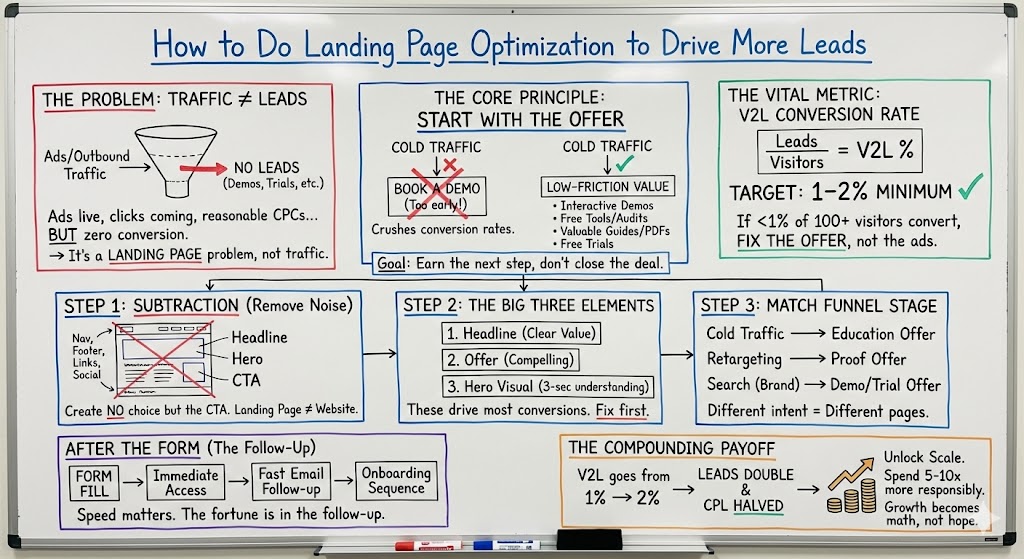
How to Do Landing Page Optimization to Drive More Leads
Learn how to turn more visitors into leads by fixing the most common landing page mistakes in B2B SaaS—from weak offers and early demo asks to cluttered pages that quietly kill conversion rates.

If you’re running ads, sending outbound traffic, or even getting solid organic clicks—but leads still feel scarce—there’s a very good chance the problem isn’t your traffic.
It’s your landing page.
I see this constantly with B2B SaaS founders. Ads are live. Clicks are coming in. CPMs and CPCs look reasonable. And yet… nothing is converting. No demos. No trials. No downloads.
That’s not a traffic problem. That’s a landing page problem.
As I told the group during our CRO session, “Once you get visitors to your website, you have to convert them into leads. And that step—visitor to lead—is where most funnels quietly break.”
Let’s walk through how to fix that.
The Only Landing Page Metric That Matters (At First)
Before you touch design, copy, or colors, you need to anchor on one number:
Visitor-to-lead conversion rate (V2L).
This is simply the percentage of visitors who land on the page and actually take the action you want—fill out a form, start a trial, download something, or raise their hand in any way.
Here’s the benchmark I use across almost every B2B SaaS company:
1–2% minimum.
.jpg)
Minimal site: HERE
If 100 people land on your page and fewer than one person converts, something is wrong. And if 200 or 300 people land and nobody converts, you don’t need better ads—you need a different landing page.
I said this very bluntly on the call: “If two hundred people in your market land on your page and not a single one wants what you’re offering, you don’t have a traffic problem—you have an offer problem.”
That framing matters, because it shifts your focus away from blaming channels and toward fixing fundamentals.
Start With the Offer, Not the Design
Most founders jump straight to layout tweaks—button colors, font sizes, hero images. Those things matter, but they are secondary.
The first question is simpler and harder:
Is what you’re offering worth someone’s email address right now?
Early-stage and top-of-funnel traffic is cold. These people are not ready to “book a demo.” They barely know who you are.
That’s why pushing demos too early crushes conversion rates.
As I explained during the session, “For marketing traffic, free trials, interactive demos, and high-value content convert far better than booking a demo. People don’t book sales calls until they’re about ninety percent ready to buy.”
High-performing landing pages almost always offer something low-friction first:
- A short recorded demo
- An interactive product walkthrough
- A valuable PDF or report
- A free tool, audit, or assessment
- A free account or limited trial
Your landing page is not there to close the deal. It’s there to earn the next step.
.jpg)
.jpg)
Remove Everything That Doesn’t Serve the CTA
One of the fastest ways to improve conversion rates is subtraction.
Navigation menus. Footer links. Extra CTAs. Social icons. Blog links.
All of it creates choice—and choice kills conversion.
I tell founders this all the time: “There should be nothing to do on the page other than read it or click the CTA.”
That’s why we often build minimal versions of sites for paid traffic—no nav, no distractions, just one clear action.
When one of our clients did this, they pushed their visitor-to-lead conversion north of two percent almost immediately. Same traffic. Same audience. Less noise.
Landing pages are not websites. Treating them like one is one of the most expensive mistakes in B2B marketing.
The Three Elements That Drive Most Conversions
If you want to prioritize what actually moves the needle, focus here first:
- Headline – Does it clearly explain the value and outcome?
- Offer – Is it compelling enough to trade attention for action?
- Hero visual – Can someone “get it” in three seconds without reading?
Everything else—button color, font size, testimonial placement—adds incremental lift. But these three elements do most of the heavy lifting.
If your headline is vague, your offer is weak, or your hero image is confusing, no amount of traffic will save the page.
That’s why I keep repeating this to founders: “If you’re under one percent conversion, change the offer, change the headline, or change the audience—but don’t just keep spending.”
Match the Offer to Funnel Stage
Not every landing page should do the same job.
One of the biggest CRO mistakes is sending all traffic to the same CTA.
Cold matched-audience ads? Offer education.
Retargeting traffic? Offer proof.
Search traffic on brand terms? Offer demos or trials.
Your landing pages should reflect where the visitor is in their buying journey.
This is also why retargeting pages often convert so much better. Those visitors already know who you are. The trust gap is smaller.
Or, as I put it during the session, “Retargeting and search are demand capture. Matched audiences and display are demand generation. You have to evaluate them differently.”
Different intent deserves different pages.
Speed, Follow-Up, and What Happens After the Form
Landing page optimization doesn’t stop at the form fill.
What happens after someone converts dramatically affects your real conversion rate from lead to customer.
Do they get immediate access to what you promised?
Do they receive a follow-up email within minutes?
Do they enter an onboarding or indoctrination sequence that builds trust?
I emphasized this on the call because it’s so often overlooked: “The fortune is in the follow-up.”
A great landing page paired with slow or sloppy follow-up still underperforms. CRO is a system, not a single page.
How Small Landing Page Improvements Compound
Here’s the part most founders underestimate.
If you increase your landing page conversion from 1% to 2%, you didn’t just double leads—you cut your cost per lead in half.
.jpg)
And because CAC compounds across the funnel, that single improvement gives you permission to spend more, win more ad auctions, and scale faster.
That’s why I keep coming back to this idea: “If you improve each step of the funnel by just ten percent, your CAC drops by about a third.”
Landing pages are one of the easiest places to get that lift.
The Real Goal of Landing Page Optimization
Landing page optimization is not about perfection. It’s about earning leverage.
When your pages reliably convert at one to two percent or higher, everything downstream gets easier:
- Ads become scalable
- CPL becomes predictable
- Sales gets better-educated leads
- Growth becomes math, not hope
Or, said more simply: “An optimized funnel doesn’t just spend more—it can spend five to ten times more within the same CAC.”
That’s the payoff.
If you’re serious about driving more leads, don’t start by buying more traffic. Start by making every click count.