
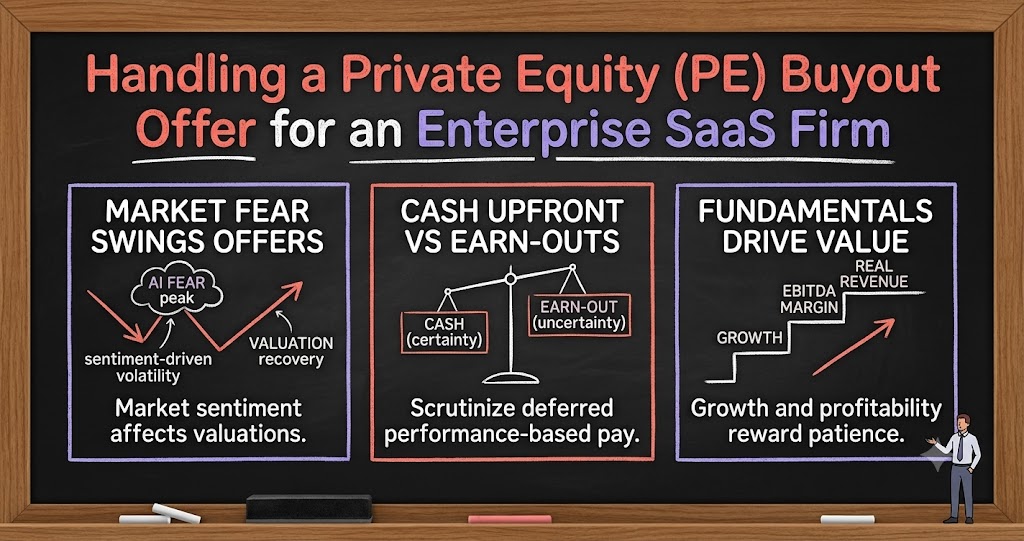
Handling a Private Equity (PE) Buyout Offer for an Enterprise SaaS Firm
A private equity group spent a year chasing one of our members, then watched their own offer swing from a strong multiple to a real haircut and back again inside twelve months. Here's what that ride revealed about how PE actually thinks about SaaS right now.

One of our members has been in on-and-off conversations with the same private equity group for close to a year now. Their plan was to acquire his company and merge it into another business already in their portfolio, one he never felt was a great fit for what he'd built. The first offer they put on the table was decent on the surface but light on cash, and the strategic logic behind the merger never quite made sense to him, so he passed.
- A merger he didn't believe in. The strategic logic behind combining the two businesses never actually made sense to him.
- Decent-looking, but light on cash. The headline offer sounded fine until he looked at how much of it was actually cash upfront.
- He passed, and they kept coming back. Each return conversation ended up telling a different story about what was happening in the wider market.
Why Buyout Multiples Went Down in Early 2026 Due to AI Fear, But Are Recovering Now
At the point when the PE group first got serious, his company was growing at a modest low-double-digit rate with EBITDA margins in the high single digits, by his own admission a weaker business than it is today. Even so, they offered something in the range of five and a half times, though he was quick to note that the real number was closer to four times cash with what he called a lottery ticket for the rest, an earn-out structure he's generally suspicious of unless it's structured as a note.
- The headline multiple and the real multiple aren't the same. 5.5x on paper worked out to roughly 4x in cash, with the rest riding on an earn-out.
- Earn-outs need real scrutiny. He's collected on one in full before, so he isn't reflexively against them, just realistic about how often they actually pay out as promised.
- A note is a different animal than an earn-out. His skepticism is specifically about ownership-transition earn-outs, not deferred payment structures generally.
Then came the stretch everyone in enterprise SaaS remembers, the period when the fear about AI wiping out software businesses hit its peak. When the same group came back during that window, their offer had dropped meaningfully, down to something like three and a half times, with only about three of that paid upfront in cash. To their credit, they were honest about why: they told him directly they were scared about their entire portfolio, not just his deal specifically.
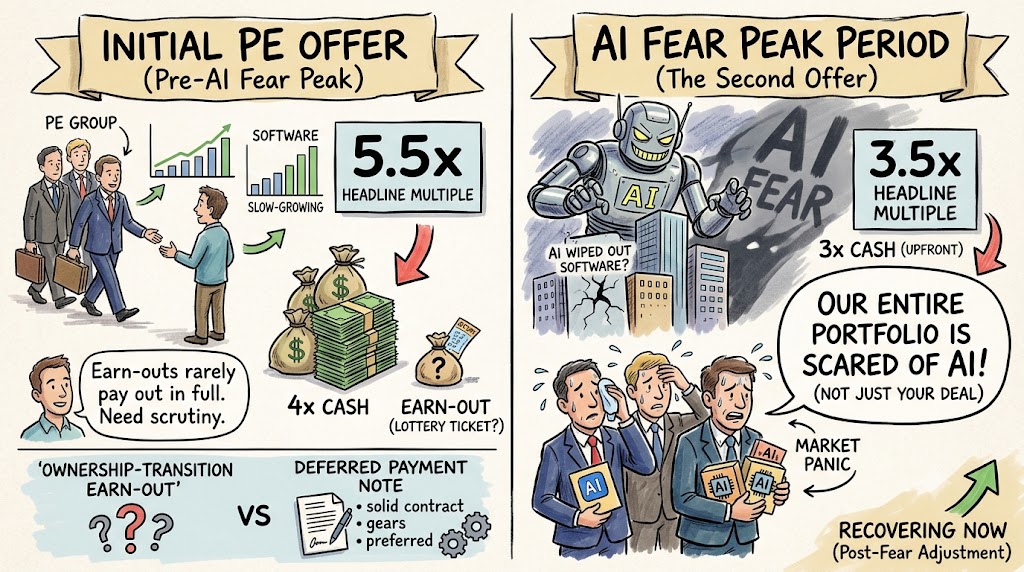
- The multiple dropped by roughly a third. From something like 5.5x down to 3.5x, with less of it paid upfront in cash.
- The pitch leaned on fear, not fundamentals. The argument was that he couldn't be sure his business would still exist in a few years without a bigger parent to protect it.
- He said no anyway. Even while admitting the pitch had a real psychological effect on him in the moment.
What makes this a useful case study rather than just one company's story is what happened next. His business kept improving through that entire stretch. Growth climbed to the mid-teens percent range year over year, EBITDA margins held at roughly fifteen percent all year, and by the time he was telling this story to the group, growth had climbed further, up around twenty-five percent year over year.
- Growth kept climbing through the fear window. From low double digits, to mid-teens, to roughly twenty-five percent year over year by the time of this conversation.
- EBITDA margin held steady at around 15%. The business didn't just grow faster, it grew faster without sacrificing profitability.
- He told the PE group this was coming. Watching the growth actually materialize in front of them appears to be part of why their numbers started climbing back up.
He's also seeing this from a wider angle through a banking relationship that shares monthly market data with him, even though his company is smaller than what that group typically targets.
- Strategic acquirer offers: up roughly 20%. The most recent monthly report showed valuations recovering over the prior month.
- Financial buyers are lagging, not absent. PE firms haven't moved up as fast yet, but several are starting to talk the way the strategics are already acting.
Reading the Real Motive Behind an Offer
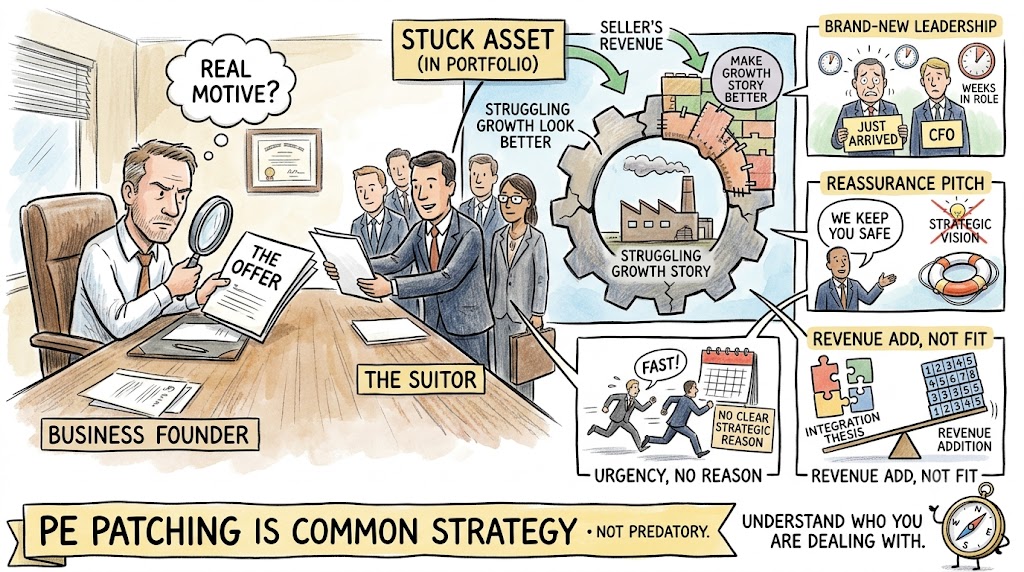
It's worth sitting with why he ultimately doesn't fully trust this particular suitor, because the reasoning generalizes well beyond his specific situation. His read on the group's real motivation wasn't that they saw something uniquely valuable in his company. It was that they had a stuck asset elsewhere in their portfolio, and adding several million dollars of his revenue on top of it would make that asset's growth story look better than it actually was. He wasn't looking for a special fit, in his view, so much as a convenient patch, and a handful of other signals reinforced that impression once he started paying attention to them.
- Brand-new leadership. The people leading the acquiring team included a CEO and CFO who had only been in their roles for a matter of weeks.
- A pitch built on reassurance, not vision. The framing leaned on safety and survival rather than a genuine articulation of why the two businesses belonged together.
- Urgency without a clear reason. The push to move quickly wasn't backed by a compelling strategic rationale he could point to.
- A revenue add, not a strategic fit. The value being described sounded more like a number to bolt onto a struggling story than a real integration thesis.
None of that means the deal is dishonest or predatory. PE groups patch portfolio companies with acquisitions all the time, and there's nothing wrong with that as a strategy on their side. It just means the seller needs to understand which version of a buyer he's dealing with.
- A buyer who sees unique value in your business. Pays, negotiates, and behaves after close very differently than the alternative.
- A buyer who sees a convenient number to bolt on. Is solving their own portfolio problem more than they're investing in yours.
- Figure out which one you're talking to early. Before you're deep into a process and it's expensive to walk away.
There's a lesson buried in his instinct to say no twice, once at the original weak offer and again at the fear-driven low point. A worse offer during a scary market isn't a reason to say yes faster.
- A believing buyer holds steady or leans in. During a downturn, genuine conviction in your business looks like stability, not a discount request.
- A wavering buyer's offer swings with the news cycle. That volatility is itself information about how they actually think about the deal.
The Interest Is Broadening, Not Just Continuing
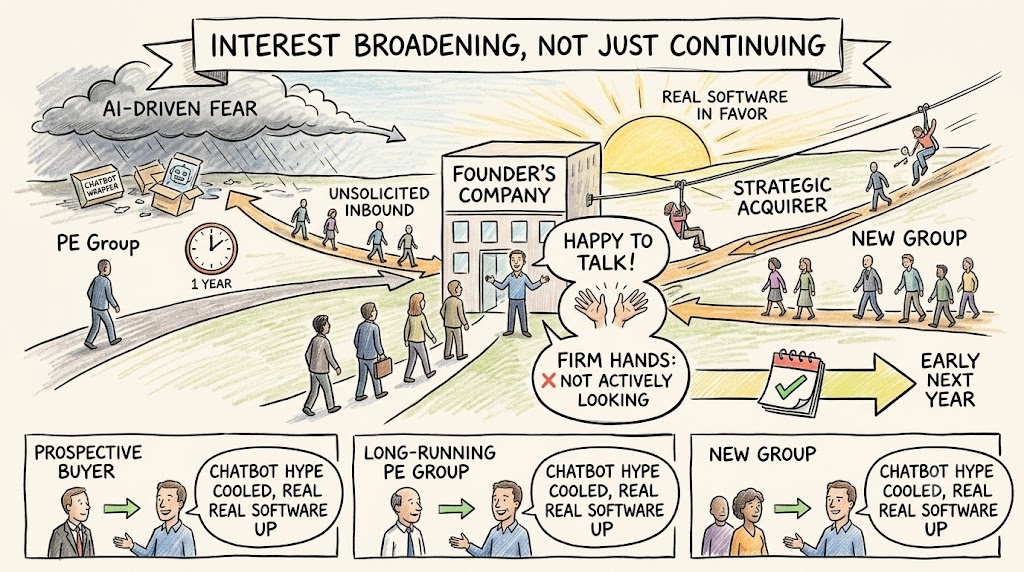
The other shift worth naming is that this is no longer a single relationship. Beyond the group he's been talking to for a year, he's started getting unsolicited inbound interest, and strategic acquirers have begun reaching out to test the waters as well. His stance with all of them is consistent: he's happy to talk, but he's telling everyone directly that he's not actively looking for a buyer or an investor right now, and that if anything happens it's more likely to be early next year, once he expects the sharpest edge of AI-driven fear to have worked its way through the market.
- Inbound is broadening, not just continuing. Unsolicited interest and strategic outreach have joined the one long-running relationship.
- His stance stays consistent across all of them. Happy to talk, not actively looking, and clear that any real move is more likely next year.
- Three separate conversations, one consistent message. A prospective buyer, the long-running PE group, and a brand-new group all said the same thing: chatbot-wrapper hype has cooled and real enterprise software is back in favor.
What This Means If You're Sitting on an Offer Right Now
If you're an enterprise SaaS founder fielding interest from private equity today, there are a few practical takeaways from watching one deal swing this widely over a single year.
- A lowball offer during a fear cycle isn't proof your business is worth less. It's often a signal the buyer is scared about their own portfolio and using market anxiety as a bargaining chip.
- Growth and margin discipline are your best negotiating tool. They're what eventually forces the other side's numbers back up, exactly as happened here.
- Pay close attention to what's actually motivating the buyer. A group that wants your numbers to make their own story look better will behave very differently than one that believes in your product as a platform.
The broader market signal underneath all of this is worth taking seriously even if you're not currently in a process. The peak of AI-driven fear about enterprise software seems to have passed. Strategic buyers are already moving their offers back up, and even skittish financial buyers are starting to talk the same way. If you run a real enterprise SaaS business with genuine EBITDA and customers who stick around, this looks like a period where patience is rewarded, and where the smartest move for most founders is exactly what our member has been doing all along: keep growing, keep the margins healthy, and let anyone who wants to buy come back with a number that reflects where the business actually is, not where fear says it might end up.