
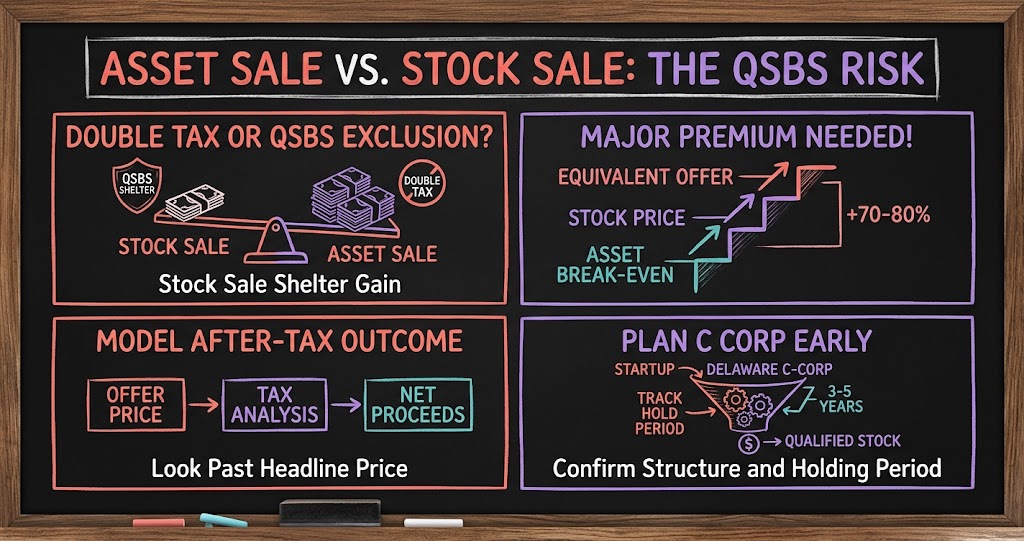
Asset Sale vs. Stock Sale: The QSBS Risk
An asset purchase offer can look similar to a stock purchase on paper and leave you with far less after taxes, especially if you qualify for QSBS. Here is how to spot the gap, why buyers ask for it, and how to push back.

One of the most expensive surprises a founder can get during an exit doesn't show up in the headline price. It shows up in the structure. You've spent years assuming you'll sell your company through a stock purchase, and then an offer arrives that says, almost as an aside, that the buyer plans to do it as an asset purchase. The number looks fine. It might even be a little higher than the other offers you've seen. But depending on your tax situation, it could leave you with dramatically less money.
That's exactly the situation one founder brought to a recent Enterprise Mastermind call. He's been talking with several PE firms and is close to a deal with a couple of them. One sent an offer that didn't mention structure in the letter, and then made it clear in conversation that it would be an asset purchase. His company is QSBS qualified, and he wanted to know whether there was any way to make the deal work.
A quick note before we go further: I'm not a tax advisor or an attorney, and this isn't tax or legal advice. The specifics depend on your entity, your state, your ownership, and the details of the deal. The goal here is to help you spot the issue early and ask the right questions of your own advisors.
Why the Structure Matters So Much
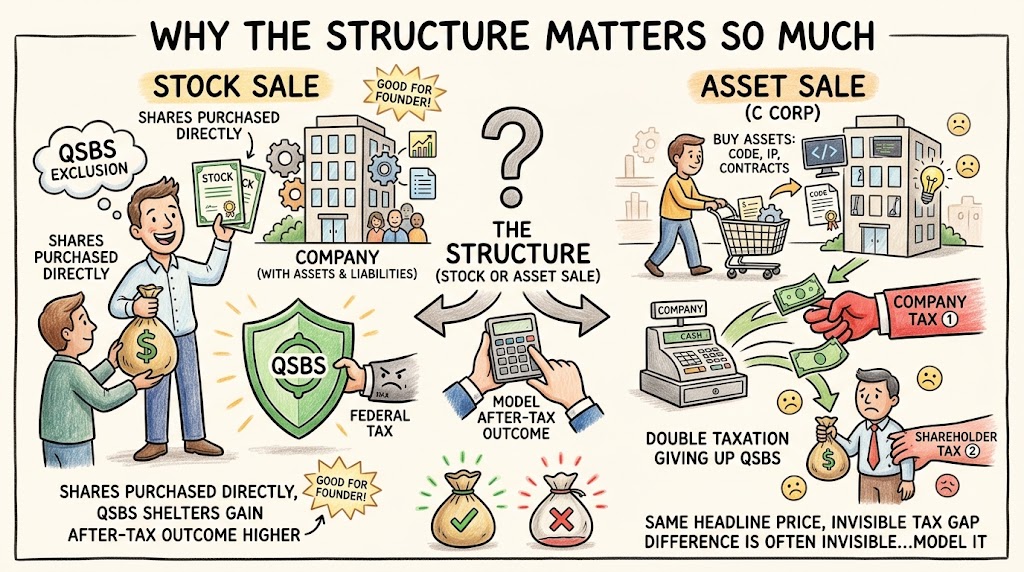
In a stock purchase, the buyer acquires the shares of your company from the shareholders. The company itself, with all of its assets and liabilities, changes hands intact. In an asset purchase, the buyer acquires the assets of the company, such as the code, customer contracts, and intellectual property, and the company itself receives the proceeds. If your company is a C corporation, that typically means the company pays tax on the sale first, and then the shareholders are taxed again when the money is distributed to them.
That double layer of tax is painful for anyone. For a founder who qualifies for QSBS, the gap gets much bigger. Qualified Small Business Stock treatment can allow founders to exclude a large portion, and potentially all, of their gain from federal tax when they sell their shares. That benefit applies to the sale of stock. When the company sells its assets instead, the founder in our session understood that the benefit largely falls away.
- Stock sale. The buyer purchases your shares, and QSBS can shelter much of the gain at the federal level.
- Asset sale. The company sells its assets, pays tax on the gain, and then shareholders are taxed again on distributions.
- The QSBS benefit is tied to the stock. Selling assets instead of shares can mean giving up the exclusion.
- The difference is often invisible in the headline number. You have to model the after-tax outcome to see it.
How Much Higher Does an Asset Offer Need to Be?
Ryan walked through the rough math. If you're QSBS qualified and sell your stock, you may pay zero at the federal level on the qualifying gain. In an asset sale, you could be looking at something like 40% to 50% of the proceeds going to taxes, depending on your state. As Ryan put it, for the two offers to be equivalent, "the price offer for an asset purchase would have to be something like 70 to 80% higher."
The founder had reached a similar conclusion on his own. His asset purchase offer was only slightly higher than the stock purchase offers he'd seen, and his analysis showed the break-even would need to be close to double. That kind of gap makes an otherwise attractive offer a non-starter.
- Model after-tax proceeds, not headline price. Two offers with the same number can produce very different outcomes.
- Expect the gap to be large with QSBS. Ryan's rough math puts the needed premium around 70% to 80%.
- State taxes matter. Where you live can swing the total tax bill significantly.
- Cross-border founders add complexity. The founder on our call has a co-founder who is a foreign national, which adds another layer to the analysis.
Why Buyers Want Asset Deals
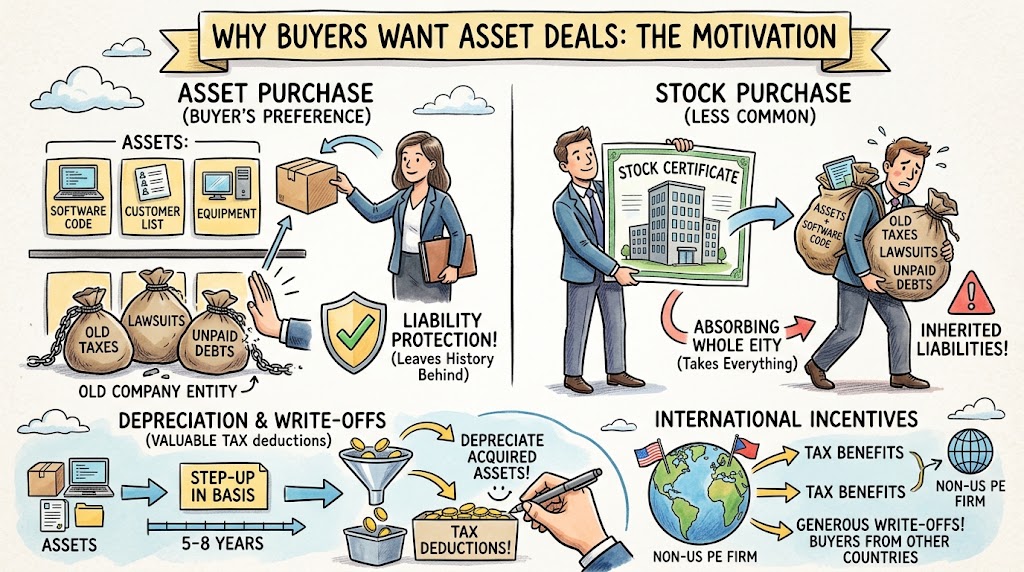
It helps to understand the buyer's motivation, because that's where the negotiation starts. The most common reason is liability. When a buyer acquires assets, they can leave behind historical liabilities that stay with the old entity. In a stock purchase, those liabilities come along with the company.
In this case, though, the buyer's reason was different. It was a PE firm based outside the US, and the partner explained that they get fairly generous tax write-offs on an asset purchase, because they can depreciate the purchased assets over five to eight years. Liabilities were less of a concern for them. That's a meaningful benefit on the buyer's side, and it's the flip side of the tax cost on yours.
- Liability protection. Buyers often want to avoid inheriting unknown obligations.
- Depreciation and write-offs. A step-up in the basis of acquired assets can create valuable tax deductions for the buyer.
- Different jurisdictions, different incentives. Buyers from other countries may have tax reasons that don't apply to US buyers.
Push Back, and Ask for a Stock Price
Ryan's advice was to have the direct conversation. Go back to the buyer, ask why they want an asset purchase, and then explain the math from your side. Given QSBS and capital gains treatment, they would need to offer about 80% more for an asset deal to be equivalent. Then suggest the alternative: a slightly lower offer structured as a stock purchase. Making it clear early that an asset deal is a non-starter saves everyone time.
The founder had actually had that conversation earlier the same day, and the buyer agreed to come back with a price for a share purchase. That's a good outcome, and a reminder that structure is negotiable. Buyers often lead with what's best for them, and many will adjust once they understand what the structure costs you.
- Ask why. Understanding the buyer's reason tells you what you can offer in return.
- Share your math. Show the after-tax gap so the buyer understands the size of the ask.
- Offer a trade. A modestly lower price as a stock deal can leave both sides better off.
- Be clear early. If the structure is a non-starter, say so before you spend weeks in diligence.
Explore the Full Menu of Structures
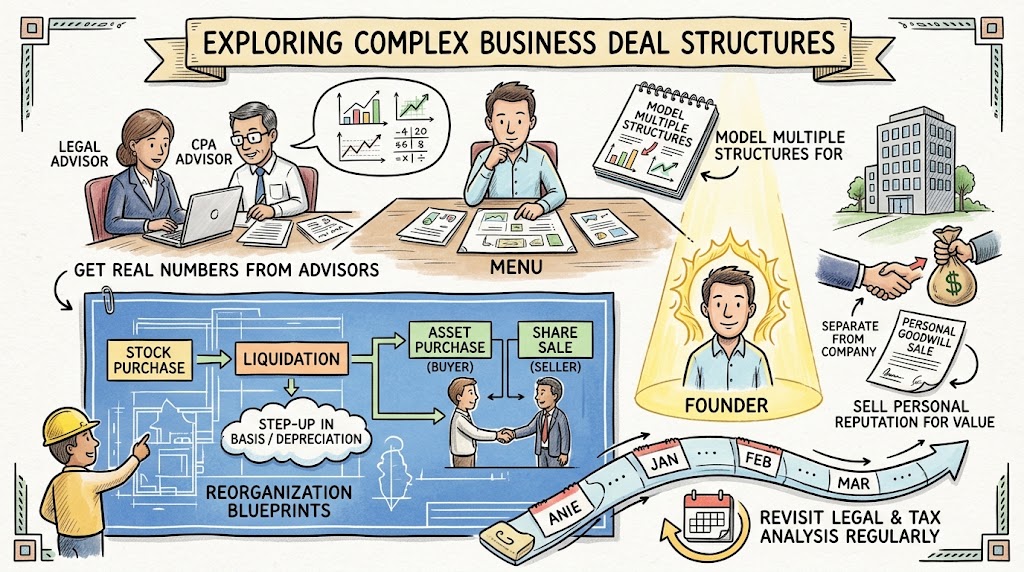
A longtime member with a background in this area added that there are more options than a simple stock-versus-asset choice. He recommended sitting down with your legal and CPA team and asking them to walk you through different structures and their numbers. There are a series of reorganization structures, including ones where the buyer purchases the stock and then liquidates the company to get the step-up in basis they want for depreciation.
He also mentioned a less common tool: selling personal goodwill. Unless you have a contract with your company for your services, the goodwill tied to you personally may be something you can sell separately, and the buyer can amortize it. It doesn't get the QSBS benefit, and it's often less attractive to buyers, but in some deals it can recover additional value.
- Ask your advisors for multiple structures. Have them model each one with real numbers.
- Look at reorganization options. The founder had heard of structures that treat the deal as an asset purchase for the buyer and a share sale for the seller, so ask your advisors whether anything like that fits your situation.
- Consider personal goodwill. In the right situation, it can be a way to capture more value.
- Revisit the analysis regularly. The founder on our call gets updated legal and tax guidance every month or two during the process.
Plan for QSBS Long Before the Deal
The last lesson here is about timing. QSBS only helps you if you've set it up in advance. As Ryan reminded everyone, you generally need to be set up as a C corporation (he pointed to the common Delaware C corp route) and hold the stock for three to five years before you can benefit from QSBS on a sale. If you're thinking about an exit a few years out and you haven't looked at your entity structure, that conversation should happen now.
- Confirm your entity structure now. If you aren't a C corporation, talk to your advisors about whether and when to convert.
- Track your holding period. Know when your shares will qualify for the full benefit.
- Include structure in your exit planning. Tell bankers and buyers early that you expect a stock deal.
And when offers start coming in, read the structure as carefully as the price. Ask whether the deal is a stock or asset purchase before you get excited about the number. Model your after-tax proceeds for every offer. The founders who come out of an exit with the most money are usually the ones who understood the tax picture earliest and made the structure part of the negotiation from day one.