
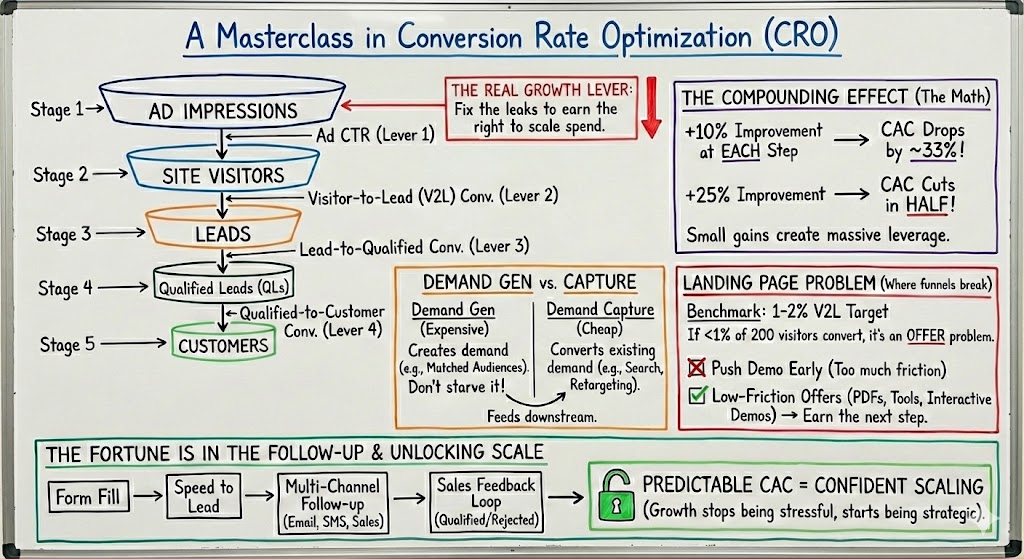
A Masterclass in Conversion Rate Optimization (CRO)
A practical, founder-led guide to conversion rate optimization in B2B SaaS—breaking down the key funnel metrics that actually matter, how small improvements compound, and why CRO is the real unlock for scalable, profitable growth.

If you’ve ever run ads and thought, “This should be working better than it is,” you’re not wrong.
In almost every B2B SaaS company I’ve worked with, conversion rate optimization is the difference between ads that stall out and ads that scale. It’s not the channel. It’s not the platform. It’s not even the budget.
It’s the math inside the funnel.
During Week 13 of the B2B SaaS Growth Program, we spent nearly an hour walking through why CRO matters so much, how small improvements compound, and why getting this right unlocks an entirely different growth ceiling for your company.
As I told the group early on, “Conversion rate optimization is usually the main difference between ad campaigns that scale and ad campaigns that don’t.” And that’s not theory—that’s pattern recognition from two decades of doing this.
Let’s break it down.
Why CRO Is the Real Growth Lever
.jpg)
Most founders think scaling ads means spending more. In reality, scaling ads means earning the right to spend more.
When your cost per lead is too high, the instinct is to pull back. But the better move is to ask: where is the funnel leaking? Because if you fix the leaks, the economics flip fast.
I shared this with the cohort very directly: “If your cost per lead is too high right now, that’s okay—because what we’re going to show you is how to get that down by about 75 percent.”
That’s not a single magic tweak. It’s the cumulative effect of improving each step of the funnel just a little.
CRO isn’t a one-week activity. It’s a discipline. And when you practice it consistently, it creates leverage everywhere else in your business.
The Four Levers That Control Your CAC
At its core, CRO comes down to four conversion points. Miss one, and everything downstream suffers.
- Ad click-through rate (CTR)
- Visitor-to-lead conversion (V2L)
- Lead-to-qualified-lead conversion
- Qualified-lead-to-customer conversion
Most teams obsess over the ad itself. Fewer teams obsess over the landing page. Almost no one rigorously optimizes follow-up and sales conversion at the same time.
That’s why CAC feels “mysterious.”
What’s powerful is how these levers compound. We walked through the math live, and it always lands the same way. “If you make a 10 percent improvement at each step of the funnel, your CAC drops by about 33 percent,” I explained. Push those improvements to 25 percent each, and you’re cutting CAC by more than half.
Nothing about that requires a miracle. It just requires focus.
Demand Gen vs. Demand Capture (And Why CRO Treats Them Differently)
One of the most common mistakes I see is treating all leads as equal.
They’re not.
Search ads and retargeting are demand capture. They convert cheaply because the demand already exists. Matched audiences, lookalikes, and thought-leader ads are demand generation. They cost more because you’re creating the demand in the first place.
This distinction matters deeply when you’re optimizing.
As I put it during the session, “If you turn off demand gen because the CPL looks higher, you eventually starve demand capture downstream.” It’s like turning off the top of a river and wondering why the waterfall dried up.
Good CRO doesn’t just lower CPL. It helps you understand which CPLs to accept and why.
Landing Pages: Where Most Funnels Break
If you’re getting clicks but no leads, that’s not an ad problem—it’s a landing page problem.
A healthy benchmark is simple: one to two percent of visitors should convert. If 200 people hit your page and nobody fills out the form, something is off.
Usually, it’s the offer.
I said this pretty bluntly on the call: “If two hundred people in your market land on your page and not a single one wants what you’re offering, you don’t have a traffic problem—you have an offer problem.”
Early-funnel ads should not push demos. They should reduce friction. High-value PDFs, recorded demos, interactive product walkthroughs, free tools—these convert far better than “Book a call” when someone barely knows you.
The goal of CRO at this stage is not to close. It’s to earn the next step.
The Non-Linear Power of Optimization
One of my favorite moments in the session was walking through a before-and-after funnel example.
Same $100,000 ad budget. Same market. Same product.
.jpg)
In the unoptimized version, that budget produced one customer. In the optimized version—after improving CTR, landing page conversion, qualification, and sales follow-up—it produced thirteen customers.
That’s not a 13 percent improvement. That’s a 13x outcome.
And that’s why I keep coming back to this idea: “The more you lower your CPL and CAC through CRO, the more you can spend—and the more customers you acquire within your target economics.”
This is how companies go from dabbling in ads to confidently spending $100k, $200k, or more per month. Not by guessing—but by earning predictability.
The Fortune Is in the Follow-Up
Even the best funnel collapses without strong follow-up.
Speed to lead matters. Multi-channel follow-up matters. Automated education matters. Sales teams accepting or rejecting leads matters.
As I reminded the group, “The fortune is in the follow-up.” CRO doesn’t stop at the form fill. It extends through email, SMS, voicemail, WhatsApp, SDR outreach, and the sales process itself.
.jpg)
This is also where qualified-lead tracking becomes essential. When sales marks leads as accepted or rejected, marketing finally gets the data it needs to optimize for quality, not just volume.
CRO Is How You Unlock Scale
The biggest mindset shift for founders is this: CRO isn’t about getting cheaper leads. It’s about building a system you can confidently pour money into.
Once your payback window is six to twelve months and your funnel is predictable, the question changes from “Should we spend more?” to “How fast can we responsibly scale?”
That’s the moment when growth stops being stressful and starts being strategic.
And that’s why CRO sits at the center of everything we teach. Because when you get this right, ads stop feeling risky—and start feeling like fuel.
If there’s one takeaway from this masterclass, it’s this: don’t chase channels. Chase conversion.
The founders who win are the ones who treat CRO as a long-term discipline, not a one-time tweak. They improve the funnel week by week, month by month—and eventually wake up with a growth engine that actually deserves to be scaled.